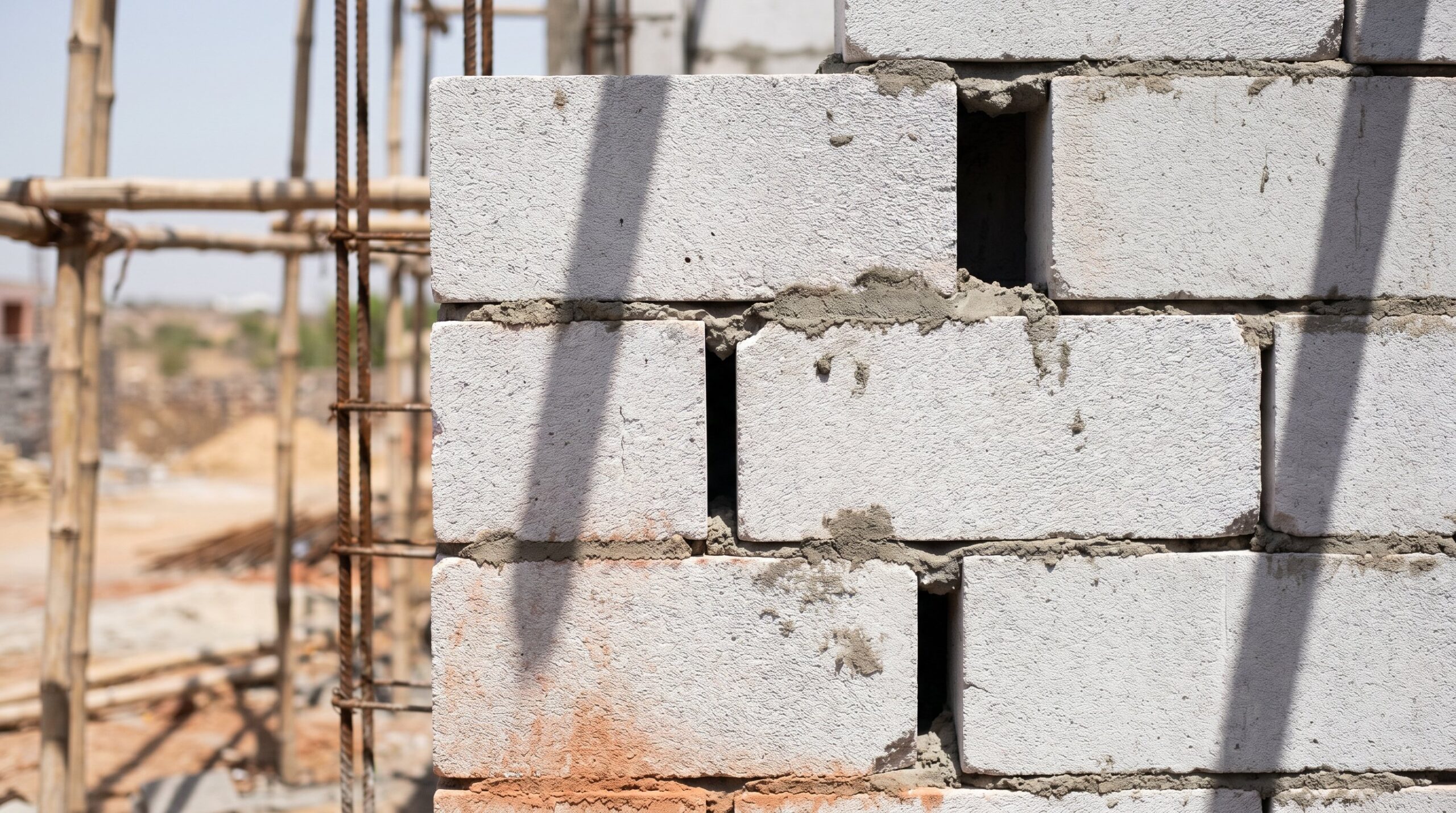
Three weeks ago in Jaipur I watched AAC blocks go up twice as fast as a brick crew next door. The block won. The installation lost.
Thumb-width gaps between blocks. The mortar was the wrong mortar — and nobody on site noticed.
Most articles compare AAC vs brick on cost, weight, and thermal mass. Nobody talks about the mortar mismatch. That is the conversation that decides whether the wall stands or cracks.
Why is AAC taking market share from brick?
Autoclaved Aerated Concrete is fired in a steam autoclave, not a coal kiln. Density 500-700 kg/m³ versus 1800-2000 for fired clay brick. That is one-third the dead load on the slab, one-third the lorries to site, and a thermal conductivity around 0.16 W/mK versus 0.8 for clay brick — a factor of five better insulation per cm of wall thickness.
For an Indian residential developer juggling slab thickness, embodied carbon, and an energy code (ECBC) that is tightening every revision, the numbers are not close. Brick is losing residential share fast.
Where does AAC quietly fail?
The bedding mortar. The chemistry of the joint matters more than the chemistry of the block, and the industry has not caught up to that.
Standard site-mixed 1:6 cement-sand mortar reaches around 5 MPa compressive strength after 28 days (EN 1015-11 test method, common civil engineering data). AAC blocks per IS 2185 Part 3 sit at 3-5 MPa. The bedding mortar is stronger than the unit it holds.
Under load, drying shrinkage, and the daily thermal cycling that is normal in Rajasthan and most of north India, stress does not stay in the joint. It concentrates in the block — the weaker element. The block cracks first. The contractor blames the supplier. The system was misspecified before the first row went up.
What does thin-bed AAC mortar actually fix?
The mortar industry has been quietly reformulating for a decade. The current best-practice product is a polymer-modified thin-bed mortar at 2.5-4 MPa, applied in joints 2-3 mm thick instead of the conventional 12-15 mm.
The chemistry is straightforward. Cement and silica sand are the base. Redispersible polymer powder (RDP) is added at 2-3 kg per tonne of binder — the same family of polymers used in tile adhesives covered in the EN 12004-2 framework. The RDP redisperses on mixing, forms polymer films during cure, and dramatically improves adhesion to the block face while keeping the cured mortar slightly flexible. Less thermal bridging across the joint, less wastage on site, and a compressive strength closer to the block itself.
The thin-bed joint thickness of 2-3 mm comes from DIN 1053-1 (thin-bed masonry standard, widely adopted across European AAC practice). That is not arbitrary — it is the geometry that lets a notched trowel deposit a continuous film without voids — the same geometry logic that decides the tile-size threshold for single vs double buttering.
The standards in one table
| Item | Value | Source |
|---|---|---|
| AAC compressive strength | 3-5 MPa | IS 2185 Part 3 |
| 1:6 cement-sand mortar | ~5 MPa | EN 1015-11 test method |
| Thin-bed AAC mortar | 2.5-4 MPa | Manufacturer datasheets, industry-typical |
| RDP loading | 2-3 kg/tonne binder | EN 12004-2 polymer-modified mortar range |
| Joint thickness, thin-bed | 2-3 mm | DIN 1053-1 |
So why is the wall still cracking?
The chemistry is ready. The site discipline is not. Most masons I meet in India still mix as if every block were a clay brick fired in a kiln. Thick joint, strong mortar, generous bedding — habits formed over thirty years of brickwork, applied to a material with different physics.
Three field signals that a wall is going to crack regardless of the block quality:
- Joints visibly over 5 mm. Mortar shrinkage at that thickness pulls on the block face.
- Site-mixed 1:6 mortar used as bedding. Strength mismatch guarantees stress migration into the block.
- No notched trowel on site. Without it, the thin-bed application is impossible. If you see a flat trowel and a heap of mortar, it is conventional masonry pretending to be thin-bed.
What is the actual bridge?
Three options, in order of how fast they would move the needle:
- BIS publishing an Indian AAC-specific bedding mortar standard. There is currently no Indian standard for thin-bed AAC mortar — EN and DIN are the references, which is workable but leaves enforcement entirely on the spec writer.
- Specifier discipline. The project manager who writes “AAC 4 MPa as per IS 2185 Part 3, thin-bed polymer-modified mortar 3 MPa as per EN 12004-2, joint 2-3 mm” gets a wall that lasts. The one who writes “AAC blocks with cement mortar” gets cracks at year three.
- Training. Mortar manufacturers in India have done the chemistry. The masonry workforce has not done the retraining. This is the slowest lever but the only one that scales.
Brick is losing residential share in India faster than the workforce is adapting. The mortar industry is ready. The cracks are the conversation nobody wants to have at the design review.
Related editions: Your tiles are lying to you covers the same redispersible polymer chemistry applied to tile adhesives (EN 12004 C2TE-S1). The wall on my morning drive covers waterproofing of facade walls that often end up bearing AAC. No insulation. No regulation. covers the U-value gap that AAC partially closes through its inherent low conductivity. The raw material shock that forces R&D reformulation of AAC mortars under cost pressure — RDP up 60%, HPMC lead times doubled — is covered in edition 7 on the Hormuz supply chain shock.
Ed #10 — how LC3 cement changes the substrate chemistry for tile adhesives and construction chemicals.
Ed #11 — what C2TE-S1 actually means on a tile adhesive bag, decoded line by line.