
Independent author of Built by Chemistry. Every edition sourced from EN / ANSI / BIS / ASTM standards or peer-reviewed literature. About →
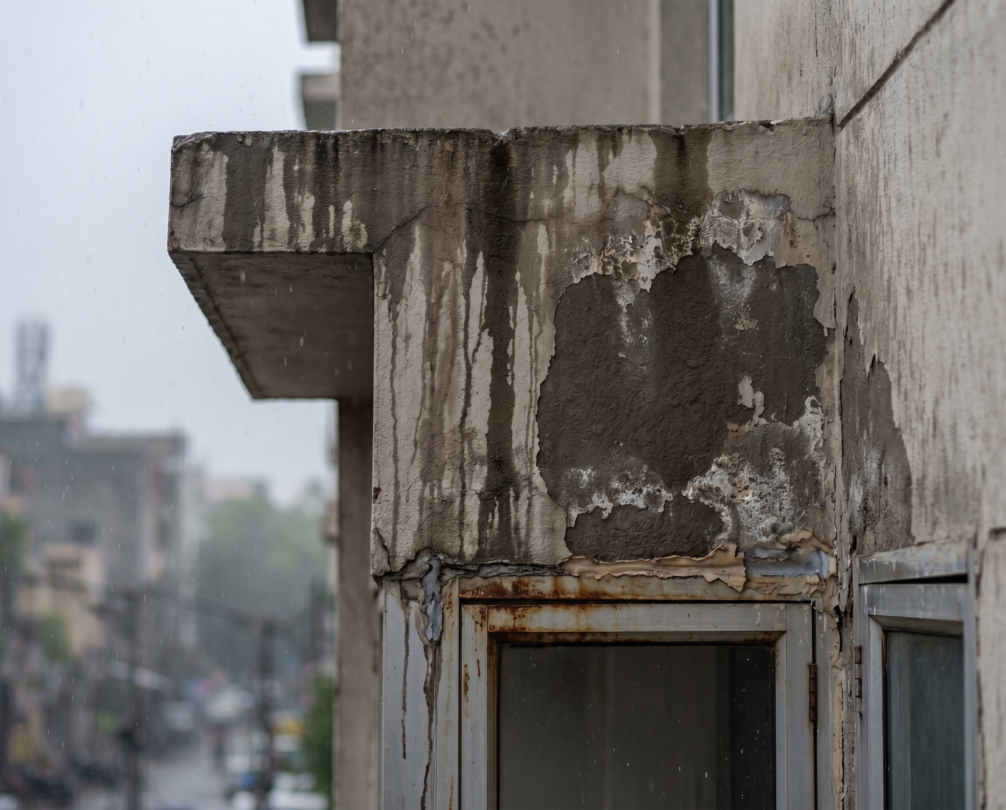
I was in Delhi during the monsoon last August. Six floors up, in an office that had been built three years earlier. The ceiling above the meeting room had a brown stain the size of a dinner plate. The carpet under it was dark. The skirting board had warped.
Outside, the rain had stopped two days before.
The building owner was furious with the waterproofing contractor. They’d applied a polyurethane liquid membrane on the terrace less than a year ago and now this. He was already getting quotes to rip it up and start again.
I went up to the terrace with him. The membrane was fine. Cured, sound, no visible breaks. The problem wasn’t the roof at all.
This is the part of waterproofing failure that nobody wants to hear. The membrane gets the blame because it’s the visible product. The actual cause is usually somewhere else entirely.
What was actually leaking in Delhi
Two things, both away from the membrane.
The window seals. The aluminium frames on the floor above the stain had been installed without proper backer rod and sealant tooling. The silicone bead was there — it just wasn’t doing anything. Water was running down the facade in heavy rain, hitting the head of the window, and finding its way behind the frame into the wall cavity. Three years of that, and the gypsum board ceiling finally gave up.
The facade finishing. This is the one that made me angry. Looking at the building from the street, you could see the perimeter of every window and every floor-slab edge — a slightly different colour from the rest of the wall. The contractor had applied the base coat of the render system correctly. They’d embedded the mesh. They’d done the corners. But on the final layer, around every detail, they ran out of the hydrophobic finishing coat and used the base coat instead. The colour difference was subtle enough that nobody on site flagged it during snagging.
The base coat absorbs water. The hydrophobic finishing coat doesn’t. From two metres away you couldn’t tell. From the inside, when the water went through the absorbent perimeter strips for two days straight, you very much could.
The membrane on the terrace was working perfectly. The building was leaking through the walls.
The three waterproofing failure patterns I see most
Once you start looking, it’s always one of three things.
1. Substrate preparation
Liquid-applied membranes — polyurethane, acrylic, cementitious — need a substrate that is sound, clean, and at the right moisture state. Most failures I see in India come from applying the membrane on a slab that is either too wet, too dusty, or has been finished with a curing compound that nobody bothered to remove.
The membrane bonds chemically to whatever is on the surface. If what’s on the surface is a thin layer of dust mixed with form-release oil, the membrane is bonded to dust. The dust is bonded to nothing. Six months later, the membrane sheets off in strips and everyone blames the product.
EN 1504-10:2017 specifies this for protection and repair systems on concrete: the substrate must be sound, free of contaminants, and prepared to the moisture state required by the product. EN 14891 sets the equivalent baseline for liquid waterproofing beneath ceramic tiling. In practice, on most Indian sites, none of this is verified. The contractor shows up, opens the bucket, and rolls it on.
2. Detail design — the parts that aren’t flat
Waterproofing membranes work brilliantly on flat areas. They fail at the details: roof-to-parapet junctions, drain outlets, expansion joints, pipe penetrations.
These are the places where the membrane has to turn 90 degrees, lap onto something else, terminate around a circular obstruction, or accommodate movement. If the detail isn’t designed and detailed in advance — if the contractor is improvising on the day — the joint will fail within one or two monsoon cycles.
For a parapet, the membrane needs to continue at least 150 mm vertically up the parapet wall and either turn into a chase or terminate under a metal flashing. BS 6229:2018 (the UK code of practice for flat roofs with continuously supported flexible coverings) makes this the explicit minimum upstand height for any abutment, door opening or parapet, and NHBC Standards Chapter 7.1 repeats the figure. Most parapets in India have neither chase nor flashing. The membrane stops at the corner, water gets behind it, and the slab edge slowly degrades from the inside.
3. The wrong system for the pressure direction
This is the one that destroys reputations.
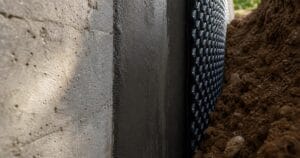
Positive-side waterproofing sits on the face of the substrate where the water is. The water pushes the membrane against the substrate. The bond is helped by the pressure.
Negative-side waterproofing sits on the face of the substrate opposite the water. The water pushes the membrane away from the substrate. Only crystalline systems and certain cementitious systems can survive this — and only if applied at the right thickness, on a properly prepared substrate, with the right number of coats.
I see acrylic waterproofing applied to basement walls — on the inside, with groundwater pushing from the outside — every other site visit. The contractor knows acrylic. The client wants it cheap. The system delaminates within a year and the basement floods.
The membrane didn’t fail. The specification did.
What this means for India in monsoon season
India is going to see more intense rainfall events, not fewer. The IMD Monsoon 2024 report logged 2,632 very-heavy and 473 extremely-heavy rainfall events — the highest in five years — and confirmed the pattern of fewer total rain days with more days of extreme precipitation. Buildings that survived twenty monsoons may not survive the next five.
The construction chemicals industry sells the membrane. We don’t sell the substrate preparation, the detail design, or the system specification. The contractor doesn’t either. The architect signs off on the spec without reading EN 1504-10 or EN 14891. The developer wants the cheapest contractor.
And then it rains for three days straight on a Delhi office and the carpet turns dark.
The membrane on the terrace is fine. It was always fine.
The problem is everything around it.
The datasheet gap that makes this pattern hard to diagnose — what manufacturers declare and what they leave out — is covered in edition 8 on what construction chemicals datasheets don't tell you.
The specific pressure test that India's waterproofing standards don't require — what ASTM D5385 tests to 70.4 metres and EN 1928 tests to 60 kPa — is the subject of edition 6 on the hydrostatic head test India doesn't require.
Next week — what a construction chemicals datasheet is actually trying to hide.
— Guillermo
Update — For the regulatory gap behind these failures — the absence of a hydrostatic pressure test in Indian standards — see Edition 6: the hydrostatic head test India doesn't require.
Ed #10 — what LC3-based substrates mean for waterproofing membrane compatibility.
If the interface failure pattern I described here is something you see in your work, I've expanded it with three specific case studies — bituminous, PVC-P, and liquid-applied — in my later edition on flat roof waterproofing failures — three peer-reviewed cases and the pull-off test nobody specifies.
Part of the pillar
Waterproofing Systems — below-grade membranes, flat roof failures, and where every system fails at the interface. Read the full cluster overview.
- Two waterproofing systems on one basement wall. When the redundancy works, and when they fail together.
- The flat roof that leaks at year three. Three real cases. One test nobody runs.