
Independent author of Built by Chemistry. Every edition sourced from EN / ANSI / BIS / ASTM standards or peer-reviewed literature. About →
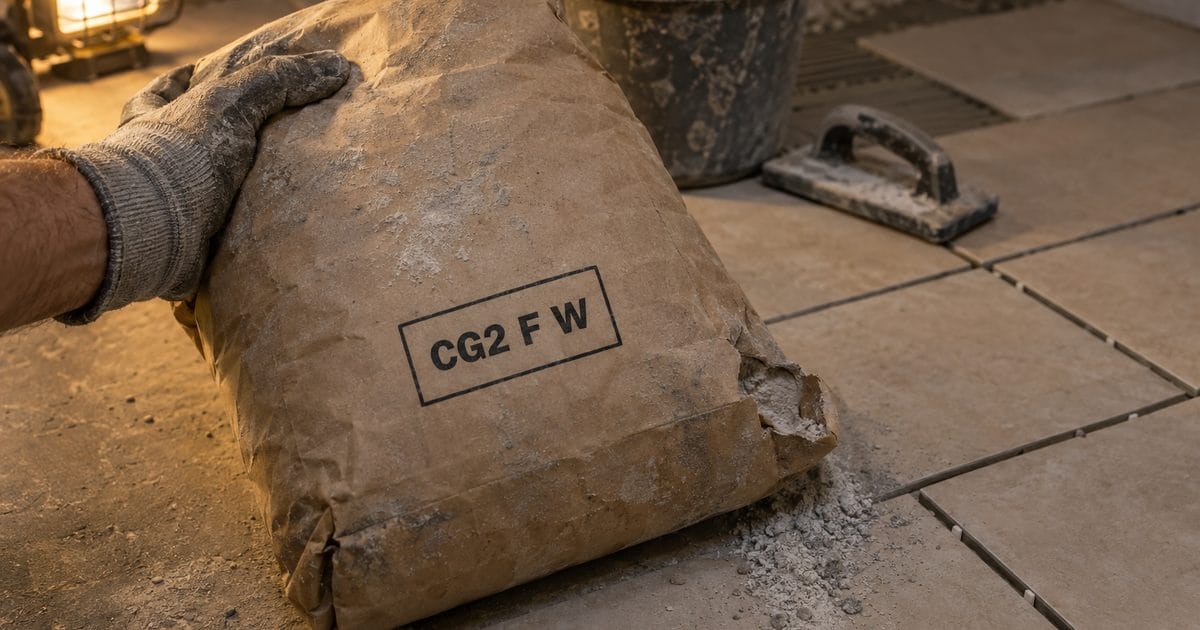
Turn the bag around. Past the brand, the colour name and the coverage chart, there is a short line of code - something like CG2 W A, or a bare CG1, or just RG. That line is the only part of the bag a laboratory had to stand behind. Everything above it is written by a marketing department; that code is a claim a standard actually tested. And almost nobody reads it.
This is the third and final part of the grout line. The first edition explained why the joint is the hardest place in the whole tiling system to cure. The second retired the idea that grout is a waterproofing layer. This one is about the label itself: how to read the grout classification code, what each letter certifies, and why the same word on two bags can mean two different things depending on which country's rulebook printed it.
The two families: CG and RG
The first two characters tell you what the grout is made of. CG stands for cementitious grout: a powder built on cement that you gauge with water on site. RG stands for reaction resin grout, a two- or three-part system - almost always epoxy - that cures by chemical reaction rather than by drying. Nearly every bag on a general shelf is CG. RG lives in a separate, more expensive world, and it is a different material with different rules, not a premium version of the same one.
The distinction matters because the two families are pored differently. Cement sets as a solid threaded with capillary pores - the space the mixing water leaves behind - so a CG grout always takes on some water, which is why absorption is even a test. A cured epoxy has effectively no capillary network, so RG sits at the near-zero end of every absorption chart - but it is a different material with its own rules, and it earns an edition of its own later in this line. For today, keep reading the cement family, where almost every bag you will ever meet actually lives.
CG1 versus CG2: what "improved" buys
Within the cement family, the number is a grade. CG1 is a normal cementitious grout: it has passed the baseline tests for strength, shrinkage, abrasion and water absorption, and nothing beyond them. CG2 is an improved cementitious grout - it has additionally passed one or both of two optional tests, and the letters that follow the number tell you which.
So CG2 is never the whole story on its own. A bag marked CG2 W A has earned both extra tests. A bag marked CG2 W has earned only one. The grade tells you the maker went past the minimum; the letters tell you where. If a bag simply says CG2 with nothing after it, treat that as a rounding error in the copywriting, because in the European standard the improvement is defined precisely through those letters.
The letters: W and A
W stands for reduced water absorption. It does not stand for waterproof, and the gap between those two ideas was the whole of last week's edition. Under the European test method, a normal CG1 grout may take on up to 5 grams of water in the first 30 minutes; to earn a W, the grout has to come in under 2 grams. Reduced, not removed. The pearl effect from the last edition is the same lesson from the chemistry side: a water-repellent surface changes the angle a droplet sits at, it does not close the pores underneath. W buys you less staining, less salt bloom and better freeze-thaw behaviour - all real, all worth specifying - but never a barrier.
A stands for high abrasion resistance. The abrasion test grinds a standard path across the cured grout and measures how much material is worn away: a normal grout may lose up to 2000 cubic millimetres, while an A-rated grout has to hold the loss under half of that. That is the letter that matters on a shop floor, a stair nosing or any joint that takes foot traffic and grit, and it stays invisible until the grout is a year into service and one joint has worn into a shallow valley while the other has not.
Built by Chemistry publishes one brand-free edition on construction chemistry every Thursday - no vendors, no filler. If the back of the bag is starting to make sense, subscribe below and keep the series.
F: fast setting, and what a premium bag really is
The 2022 revision of the European standard added a letter the older rulebooks do not carry: F, for fast setting. A CG1F or CG2F grout has to reach an early compressive strength of at least 7.5 N/mm2 within six hours - a hard, timed requirement, not a marketing "quick" claim. That letter is why a tiler can grout in the morning, wash down, and put the floor back into service the same afternoon.
F is also where the premium end of the cement family actually lives, and it pays to know what you are buying. A top-tier white joint grout is usually three upgrades stacked on one bag: a rapid-setting binder chemistry - a calcium sulfoaluminate cement, or a white Portland accelerated to build strength fast, both of which grow ettringite crystals early to lock the joint - then a genuinely white cement, made white by driving the iron oxide that colours ordinary grey cement down to a fraction of a percent, and white micronised fillers chosen to keep that brightness. Add a biocide to resist mould in a joint that stays permanently damp, and you have the fungicidal white rapid grout that sits at the top of most premium ranges. None of it shows up in the colour name; some of it is in the F, and the rest is in the small print the letters never reach - which is exactly why you turn the bag over.
Three rulebooks that do not convert
Here is the part almost nobody tells a specifier: CG2 W A is a European sentence. It is written in EN 13888, the European grout standard, and measured by the EN 12808 test methods - absorption in grams, abrasion in cubic millimetres. Cross the Atlantic and the letters vanish. American grout is classified by separate ANSI documents - one number for standard cement grout, another for high-performance polymer-modified cement grout, another again for epoxy - each with its own test, with absorption reported as a percentage by total immersion and strength in pounds per square inch. There is no CG2 in ANSI, and the Tile Council of North America is explicit that the European and American classifications are not intended to correlate.
India adds a third dialect. IS 17190, published in 2020 and tested at 27 degrees rather than Europe's 23, keeps the CG and RG letters but reports absorption and abrasion as percentages, and names a class the European bag does not: MRG, a modified deformable resin grout that has to bend at least 2.5 millimetres before it fails. The table below lines the three rulebooks up side by side. Read it as three languages describing the same wall, not as three grades on one scale - a number that looks better in one column may just be a different test, temperature or unit.
| Code on the bag | What it certifies | Europe (EN 13888-1:2022) | USA (ANSI A118) | India (IS 17190, at 27 C) |
|---|---|---|---|---|
| CG | Cementitious - cement-based powder, gauged with water | Family "CG" | A118.6 and A118.7 (cement grouts) | Types CG1, CG2 |
| RG | Reaction resin - epoxy (its own edition coming) | Family "RG" | A118.3 (epoxy grout) | Types RG1, RG2, MRG |
| CG1 | Normal cementitious - baseline tests only | CG1 | Closest: A118.6 (standard cement) | CG1 - absorption ≤ 15% |
| CG2 | Improved cementitious - has earned W and/or A | CG2 | Closest: A118.7 (high-performance) | CG2 - absorption ≤ 10% |
| F | Fast setting - early compressive strength | CG1F / CG2F: ≥ 7.5 N/mm2 within 6 h | No letter (separate rapid products) | Not a class in IS 17190 |
| W | Reduced water absorption | ≤ 2 g at 30 min (vs ≤ 5 g for CG1), EN 13888-2:2022 §9.2 | Reported as % by total immersion | Built into the type: CG2 ≤ 10% vs CG1 ≤ 15% |
| A | High abrasion resistance | ≤ 1000 mm3 (vs ≤ 2000 for CG1), EN 13888-2:2022 §9.4 | Separate wear method | Mass loss: CG2 ≤ 2.5% vs CG1 ≤ 3.0% |
| MRG | Deformable resin - bends before it fails | Not marked as MRG on the bag | Not a separate letter class | MRG - transverse deformation ≥ 2.5 mm (class S1) |
From letters to a specification
None of this stays academic once you are the one writing the spec. Start from the joint, not from the bag. A dry interior floor with wide joints and no chemical exposure is a CG1 job, and paying for more is paying for tests the joint will never be asked to pass.
A wet room, a balcony or anything that sees freeze-thaw wants the W - not because the grout becomes the waterproofing (the membrane under the tile is still what keeps water out, as the second edition set out) but because a lower-absorption joint stains less, blooms less and survives the cold better. A floor with real traffic wants the A. A porous, easily-stained natural stone wants the lowest absorption you can get plus a grout the stone supplier has cleared, because some pigments and some stones do not get along. And a pool, a commercial kitchen or a chemical room is where you stop reading letters and specify RG outright.
Two more lines on the bag decide whether the grout even fits the joint. Grade the width: the cement grouts are typically rated for joints up to about 5 millimetres on their own, and only up to wider joints - around 12 millimetres - when they carry graded sand, which is exactly why a fine, sand-free grout crammed into a wide joint cracks. And match the grout to the tile: a thirsty ceramic pulls water out of the joint from both cut edges while a dense porcelain does not, so the same bag behaves differently behind two different tiles - the failure the first edition opened on.
The label is the honest part
Every other number on the bag was chosen by someone selling it to you. The classification code is the one line a laboratory signed. It will not tell you the grout is beautiful, or easy, or worth the price - it will tell you, precisely and in a language you can now read, what the grout was actually tested to do. CG or RG. The grade. The letters. And the rulebook they were written in.
That is the whole grout line in a single habit: turn the bag around before you turn to the colour chart. Read the crumble edition for why the joint fails, the waterproofing edition for what the joint is not, and this one for what the code means - and you will out-specify most of the people selling to you. New edition every Thursday, independent and brand-free. Subscribe, and never buy a grout by its colour name again.
- Why your C2TE-S1 stops working at 60×60
- Your adhesive is not drying. It is hydrating, and the weather sets the clock.
- Hormuz, Bab el-Mandeb and your tile adhesive (2026)
- Grout was never waterproof - and never had to be
- Why tile grout crumbles: the joint that can't cure