
Independent author of Built by Chemistry. Every edition sourced from EN / ANSI / BIS / ASTM standards or peer-reviewed literature. About →
Two tenders, six identical characters
Picture two tenders, both asking for C2TE-S1. One is a 30×30 bathroom floor. The other is 80×80 porcelain on a rendered, south-facing façade in a hot inland climate. Same six characters, often the same price line. Only one of them has a chance.
Composite tenders, not a real project, but I read some version of both every month. On the small floor, C2TE-S1 is reasonable. On the façade it is six letters copied from the last job, and none of them says anything about the white dust I keep finding on the back of tiles that size when I am called in for a claim.
Key takeaways
- Bond comes before flexibility. On dense porcelain the grip comes from the polymer, and a dusty tile back gives it nothing to hold.
- A bigger tile puts more movement into fewer joints. That is the job of S1 and S2, and on a C2 the cement and the polymer pull the formula in opposite directions.
- More tile means more water under it and a longer wait before grouting.
- The European product standard never mentions tile size. India's IS 15477 does (S1 above 600 × 600 mm, S2 above 1 200 × 1 200 mm), and so does Spain's installation standard, UNE 138002, by the tile's longest side.
- The fix is in the tender: class, method, a checked tile back, coverage and the joint.
What changes when the tile gets bigger
The back of the tile
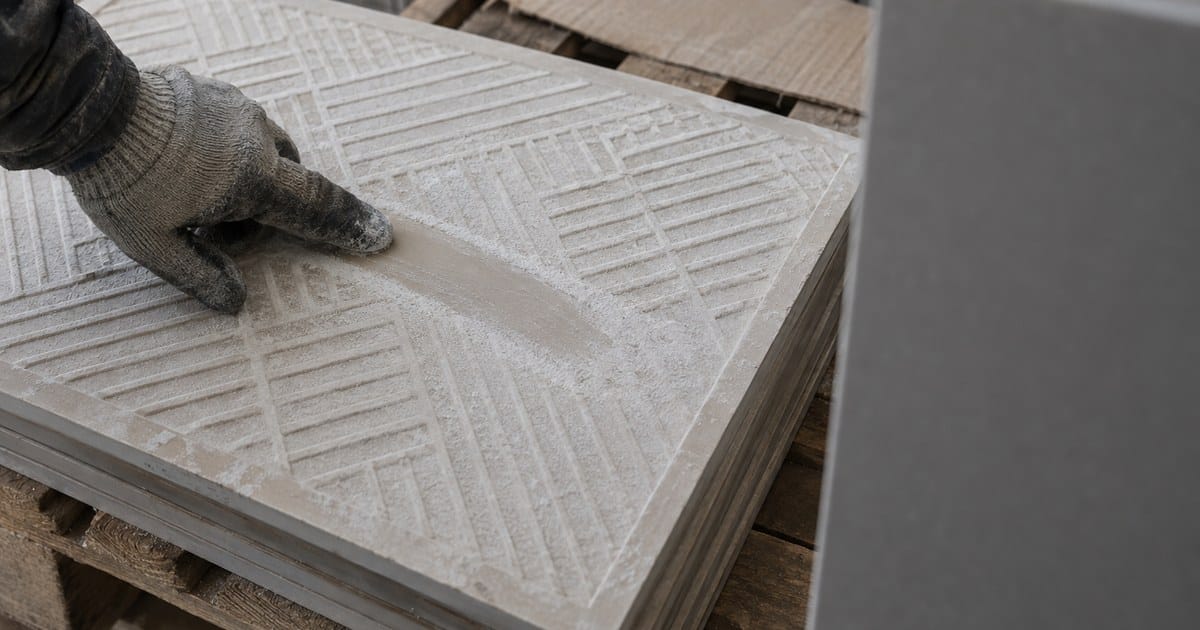
Most of my claim visits start at the back of the tile. On high-end porcelain, especially pieces with relief or complex shapes, I keep finding a fine white dust there: residue from the release agent or other process chemicals, working as a release layer between adhesive and tile. I have seen it on many jobs.
Why it matters so much on porcelain comes down to what holds the tile. A polymer supplier's conference paper on EN 12004 adhesives puts it plainly: on a non-porous porcelain tile there is no mechanical anchoring of the cement mortar, so the adhesion has to be provided by the polymer. The polymer can only hold what it touches. If what it touches is loose powder, it is bonded to the powder, not to the tile. That is the whole argument of this edition in one sentence: a deformable adhesive cannot hold a tile it was never bonded to.
On site the usual answer is to soak and scrub the tiles. It helps, but be careful with it: I have also seen that washing cause problems further down the line. The cleaning method belongs in the method statement, the back should be clean and dry when it meets the bed, and an early lifted tile, read as in the coverage tell, shows whether it worked.
Fewer joints, more movement
Only once the tile is bonded does deformability come into play. Fewer joints per square metre means more thermal and substrate movement lands on the adhesive layer. S1 and S2 measure how far a cured strip of adhesive bends before it breaks: at least 2.5 mm for S1 and at least 5 mm for S2 (EN 12004-1:2017, Table 1c; method in EN 12004-2:2017, clause 8.6). The letters are decoded in what each of the six characters certifies; here is the part specifiers rarely hear.
C2 and S pull a formula in opposite directions. The same paper notes that the hardest C2 tests, after water immersion and freeze-thaw, are carried by the cement, so cement content often rises to around 40 %; at a constant polymer dose that lowers the polymer-to-cement ratio, and the flexibility with it. A C2TE-S1 is a balance struck in a lab at 23 °C, and a large façade tile leans on the S half.
Built by Chemistry is an independent weekly: no brands, no sponsors, every clause checked. If you write tile specs, subscribe.
More water under more tile
Then the clock. A bigger tile covers more bed, and its water has further to go to reach a joint. Our archive has no measured drying rate under a tile, and I won't invent one. It has the measured setting time of the mortar, 4 to 18 hours depending on additives (the four clocks), and an estimate of how far cold stretches it (the bigger the tile, the longer the clock). An Australian manufacturer's cold-weather sheet says large format tiles and stone need longer curing in cooler temperatures.
It is also why I treat the joint on large format as part of the system. Large tiles go down with particular care, and where I can I specify an epoxy or a high-performance cementitious grout, a CG2 WA under EN 13888-1 (what CG2 WA certifies), because in my experience they cope better with change and movement.
What the standards actually say about size
This is where most tenders go wrong. The European product standard, EN 12004-1:2017, never mentions tile size. I went through it twice for this edition: the only dimensions in it belong to test specimens and trowels. It says as much in its introduction: the relationship between an adhesive's characteristics and the working conditions "is not given in this standard", and the specifier is expected to assess the site and choose the product.
The Indian standard does mention size, at three steps. IS 15477:2019 places Type 1 on tiles of not more than 300 × 300 mm and Type 2 on denser, larger ones (clauses 4.1 and 4.2). Then, in clause 4 (the paragraph after 4.4): for all tiles and stones of size more than 600 × 600 mm the adhesive shall also comply with S1, and above 1 200 × 1 200 mm with S2. Its foreword adds a contact target, 85 % minimum for normal conditions and 95 % for demanding ones.
Two details matter. Clause 5.6 calls deformability "required for vertical application only", so on a large floor the two clauses pull against each other, and nothing says how a 60×120 compares with 600 × 600 mm. Even the class boundaries differ: EN 12004-1 sets S1 at 2.5 mm or more and below 5 mm, and S2 at 5 mm or more, while IS 15477 writes S1 as more than 2.5 and less than 5.0 mm, and S2 as more than 5.0 mm. Read literally, an adhesive that measures exactly 5.0 mm is S2 in Europe and neither class in India.
Format rules mostly live in installation standards, and Spain has one. Since its March 2023 revision, UNE 138002 sets the minimum adhesive class in tables by use, substrate and the tile's longest side, in steps of 30, 60, 90 and 120 cm. For a residential interior floor on a screed without underfloor heating (Table 12) it asks for C2 up to 120 cm and C2 S1 above. For an exterior wall on cement or lime render (Table 16) it asks for C2 S1 up to 60 cm and C2 S2 beyond; directly on concrete, C2 S2 above 30 cm. So the 80×80 façade in the opening tender needs an S2 by Spain's own standard, and its C2TE-S1 falls short. The longest side also settles the rectangle question the Indian clause leaves open. BS 5385, DIN 18157 and ANSI I have not read at clause level; double buttering is in where single buttering stops working.
The short version: the European product standard never mentions tile size. The Indian one does, with hard thresholds at 600 and 1 200 mm, and the Spanish installation standard does by the longest side. Most tenders I read copy none of them.
One label, two standards, two verdicts
In November 2024 a two-component epoxy-polyurethane adhesive launched in India declaring IS 15477:2019 Type 5 "T S2" and EN 12004:2017 "R2T", for interior and exterior use. In June 2026 a second Indian launch declared the same pair, Type 5 and R2T, also for exteriors. On the Indian side the claim holds together: Type 5 is described as generally a mixture of synthetic resin, mineral fillers and organic additives that hardens by chemical reaction, and nothing in IS 15477 limits S1 or S2 to cement-based types (clause 5.6; marking, 8.2.1).
On the European side it reads differently. EN 12004-1 covers reaction resin adhesives for internal tile installations only (clause 1), and its S classes are defined for cementitious adhesives (Table 1c; the test in EN 12004-2, 8.6, is titled for cementitious adhesives), which is why the European half of both labels stops at R2T. Yet Spain's installation standard does call for R2 on some exterior walls, on metal with tiles over 60 cm and on cement-based panels with tiles over 120 cm, with a footnote that the reaction resin adhesive must be very deformable. That is a property the European product standard gives no class for. So the label is coherent in Delhi, outside its own product standard in Madrid, and up against a Spanish installation rule that asks for something no European class can certify. A tender that copies "Type 5" into a European spec, or "R2T S2" into an Indian one, does not know which family it is asking for.
The format × document matrix
| Longest side of the tile | EN 12004-1:2017 (product standard) | IS 15477:2019 (product standard) | UNE 138002:2023, Table 12: residential interior floor on screed (no underfloor heating) | UNE 138002:2023, Table 16: exterior wall on cement or lime render | One Spanish manufacturer's datasheets (03/2019) |
|---|---|---|---|---|---|
| Up to 30 cm | No size link | Type 1 allowed up to 300 × 300 mm, porous tiles, interior dry areas (4.1) | C1 (Ci if the tile absorbs over 3 %) | C2 S1 (C2 on plinths up to 1.5 m; D2 if protected from rain and frost) | C2T, C2TE and C1TE S1 up to 60 cm |
| 30 to 60 cm | No size link | Type 2 for dense or larger tiles above 300 × 300 mm (4.2); no S by size | C2 | C2 S1 | C2T, C2TE and C1TE S1 up to 60 cm |
| 60 to 90 cm | No size link | S1 above 600 × 600 mm (cl. 4, after 4.4); deformability "required for vertical application only" (5.6); rectangles not defined | C2 | C2 S2 | Only its C2TE S2, up to 90 cm |
| 90 to 120 cm | No size link | As above (S1) | C2 | C2 S2 | None of the five datasheets |
| Over 120 cm | No size link | S2 above 1 200 × 1 200 mm (cl. 4) | C2 S1 | C2 S2 | None of the five datasheets |
| Ceramic sheets (thin panels) | No size link | No specific clause found | Table 17: C2 up to C2 S2 by size and fibre backing | Table 17, façades: C2 S1 (60 cm or less, no fibre) up to R2 (over 60 cm, fibre-backed) | Not checked |
Read the 60 to 90 cm row: the product standard is silent, India wants S1, Spain wants S2 on render, and one maker offers a single product that size. A 60×120 is past all five of its sheets.
What to write in the spec for 60×120
For a 60×120 porcelain I would write, in this order. The class: C2 with S1 at least, S2 on façades or moving substrates, E if format and weather stretch the clock, and T on walls (thixotropy on the label). In Spain, cite the UNE 138002:2023 table for the use and substrate (on a rendered façade above 60 cm, that means S2). In India, cite clause 4 of IS 15477 and state how the tile is to be measured. The method: double buttering, as in the double-buttering edition. The back: checked by hand, residue removed by an agreed method, clean and dry. Coverage: a lifted tile per area against a stated target. The joint: CG2 WA or epoxy.
A class is a measurement, not a guarantee: across 19 laboratories running EN 12004 adhesion tests, the spread was significant enough to matter in market surveillance (Stancu and Michalak, Materials, 2022). I would not accept a C2TE-S1 on an 80×80 façade without a deformability argument in writing, and in Spain the installation standard already asks for more. The rest of the method is in the tile adhesive application hub and the classes in the tile adhesive technology hub.
The throughline
The format didn't outgrow your adhesive. It outgrew your spec. And once the tile is bonded and the bed can bend, the next question is what the joint does with all that movement.
New edition every week: independent, sourced, brand-free. Subscribe, and read the back of the tile before you read the bag.
Sources
Standards. EN 12004-1:2017, Adhesives for ceramic tiles - Requirements, assessment and verification of constancy of performance, classification and marking: Introduction, clause 1 (scope), Table 1c - iTeh preview. EN 12004-2:2017, Test methods, clause 8.6 - iTeh preview. IS 15477:2019, Adhesives for ceramic tiles and mosaics: foreword, clauses 4.1, 4.2, 4 (size paragraph after 4.4), 4.5 and note, 5.6, 8.2.1 - archive.org. EN 13888-1:2022 (grout classes CG2, W, A). UNE 138002:2023, Reglas generales para la ejecución de revestimientos con baldosas cerámicas por adherencia: adhesive selection tables for interior floors, exterior walls and ceramic sheets, Tables 12, 16 and 17, as reproduced by ANFAPA (Spanish association of mortar manufacturers) - ANFAPA summary (PDF); the standard itself, which replaced the 2017 edition - UNE catalogue.
Peer-reviewed. Stancu, C., Michalak, J., "Interlaboratory comparison as a source of information for the product evaluation process. Case study of ceramic tiles adhesives", Materials 15 (2022) 253, doi:10.3390/ma15010253.
Manufacturer and trade guidance (examples, not standards; cited without links). A polymer supplier's conference paper on deformability and water resistance of C1 and C2 adhesives (QUALICER, Castellón; predates the S classes in EN 12004). One Spanish manufacturer's adhesive datasheets (five products, 03/2019). An Australian manufacturer's cold-weather tiling technical sheet (07/2018). Two Indian product launches reported in the trade press (November 2024 and June 2026). Field observations on tile backs: the author's own claim inspections.
- Your adhesive is not drying. It is hydrating, and the weather sets the clock.
- Hormuz, Bab el-Mandeb and your tile adhesive (2026)
- Grout classification, decoded: CG1, CG2, W, A, F
- Grout was never waterproof - and never had to be
- Why tile grout crumbles: the joint that can't cure