
Independent author of Built by Chemistry. Every edition sourced from EN / ANSI / BIS / ASTM standards or peer-reviewed literature. About →
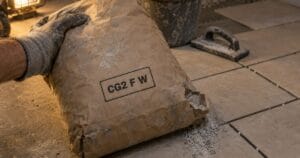
There is a dependency on the back of your tile-adhesive bag that the datasheet never prints. It will tell you the class - C2TE S1, say - the open time, the slip, the deformation. It will not tell you that the single ingredient which earns that S1, the polymer that makes a rigid cement mortar bend without cracking, is the end of a chemical chain that starts as a gas molecule in the Persian Gulf and has to cross two straits that are, as of late September 2026, both at war. This edition is about that line item you cannot see.
It is tempting to file 2026 under "the Red Sea again, plus expensive freight." That is not what this is. 2026 is a double chokepoint shock hitting the Gulf petrochemical feedstock at source, not merely lengthening its route - and for construction chemistry that distinction is the whole story.
Two straits, at once - what actually changed in 2026
The first is the Strait of Hormuz. It has been effectively shut for much of 2026 by the Israel and United States war with Iran: the fighting opened around 28 February, Iran declared Hormuz "closed" on roughly 4 March, and the July ceasefire collapsed (House of Commons Library, CBP-10636). Hormuz is not a side door. It carries about 20 million barrels a day of crude - close to a quarter of the world's seaborne oil - along with around 19 percent of seaborne LNG and roughly 13 percent of seaborne chemicals including fertilizers, and about 80 percent of it is bound for Asia (IEA, Strait of Hormuz factsheet, February 2026).
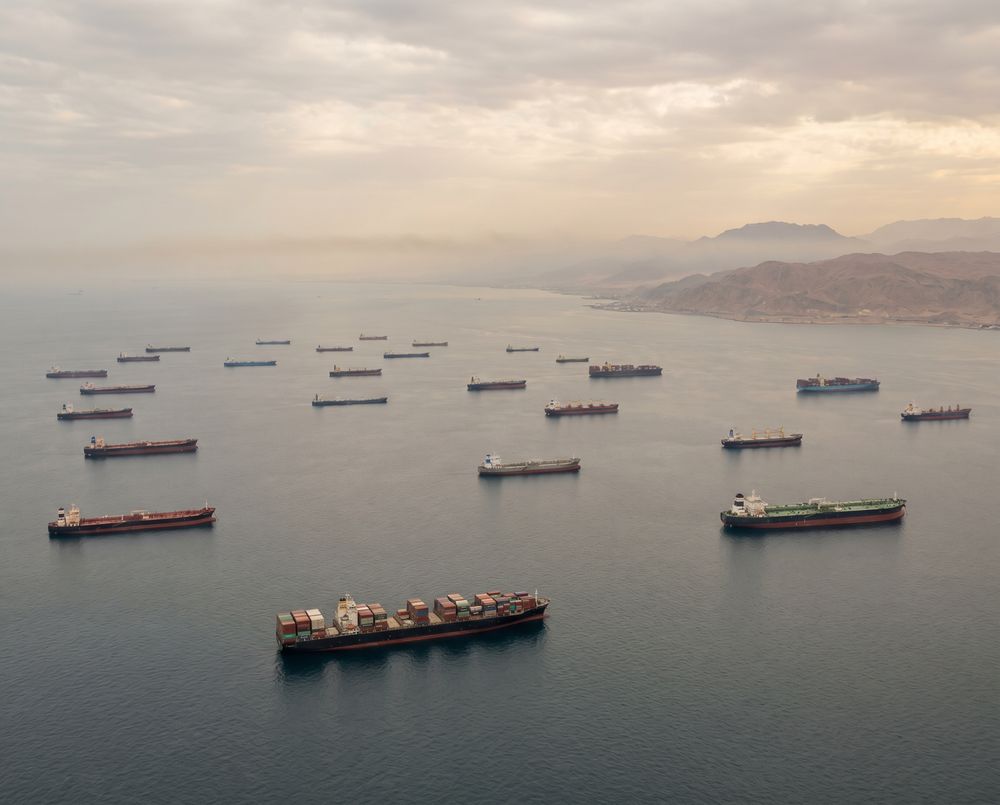
The second is Bab el-Mandeb, at the mouth of the Red Sea. Since 11 September 2026 Houthi forces have controlled both shores of the strait and the key islands, having taken Mocha and declared a blockade on Saudi-linked shipping (Al Jazeera and USNI, 11 September 2026). Transits have fallen to roughly 22 to 26 vessels a day (IMF PortWatch, 20 September) against about 70 a day before 2023 - down around two thirds - and Suez transits fell about 52 percent between 2023 and 2025. The military picture is contested; Al Jazeera notes it could not verify battlefield claims, and the precise reach of the blockade beyond Saudi-linked tonnage is not firm. What is firm is the geometry.
And the geometry is the new part. In the 2024 Red Sea disruption, the fix was to sail around: divert Gulf and Asian cargo down the Cape of Good Hope, eat 10 to 14 extra days and 3,500 extra nautical miles, and carry on. In 2026 the diversion route is squeezed too, because the corridor you would divert into is the one the second war sits on. The two ways Gulf feedstock leaves the region - out through Hormuz, then up through the Red Sea - are constrained at the same time, and at source.
| Chokepoint | What moves through it (for construction chemistry) | Status, late Sep 2026 | Where it lands in your bag |
|---|---|---|---|
| Strait of Hormuz | ~20 Mbpd crude (~25% of seaborne oil), ~19% of LNG, ~13% of seaborne chemicals incl. fertilizers; the Gulf methanol and acetic-acid / VAM feedstock; ~80% Asia-bound | Effectively shut for much of 2026 (war from ~28 Feb; Iran declared "closed" ~4 Mar; July ceasefire collapsed) | The molecule: methanol -> VAM -> the redispersible polymer (VAE / RDP) that makes your flexible C2TE S1 and your membranes flexible |
| Bab el-Mandeb / Suez | The short way for Gulf and Asian cargo to reach Europe; containers and mixed cargo | Houthis control both shores since 11 Sep 2026; ~22-26 transits/day vs ~70 pre-2023; Suez -52% (2023 to 2025) | The detour tax: the Cape of Good Hope adds +10-14 days and +3,500 nm to whatever still ships |
The molecule, not the freight
Here is the chain, and it is the heart of this piece. The polymer that flexibilises a cement mortar is a vinyl acetate ethylene copolymer, sold as a redispersible polymer powder - RDP, or VAE. It is made, by the standard industrial route, from vinyl acetate monomer (VAM); VAM is made from acetic acid and ethylene; and acetic acid is made from methanol. Methanol is the Gulf-heavy first link. So the sentence "your S1 adhesive contains RDP" unrolls backwards into "your S1 adhesive contains Gulf methanol that crossed Hormuz." (The methanol-to-acetic-acid-to-VAM sequence is described here as the established industrial process, not as a reaction mechanism.)
Why does that powder matter so much? Because it is the difference between a mortar that grips a low-absorption porcelain tile on a moving facade and one that lets go. When an RDP-modified mortar cures, the polymer redisperses in the mix water and then forms a continuous film threaded through the hardened cement, bridging the brittle mineral grains so the joint can absorb movement instead of cracking - the mechanism behind the deformation classes S1 and S2, and behind the flexibility of cementitious waterproofing membranes (Brachaczek, Materials, 2021; Jansen, 2021). Take the polymer out and you do not have a cheaper adhesive; you have a different, more brittle product. That is why the feedstock chain is not an abstraction - it is the class on the bag.
The chain has been visibly under stress. Trade press logged 31 force majeure and sales-allocation declarations across Asian and Middle Eastern chemical producers (ICIS, 13 March 2026), and the methanol major Methanex had on the order of 18 to 20 million tonnes a year of Middle East capacity constrained. For a country that imports about 98 percent of its methanol, that is not weather - it is supply. India's Middle East share of methanol fell from around 88 percent in the April-2025-to-February-2026 window to roughly 51 percent across March to May 2026, with the Saudi share collapsing from about 34 percent to zero over February to May (CRISIL, via Business Standard, 29 July 2026).
The pass-through, honestly
This is where it would be easy to exaggerate, so here is the measured version. Producers have raised prices and said why. On 13 March 2026 Wacker announced increases on dispersions, resins and redispersible polymer powders effective 1 April 2026, citing explicitly the Middle East conflict alongside raw-material and freight costs (wacker.com). Celanese raised vinyl acetate monomer - roughly 100 US dollars a tonne in the West on 17 March 2025, and again by about 331 dollars a tonne in the US and 300 euros a tonne in EMEA around 11 May 2026. These are public market announcements, cited here as data, not as endorsements of any maker.
On the raw numbers, the move is real but not yet violent. VAM in China ran near 728 US dollars a tonne in September 2025 and about 776 by June 2026; in Germany from roughly 1,165 to 1,267; India's Pidilite cited VAM near 924 dollars a tonne in the first quarter of its 2026 financial year, rising toward about 1,370. Redispersible powder itself has been steadier - China roughly 970 to 1,020 dollars a tonne, Germany near 1,675, the US around 1,790 to 1,890. Treat those as ranges: the price aggregators that publish them (ChemAnalyst, IMARC and similar) diverge by 30 to 75 percent and carried at least two probable errors on 2026 VAM and cellulose spikes, so the producer announcements and ICIS are the firmer anchors. And critically, so far Indian formulators have largely absorbed the increase rather than passed it on - Pidilite runs margins near 25 percent and VAM is under 10 percent of its raw-material basket. The cost pressure is upstream and moderate, not a shelf-price spike. Yet.
Built by Chemistry is an independent, brand-free weekly on construction chemistry - one edition every Thursday, no vendors, no filler. If you buy, spec or sell these materials, subscribe and keep the thread.
The freight layer, put back in its place
Freight is the headline everyone reaches for, and it is genuinely dramatic - on the tanker side. Very large crude carrier earnings ran to about 722,946 dollars a day in mid-September 2026, up roughly 807 percent year on year (Cyprus Mail and USNI, 18 September 2026). War-risk insurance for Hormuz transits sat at 3 to 10 percent of hull value, against something like 0.25 percent before the crisis, with the southern Red Sea around 1 to 2 percent, as the Joint War Committee's listed areas were widened in March and again in July 2026 (The National, 17 July 2026).
But those are tanker and hull-insurance numbers, and your redispersible powder does not travel in a crude tanker. It travels in a container - and the container market is soft. Drewry's World Container Index was about 4,468 dollars per forty-foot box on 24 September 2026, below the 2024 peak of 5,937, with Shanghai to Rotterdam near 3,485 and Shanghai to Genoa near 3,835, and Asia-Europe rates easing. The tanker shock is not the container shock. Reading the VLCC headline and concluding your adhesive freight has gone up eightfold is exactly the mistake this edition exists to stop.
Why the cement barely moved and the binder did
Now the forensic turn, because the pattern is counter-intuitive. Indian cement - the heaviest, lowest-value thing on the site - barely moved: a bag ran about 356 rupees in September 2026, up 7 month on month, against 341 a year earlier (as of late September 2026). It held nearly flat even though the imported petcoke that fires the kilns spiked to 160 US dollars a tonne CFR India in April 2026 before easing to 135.5 by June. The binder - the light, high-value, imported polymer - is where the direct producer increases landed.
The reason is an inversion worth internalising. For a bulk, low-value, heavy material like cement, transport is a large share of the delivered cost, but it is made and burned locally, so a global freight and fuel shock is diluted by domestic production. For a high-value specialty shipped in small mass - the polymer - freight is a small share of the delivered cost, but the material itself is exposed to the feedstock war at source, so the producer raises the price directly. Freight as a percentage of delivered cost is best treated as a principle here rather than a single figure: bulk and low value means a high freight share, specialty means a low one. The lesson for a formulator is not "freight went up." It is which links are worth localising - and the polymer is the one you cannot make in a kiln down the road.
The site feels this as schedule and escalation, not as a single line. Turner and Townsend's India read put imported raw materials at 10 to 15 percent cost escalation with mechanical, electrical and plumbing lead times out by 2 to 4 weeks - the shape of a supply shock that arrives quietly, as slippage, before it ever shows up as a sticker price.
The quieter second force - tariffs, not detours
While everyone watched the straits, a second force redrew India's cost map with less noise: anti-dumping duty. It is reshaping the landed price of specialty inputs more than freight is. On epoxy, India's Notification 33/2025 (17 November 2025) set five-year duties - China 37 to 258 dollars a tonne, Korea 483, Thailand 331, Saudi Arabia 175, Taiwan 115 - while the EU had gone definitive on 28 July 2025 (China 33 percent, Taiwan 11 percent, Thailand 29.9 percent) and the US moved in May 2025. On titanium dioxide, the whitener behind every bright grout and paint, India imposed a duty in May 2025, saw it struck down by the Calcutta High Court on 22 September 2025, and then had the DGTR re-recommend 460 to 681 dollars a tonne on 3 August 2026 - a whiplash that makes planning harder than any single rate.
And in the middle of all this India did the revealing thing: it exempted around 40 petrochemical imports from duty between 2 April and 30 June 2026, specifically to shield its own industry from the conflict. Read the two moves together and you can see policy trying to do what the straits will not - keep the molecule flowing and cheap - while walling off the finished specialties where domestic capacity exists. That is the real map a formulator has to price against, and it is drawn in customs notifications, not shipping lanes.
We said this would happen
When the war opened, this publication ran the early warning - the edition headed "Polymer prices up 60 percent. Naphtha up 74 percent in 14 days. Hormuz is rewriting construction chemicals". This is the follow-up: what has actually happened since. The molecule got squeezed at source; the producers raised and said why; the Indian makers absorbed, for now; the container market stayed soft while the tanker market went vertical; the cement held and the binder moved; and tariffs did quieter damage than any detour. That is not a freight story. It is a feedstock story wearing a freight headline.
None of it is on the bag. The datasheet still says C2TE S1, and the number is still true - but the S1 rides on a redispersible polymer, the polymer rides on Gulf methanol, and the methanol rides through two straits at war. The market this sits inside is the one we mapped in the India premium paradox edition and the construction chemicals hub: a price set far upstream of the shelf, in places the specifier never sees. The most useful thing you can do this quarter is know which of your line items is a local bulk you can lean on, and which is a molecule that crosses a war - because the datasheet will never tell you.
New edition every Thursday - independent, sourced, brand-free, and dated because this one moves. Subscribe, and read the market before it reaches your invoice.
- Why your C2TE-S1 stops working at 60×60
- Your adhesive is not drying. It is hydrating, and the weather sets the clock.
- Grout classification, decoded: CG1, CG2, W, A, F
- Grout was never waterproof - and never had to be
- Why tile grout crumbles: the joint that can't cure