
Independent author of Built by Chemistry. Every edition sourced from EN / ANSI / BIS / ASTM standards or peer-reviewed literature. About →
For three weeks we have followed a single grey bag. In Edition #18 we opened it and found that its flexibility is manufactured on site — roughly a fifth of the powder is polymer, and a quiet race between cement and film decides whether it ends up elastic or brittle. In Edition #19 we read the rulebooks and found five countries measuring "flexible" five incompatible ways — and India measuring it, as a product, not at all. This finale asks the question the chemistry and the standards set up but neither answers: in a market with no product standard and a workforce that is four-fifths unskilled, who actually buys the most expensive, most chemically loaded membrane on the shelf — and does it make any sense that they do?
India is the sharpest place to ask it. Its waterproofing market is worth around US$1.3 billion in 2025 and growing at roughly 7–8 % a year (Mordor Intelligence) toward US$2 billion by the early 2030s, inside a construction-chemicals market of about US$2.6 billion. That is a large, fast, and — this is the important part — largely un-refereed market. So the economics get interesting.
The price is set upstream
Start with why the premium bag is expensive at all, because the answer is not "branding." A flexible membrane is roughly 15–20 % redispersible polymer by dry weight — an order of magnitude more than a tile adhesive. That polymer is mostly vinyl acetate–ethylene, which alone is about 47 % of the global redispersible-powder market, and it is built from a single feedstock, vinyl acetate monomer, which is in turn made from acetic acid and ethylene (or, in much of China, from coal via acetylene). Each of those links is a commodity with its own weather.

The consequence is that a flexible membrane's cost is largely a petrochemical position wearing a construction label. In mid-2025 vinyl acetate monomer traded near 738 US$/t in China but close to 1,345 US$/t in Brazil (ICIS), and Chinese prices slid several per cent in a single quarter on weak demand and oversupply while other regions rose — all of it driven by disruptions in acetic acid and ethylene, the two feedstocks. When you buy the flexible grade, most of what you pay for is that polymer, and most of the polymer's price is a bet on a raw-material market the applicator has never heard of. It also means the premium is not a fat margin waiting to be competed away; it is mostly chemistry, and chemistry has a floor.
There is a strategic wrinkle here that matters for India specifically. The redispersible-powder market is concentrated — Asia-Pacific accounts for roughly 46 % of global volume, a handful of global majors make most of the rest, and the single largest production base is China, where capacity keeps expanding. India is a huge consumer of this polymer but not, in the main, its maker. So the flexibility in an Indian premium membrane is, to a large degree, an imported input whose price and availability are set in boardrooms and cracking plants outside the country. For a market growing at 7–8 % a year, that is a quiet dependency worth naming: the premium segment India is building rests on a specialty polymer it does not control.
Two Indias in one bucket
Now the demand side, which in India is really two markets stacked in one product category. India's construction sector employs on the order of 71 million people, and by the standard estimates around 81 % of them are unskilled (Knight Frank India, 2023) and the overwhelming majority are casual workers who learned the trade on site, without formal training. That is not a slight; it is the structural reality of a booming, informal, contractor-applied base — the mason in a smaller city who mixes by feel, buys on price, and has never been shown the back of a lifted tile. Above it sits a thin, fast-growing premium layer: branded, specification-driven work in the metros, high-end homes, and B2B towers, where the person paying wants a result and is prepared to pay for certainty.
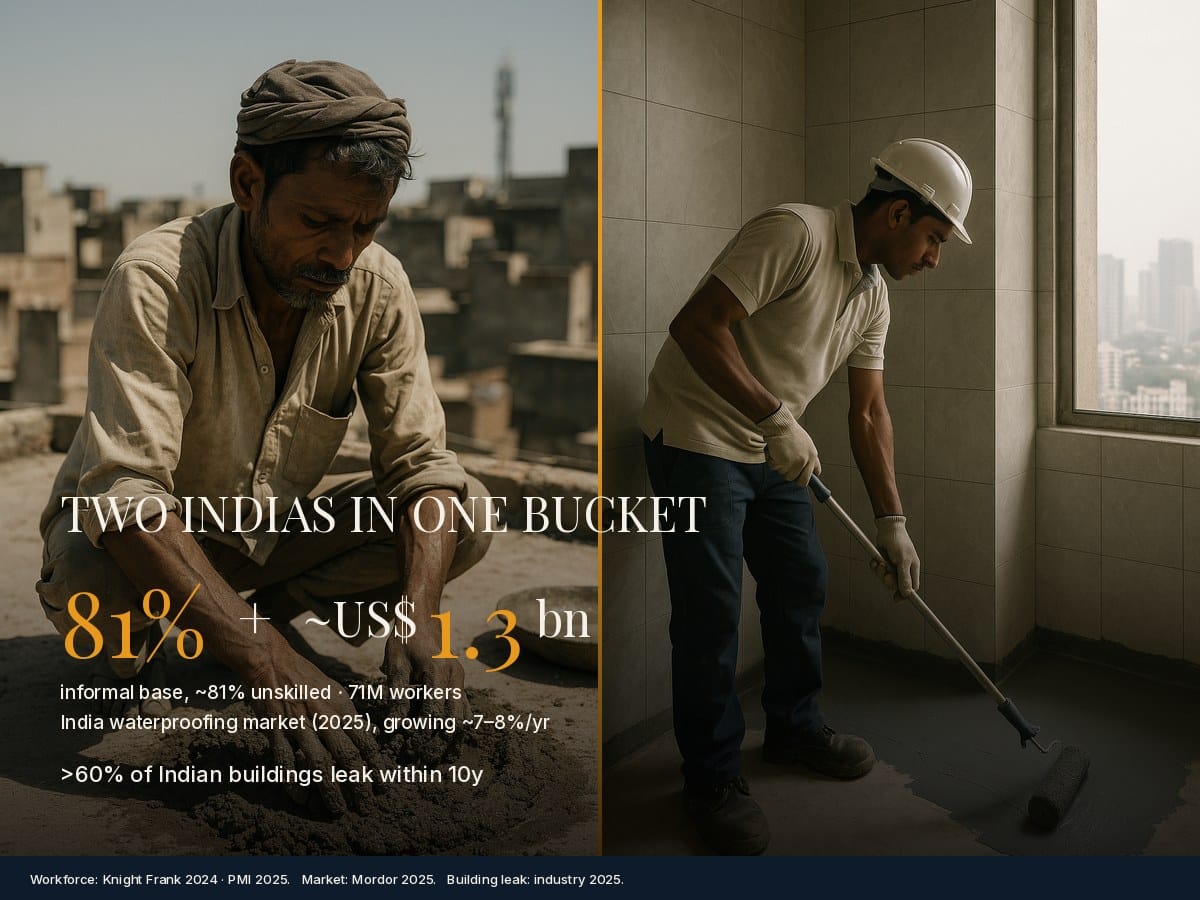
The whole market is mid-transition between the two. It was, until recently, fragmented and largely unbranded — waterproofing was a bucket a contractor chose, not a product a homeowner specified. That is changing fast: a single category leader now holds more than a third of the retail waterproofing market, the big paint and adhesive majors are pushing in with huge dealer networks, and category advertising has taught Indian homeowners a phrase they did not use a decade ago — "waterproofing" as a thing you buy on purpose, before the leak.
The premium paradox
Here is the paradox promised by the title. In a market with a strong national product standard, quality is enforced from above: the standard sets a floor, everyone must clear it, and competition happens on price and marginal features just above the line. India, as Edition #19 showed, has no such floor for a cementitious membrane — only a practice code and an admixture spec. Intuitively you might think that a market with no standard would be a race to the bottom, and at the informal base it often is. But at the top the absence of a floor does something counter-intuitive: it makes the premium the only defensible place to compete. You cannot win a buyer by promising you "meet the standard," because there is no standard to meet. The only thing left to sell is demonstrated performance and trust — a track record, a warranty that is actually honoured, a European class voluntarily printed on an Indian bag. The buyer with money and taste, wanting something above an undefined average, becomes the whole game, because they are the only buyer for whom "better" can be proven rather than merely claimed.
This is why "there is no Indian standard" is not a reason to sell down-market in India; it is the argument for the opposite. Where the rules are absent, reputation is the standard, and reputation is a premium product's home turf.
One sourced construction-chemistry read every Thursday. No brands, no spin. → Subscribe.
The value is the failure you don't have
The premium only makes sense if the downside it prevents is large, and in India it is enormous. More than 60 % of Indian buildings develop a water-related problem — terrace leaks, bathroom seepage, wall damp — within their first ten years, and the climate makes the timing brutal: demand for waterproofing spikes before and after each monsoon, when the failures announce themselves and the good applicators are already booked. The arithmetic of delay is the real sales pitch. Waterproofing a terrace proactively runs on the order of a few tens of rupees per square foot and buys the best part of a decade; waiting until the ceiling paint peels turns the same job into crack repair, re-waterproofing, and an interior repaint that can run to tens of thousands of rupees per room — an order of magnitude more, and that is before the value of the finish it was protecting.
The monsoon also concentrates the whole market into two short windows a year. Demand for waterproofing spikes in the pre-monsoon months and again just after, and prices rise perhaps 10–20 % in those peaks as the competent applicators fill their books and the weather shortens every working day. That seasonality quietly favours the premium end twice over: the buyer who plans ahead and specifies a durable membrane in the dry season gets both the better product and the better crew, while the one who waits for the leak pays a peak price for whoever is still available in the rain — usually the informal base, applying the cheap grade in the worst possible conditions.
Set against that, the extra cost of the high-polymer flexible grade is almost a rounding error. This is where the chemistry of Edition #18 finally pays for itself commercially: the whole point of loading a fifth of the bag with polymer is to survive movement, thermal cycling and standing water for years rather than seasons, and the more expensive the building and the finish above it, the more that durability is worth. A premium membrane is not a premium because someone is being fleeced. It is cheap insurance on an expensive asset, priced by a global polymer market and paid for by the value of the room it keeps dry.
Where this goes — and the throughline
The direction of travel is clear even if the timing isn't. Premiumization, stricter climate-resilient building codes, a large public infrastructure pipeline and a homeowner pivot toward preventive maintenance are all pulling the Indian market up the pyramid at once. Our call — an opinion, not a citation — is the one we made in Edition #19: a market this size will not run indefinitely without a product standard, and when India writes one it will likely borrow the shape of EN 14891, so that exporters and multinationals can reuse their test data. Until that day, the safest specification in India is still an explicit class written into the contract, and the clearest opportunity is still the top of the pyramid, where proof beats compliance because compliance has nothing to point at.
And that closes the loop we opened three weeks ago. A flexible cementitious membrane is manufactured — its elasticity built on site from a fifth of a bag of polymer, in a race against the cement (Edition #18). It is measured — judged "flexible" by five national rulebooks that don't agree, and by India not at all (Edition #19). And in the end it is chosen — bought, or not, by a buyer weighing an upstream petrochemical price against the cost of a failure they would rather not have (this one). Chemistry decides what the product can do. The market decides whether anyone pays for it. In India, for now, that decision is made without a rulebook — which is exactly why it is worth understanding.
That's the membrane trilogy. Built by Chemistry — construction chemistry, sourced and brand-free. → Subscribe for what's next.
- Why your C2TE-S1 stops working at 60×60
- Your adhesive is not drying. It is hydrating, and the weather sets the clock.
- Hormuz, Bab el-Mandeb and your tile adhesive (2026)
- Grout classification, decoded: CG1, CG2, W, A, F
- Grout was never waterproof - and never had to be