
Independent author of Built by Chemistry. Every edition sourced from EN / ANSI / BIS / ASTM standards or peer-reviewed literature. About →
A terrace is tiled over a "flexible" waterproofing layer. The bag was certified; the installer followed the drawing. Two winters later, a crack opens along the first structural joint and water finds the slab underneath. Everyone reaches for the datasheet, and the datasheet says flexible. It was — on the day it was tested, at 23 °C. On the January morning it was asked to stretch, it wasn't. The word on the bag and the material on the wall were not the same thing.
We have spent this cluster arguing about systems — which waterproofing to choose, which test measures it, which interface fails. This edition opens the bucket instead. A flexible cementitious membrane is one of the strangest products in construction chemistry: it is mixed from a bag like a mortar, and it is supposed to behave like a sheet of plastic. Understanding how a mortar crosses that line — and where the crossing quietly fails — is the whole game. It is also the exact point where two of our clusters meet, because the flexible membrane under a tiled terrace is a waterproofing product and a substrate for adhesive at once.
Two hardenings race for the same water
Mix a polymer-modified slurry and you start two processes at once, and they are not friends. The cement begins to hydrate — consuming water, growing interlocking mineral crystals, building rigidity. At the same time the redispersible polymer, once it redisperses into fine particles, needs to lose water so those particles can flow together and knit into a continuous film. The two share one pool of water and, as a careful NMR study that watched both happen simultaneously put it, each one retards the other: the polymer slows the cement, and the cement, by drinking the water, controls when the polymer can coalesce.
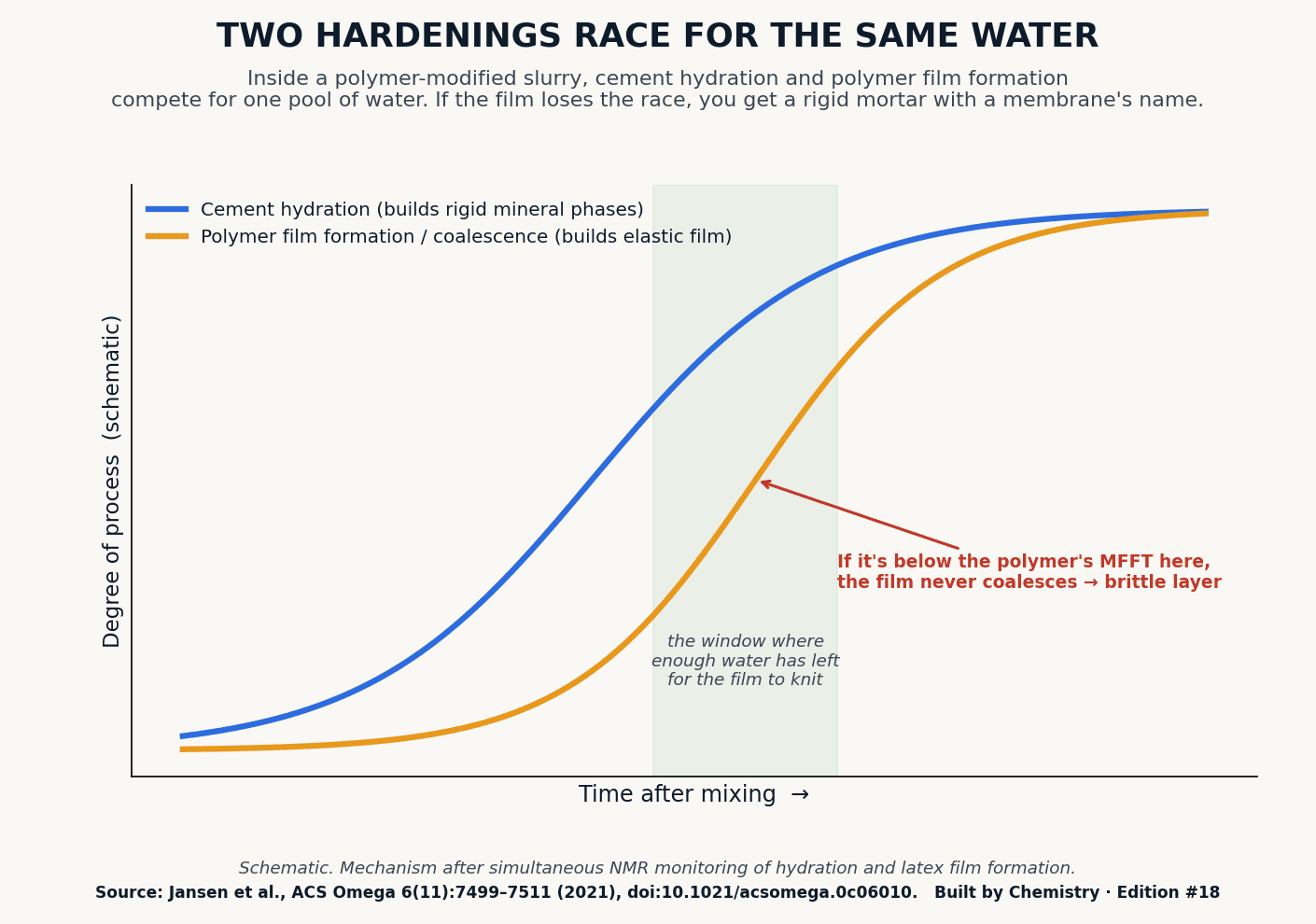
Here is the catch that decides everything: film formation, unlike hydration, has a temperature below which it simply does not happen. It is called the minimum film-forming temperature, the MFFT, and for the polymers used in these membranes it sits low — around freezing — but not at zero risk. Lay a "flexible" slurry on a cold morning below its MFFT and the polymer particles never fuse. The cement hydrates anyway. What you get is a rigid, cracked-earth mortar wearing a membrane's name. The elasticity was never built. This is why the same product can pass in the lab and shatter on site: the lab was warm, the site was not.
The P/C dial: the same polymer, three completely different jobs
The single number that separates a tile adhesive from a membrane is the ratio of polymer to cement. It is the same family of redispersible polymer you met in Edition #15 — but the dose changes what the product is. In a premium C2 tile adhesive the polymer is a low single-digit share of the dry mix; it assists, wetting the tile and adding a little forgiveness, while the hydrated cement remains the matrix that carries the load. Turn the dial up and the roles invert.
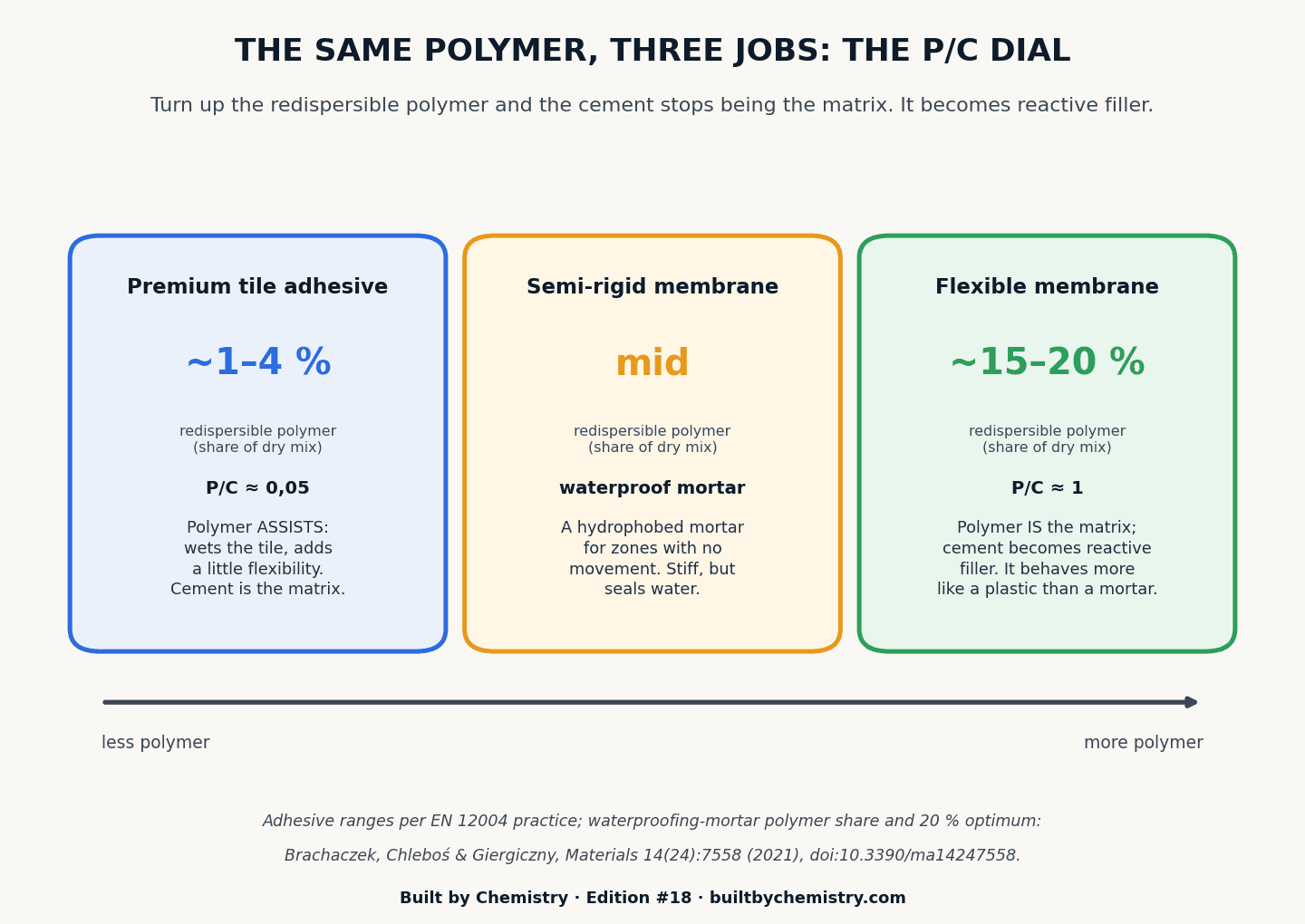
In a flexible membrane the polymer can reach roughly a fifth of the dry blend — an order of magnitude more than in the adhesive. Published work on cement waterproofing mortars that stepped the polymer modifier through 15, 20 and 26 % of the dry mass found the sweet spot around 20 %: below it the layer leaked and barely adhered; around 20 % it turned watertight and its adhesion climbed past 1 N/mm²; beyond it there was little extra to gain. At that loading the cement is no longer the star. It becomes a reactive filler suspended in a continuous polymer film. Formulators sometimes reach for it with a rough rule of thumb — think one part cement, one part polymer, one part water — and the useful thing that captures is the destination: a material that behaves more like a plastic than a mortar.

It isn't only how much polymer — it's which one
"Redispersible polymer" is a category, not a substance, and behind the dose sits a second dial: the chemistry. The workhorse in cement is vinyl acetate–ethylene (VAE), where the ethylene is a built-in softener, but the family also runs to vinyl acetate–versatate, pure and styrene-acrylics, and styrene-butadiene — and they are not interchangeable. Two properties decide the split. The first is the glass transition temperature, Tg, the point where the film turns from glassy to rubbery: a membrane that has to bridge a crack needs a soft, low-Tg film — in practice below roughly −20 °C — and that value is engineered by the ratio of hard monomers (styrene, Tg near 100 °C) to soft ones (an acrylate such as 2-ethylhexyl acrylate, Tg near −50 °C). The second is how the cured film survives the cement itself: a plain vinyl-acetate film is vulnerable to the high alkalinity and to standing water, which is precisely why ethylene, versatate or an acrylic backbone is brought in to buy alkali and water resistance. Same 20 % on the dial, a different resin, and you have a different membrane — one that stays elastic through a cold snap, or one that turns brittle and chalky in a few winters. Which resin, not just how much, is a lever in its own right — and it deserves an edition of its own, which it will get.
Semi-rigid or flexible: two different promises
Between the adhesive and the plastic sits the semi-rigid membrane, and it is honest about being less. It is essentially a mortar made water-repellent — a modest polymer content, a hydrophobic admixture, tuned for compressive strength rather than stretch. It seals beautifully where nothing moves: a buried tank, a lift pit, a wall with no live joints. Ask it to bridge a working crack and it will do exactly what a mortar does, which is split. The flexible grade is the one built to survive movement, and it pays for that with chemistry, with price, and — as we just saw — with a temperature limit most datasheets keep quiet about.
What "flexible" has to prove — and what the class doesn't tell you
In Europe, the word is not a marketing claim; it is a test. EN 14891 governs liquid-applied water-impermeable products under ceramic tiles and sorts them into three families — CM (cementitious), DM (polymer dispersion) and RM (reactive resin). To be sold at all, a product has to hold at least 0,5 N/mm² of adhesion in a battery of conditions — initial, after water immersion, after heat ageing, after freeze–thaw, after lime water — and it has to bridge a crack of at least 0,75 mm.
Read the last requirement carefully, because it is the trap. That standard crack-bridging test is run at 23 °C. The ability to bridge a crack in the cold is an optional extra class: O1 proves it down to −5 °C, O2 down to −20 °C (a separate letter, P, covers contact with chlorinated pool water). So a membrane can be perfectly, truthfully certified "flexible" to EN 14891 and never have proven it does anything at all on a frosty morning. The class you want under a terrace in a cold climate is not bare CM — it is CM with an O. If the datasheet doesn't carry the O, the flexibility it advertises has only ever been demonstrated at room temperature. The bag said flexible. The class told you at what temperature.
One sourced, no-brand construction-chemistry breakdown in your inbox every Thursday. Subscribe here.
Why a good membrane still dies on site
Even with the right class in the bag, the film has to be allowed to form, and the site is where it is most often denied. Flood a fresh flexible membrane with cure water too early and you drown the coalescence: the polymer particles are pushed apart before they can knit, and the film sets porous and weak. Apply it below the MFFT and, as above, it never fuses. Recoat too soon — before the first pass has lost enough water to build its film — and you trap a soft, wet layer under a skinned one, which is simply a fifth clock added to the four we timed for adhesives in Edition #16. None of these is a defect in the bag. Each is the same quiet failure: the polymer never got the conditions it needed to become the thing you paid for.
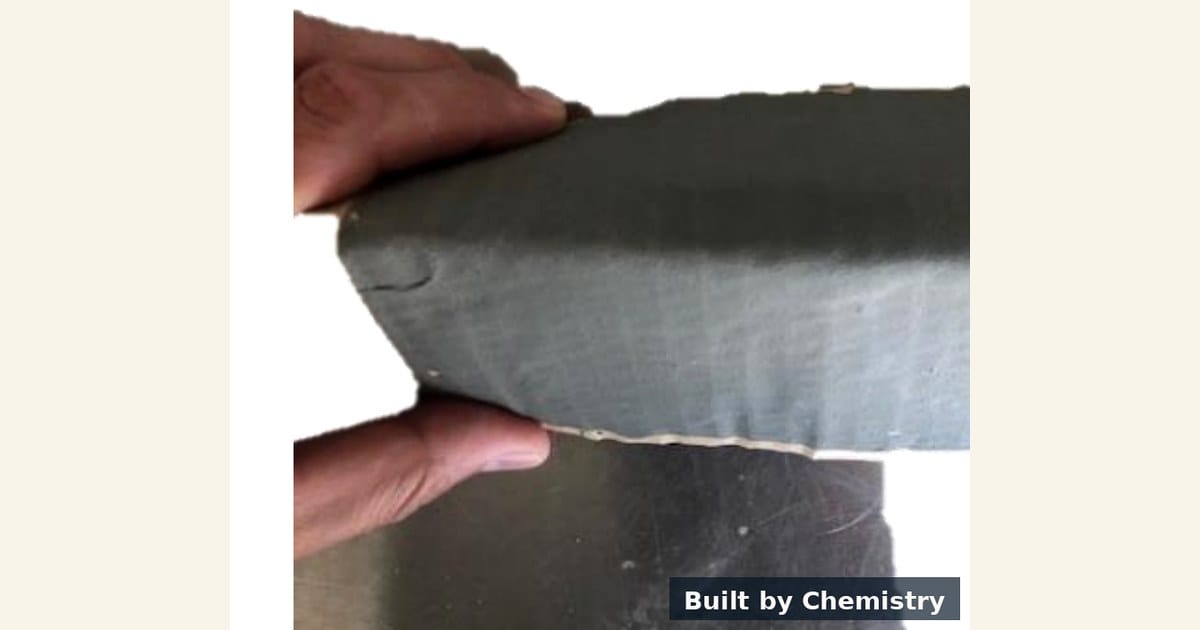
This is also why the honest comparison is never "cementitious versus liquid." A styrene-acrylic liquid membrane is a pre-formed film in a can; a flexible cementitious slurry has to manufacture its film in place, in the weather, on your substrate. When that manufacturing goes right, the cementitious grade gives you adhesion and vapour tolerance a peel-and-stick sheet can't match. When it goes wrong — cold, drowned, rushed — you are left holding a rigid grey biscuit with a flexible label. The chemistry is genuinely elegant. It is also genuinely conditional.
The formulator's view, in one line
A tile adhesive borrows a little polymer to help cement do its job. A flexible membrane spends so much polymer that cement becomes the helper. Everything else — the temperature limit, the curing rules, the price, the class letters — follows from that one inversion. Next week we leave the bucket and open the rulebook: what "waterproof" actually means when you cross a border, and why an EN 14891 membrane, an ASTM-rated coating and an Indian IS-classed product are three different promises wearing the same word. (Now live: Edition #19 - Waterproofing membrane standards across five countries.)
If this membrane is the barrier, the joint above it is not: grout was never waterproof, and never had to be.
Built by Chemistry — construction chemistry, sourced and brand-free. The trilogy is now complete: Part 2 “Waterproofing membrane standards across five countries” and Part 3 “what that 20% polymer costs in the market”. Subscribe here.
- Why your C2TE-S1 stops working at 60×60
- Your adhesive is not drying. It is hydrating, and the weather sets the clock.
- Hormuz, Bab el-Mandeb and your tile adhesive (2026)
- Grout classification, decoded: CG1, CG2, W, A, F
- Grout was never waterproof - and never had to be