Independent author of Built by Chemistry. Every edition sourced from EN / ANSI / BIS / ASTM standards or peer-reviewed literature. About →
Ask three tilers what “open time” means and you will get three answers. One will tell you it is how long the mixed bucket lasts. Another, how long you have to nudge a tile once it is down. The third will shrug and call it “the setting time”. I have had this exact conversation on sites in Spain and in India, with people who have laid tile for thirty years — and the confusion is not harmless. In my experience it is the single largest source of product complaints in this trade, and almost none of them are actually the product’s fault.
Here is how the failure looks. A hot day, an absorbent substrate, and an installer paid by the square metre who combs out a big area to get ahead — then steps away for a cigarette. By the time the tiles go on, the ridges have skinned over and gone dead. Months later the whole area lifts. The bag gets blamed. But four separate clocks were running that morning, the installer was watching the wrong one, and the one that mattered had already run out. This edition pulls the four apart — pot life, open time, adjustment time, setting time — and shows why only one of them is written into the adhesive standard, and what it actually measures.
Key takeaways
- Four clocks, four different moments and scales: pot life (the mixed bucket), open time (the combed bed), adjustment time (the placed tile), setting time (the hardened mass). Minutes, minutes, minutes — and hours.
- Open time is a norm, not a feeling. Under EN 1346 it is the time after combing at which an embedded tile still develops a tensile bond of ≥ 0,5 N/mm²; the “E” class means that still holds at ≥ 30 min.
- The cellulose ether decides your open time. In one published dataset, the same base mortar with a different cellulose gave a 30-minute bond of anywhere from 0,30 to 1,33 N/mm² — the difference between failing and passing the class (Petit & Wirquin, 2013).
- Setting time runs on hours, not minutes — 4 to 18 h in that same study — and is the cement’s hydration clock (Vicat, EN 196-3), not a placement window. Confusing it with pot life is confusing the bucket with the wall.
- The forensic tell of a botched job: lift a failed tile and if the trowel ridges are still sharp and visible on the back, the tile either was never beaten in, or went onto a bed that had already passed its open time — either way, voids, weak points, debonding.
What are the four clocks, and why does the market run them as one?
They are four distinct time windows that begin at different moments — mixing, combing, placing, and hydration — and run on completely different scales. The market blurs them because they all sound like “how long have I got”, but each answers a different question at a different stage.
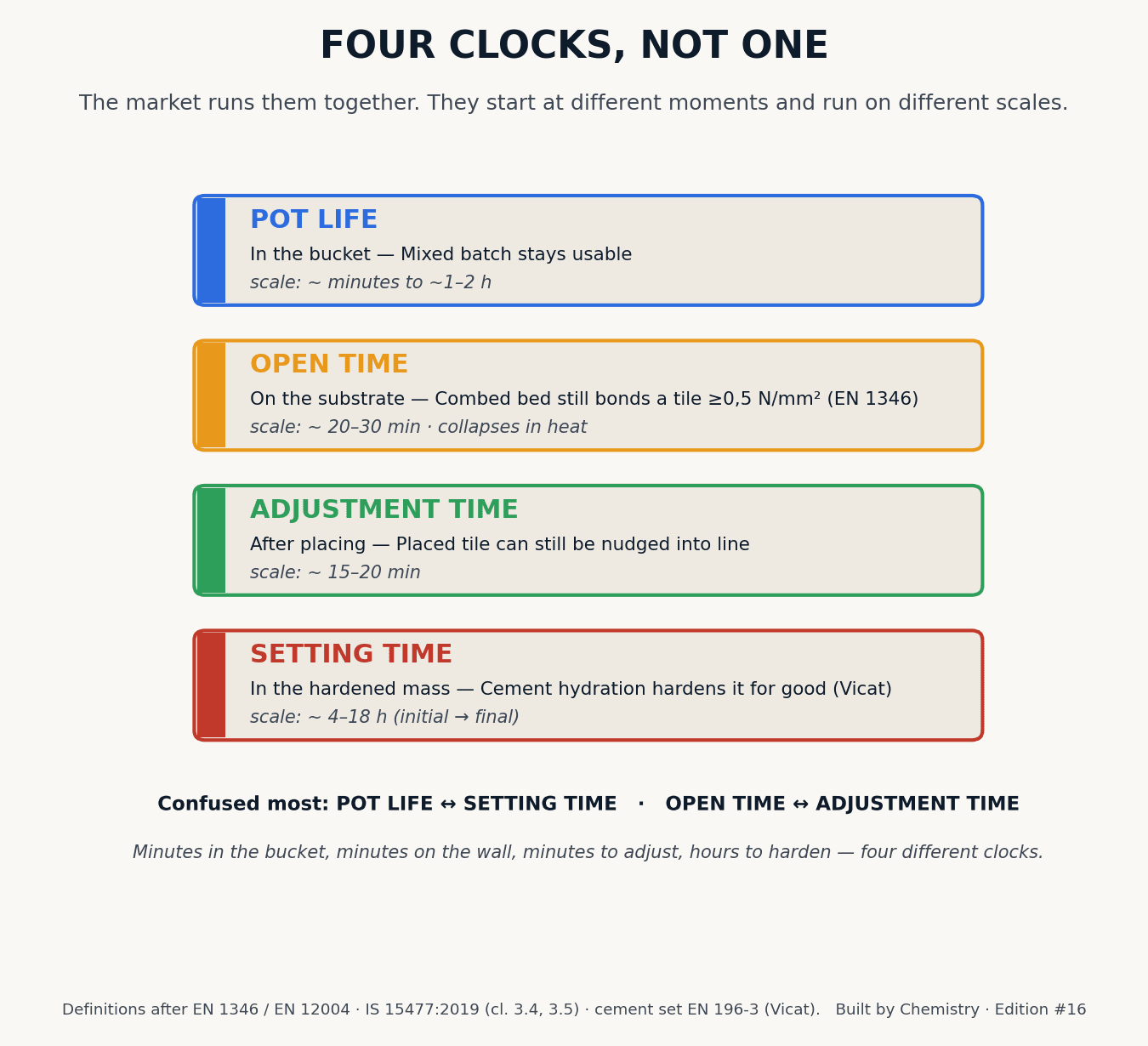
Pot life is the working life of the mixed batch in the bucket — how long the adhesive stays usable before it stiffens in the pot. Open time is the window on the combed substrate during which a tile pressed into the ridges still bonds properly. Adjustment time is the window after the tile is placed during which it can still be slid and lined up without wrecking the bond. And setting time is the cement’s own clock — the hours over which hydration turns the whole mass rigid. The two confusions I meet most are precise: people swap pot life for setting time, and open time for adjustment time. Getting them straight is the whole point of this piece, because the corrective action is different for each.
What is open time, exactly — and why is it a norm, not a feeling?
Open time is defined by EN 1346 as the elapsed time after combing the adhesive at which a tile embedded into it still develops a tensile adhesion of at least 0,5 N/mm². It is not “when the surface looks dry” — it is a measured bond strength against a pass line, and it is the only one of the four clocks written into the tile-adhesive standard.

The test is exactly what a tiler does, run in a lab. Adhesive is combed onto a slab, and at set intervals — typically 20 and 30 minutes — a tile is pressed on under a defined load, left to cure, and pulled off. The adhesion is plotted against time, and the open time is the moment the curve drops through 0,5 N/mm². An adhesive that still clears the line at 30 minutes earns the “E” (extended open time) designation in EN 12004; India’s IS 15477:2019 defines open time the same way in clause 3.4, as the maximum interval after application at which tiles can still be embedded.
This is the concept nobody buys with the product. “Open time” on a datasheet is not a promise that the bed stays workable-looking for that long — it is a promise that the bond survives that long, measured at 23 °C in a conditioning room. On a real wall the line moves, and where it moves is decided by chemistry.
What is pot life, and why do people confuse it with setting time?
Pot life is the working time of the mixed adhesive in the bucket; setting time is the hours-long hardening of the cement in the finished bed. Same hydration, different material, different stage. Calling them the same thing is calling the bucket the wall.
The moment water meets the powder, cement hydration begins and viscosity starts to climb. Pot life is the practical window before the bucket stiffens enough to stop spreading cleanly — minutes to an hour or two depending on formulation and heat. Setting time is the same reaction taken to completion in the placed mortar, and it is measured by the Vicat needle under EN 196-3, giving an initial and a final set. The scales are not close. In the Petit & Wirquin study, initial setting time ran from 4 hours for a plain mortar to over 12 hours once cellulose ether and polymer were added, with final set out to 18 hours — because those same additives that hold open time also delay the cement.
So the man who leaves his bucket “because it still has setting time” has confused a four-hour cement clock with a bucket that may already be past its usable pot life. The two run on different scales, and only one of them tells you whether the next trowel-load will spread.
What is adjustment time, and why isn’t it open time?
Adjustment time is the window after a tile is placed during which it can still be moved into line without significant loss of adhesion — IS 15477:2019 defines it explicitly in clause 3.5. Open time ends when you can no longer usefully place a tile; adjustment time ends when you can no longer usefully move one you already placed.
They feel similar on site — both are “how long have I got” — but they bracket different actions and they do not run together. A tile can be within its adjustment window and still be sitting on a bed whose open time has expired: it slides fine, and it bonds to nothing. This is the trap behind a lot of “but I lined them up perfectly” complaints. The tile looked adjustable, moved sweetly, and had already lost its grip on a skinned bed. Adjustment time is typically on the order of 15 to 20 minutes per the datasheet, and beyond it a tile should be lifted and re-bedded, not nudged.
Why does the cellulose ether decide your open time?
Because open time is really a race between the cement paste staying wet enough to bond and a skin forming on the ridges — and the cellulose ether governs both the water retention and the skin. Change the cellulose and you move the whole open-time curve.
Petit and Wirquin traced the mechanism directly. In the fresh state, water evaporates from the surface of the combed ridges; within about five minutes a thin cellulose-ether film forms, which slows further evaporation. But water keeps migrating out from the core of the ridge, partly dissolving that first film and carrying more cellulose to the surface, where it concentrates over time into a more solid skin that no longer redissolves. Once that skin sets, the adhesive can no longer wet the tile — and the bond is gone. That skin is the physical event behind “I left it and it went dead.”
The consequence is measurable and, frankly, striking. Testing the same base mortar with eleven different cellulose ethers, the 30-minute open-time bond ranged from about 0,30 N/mm² for the weakest to 1,33 N/mm² for the best — a spread that straddles the 0,5 N/mm² pass line. The very same formula, one ingredient swapped, either comfortably earns its “E” class or fails it outright. And heat only sharpens this: raise the temperature and a cellulose ether’s thickening and the substrate’s suction both accelerate the skinning (Ling et al., 2025), which is why an open time that reads generously at 23 °C can collapse on a wall at 35 °C (the temperature effect I covered in the thixotropy edition runs the same way here). The letter “E” on the bag is decoded, like the rest of the class code, in the C2TE-S1 edition.
How do you read a failed job — the forensic tell?
Lift a debonded tile and read the back: if the trowel ridges are still standing sharp and unflattened, the tile never made real contact. A properly bedded tile leaves the ridges collapsed and the coverage continuous; a failed one leaves the comb marks fossilised — either from poor beating-in, or from a bed that had already skinned past its open time.
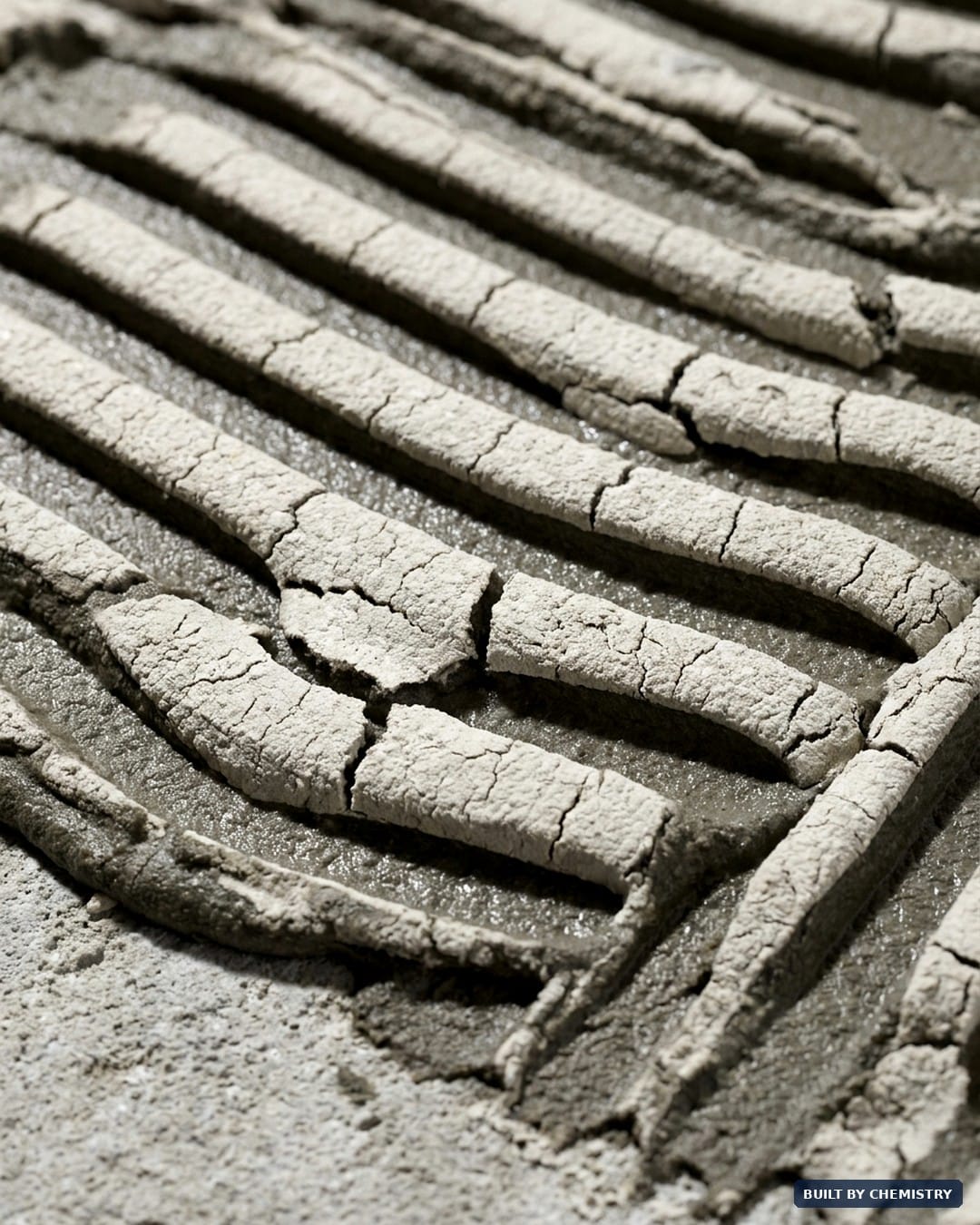
That single observation separates the two most common causes on the spot. Sharp ridges plus a fresh-looking, un-skinned adhesive point to an application fault — poor beating-in, no back-buttering, coverage left in the voids that the buttering and coverage edition covers in full. Sharp ridges over a glazed, skinned adhesive surface point instead to an open-time failure — the bed was dead when the tile met it. Either way the geometry is the same: the voids under those un-collapsed ridges are the fragile points where water and stress concentrate, and where the tile eventually lets go.
This is why the experienced tiler works a tajo — combing only what can be tiled immediately, laying as the adhesive goes down, never running ahead with a big open field to save a few minutes. It is not caution for its own sake. It is the only way to guarantee every tile meets its bed inside the open time, on a hot substrate that is trying to skin the moment the trowel lifts.
Three questions before you comb a square metre
What is the open time, and at what temperature was it measured? A datasheet open time with no stated conditioning is half a number. If your wall runs at 35 °C, a 30-minute open time proven at 23 °C is not your open time — ask what it gives warm, or plan the work so no bed waits.
How large an area will be combed before tiling starts? The honest answer on a hot, absorbent substrate is “only what can be tiled inside the open time”. A method statement that lets an installer comb ahead to raise output is specifying the failure. Working a tajo is the control.
Will a tile be lifted early to confirm the bed is still live? One tile pulled at the start of each area, read for ridge collapse and wet transfer, tells you whether the open time is holding under the day’s real conditions. It costs a minute and it is the difference between catching a skinning bed at tile ten and discovering it at tile ten thousand.
The trilogy closes in Ed #17 — Why tiles fall off: inside a tile-adhesive failure. We put thixotropy, open time and coverage together on one bag and one wall, and show how they are read from a single failed tile.
— Guillermo
Ed #18 adds a fifth clock — the second-coat window on a flexible cementitious membrane: recoat before the first pass has lost enough water to build its polymer film and you trap a soft, wet layer under a skinned one.
Related read → Why tile grout crumbles: the joint that can't cure — Part 1 of the Grout trilogy: the adhesive is still drinking when you rejoint too soon.
All four clocks above were measured at 23 °C. What a cold slab or a humid site does to them is in tile adhesive drying time: humidity and cold.
- Why your C2TE-S1 stops working at 60×60
- Your adhesive is not drying. It is hydrating, and the weather sets the clock.
- Hormuz, Bab el-Mandeb and your tile adhesive (2026)
- Grout classification, decoded: CG1, CG2, W, A, F
- Grout was never waterproof - and never had to be