
Independent author of Built by Chemistry. Every edition sourced from EN / ANSI / BIS / ASTM standards or peer-reviewed literature. About →
Type “grout” into any DIY forum and the first question is almost always the same: why is mine turning to powder? You run a fingernail along a joint a few weeks old and it comes away chalky; a thin line of sand collects on the floor below. The usual answers online blame a “bad batch.” They are almost always wrong. Crumbling grout is rarely a defective bag — it is the predictable result of the joint being the single hardest place in the whole tiled system to cure. This is the first of three editions on the humble grout line; we start where the forums start, with the joint that fell apart, and read it the way we read a fallen tile.
First, a twenty-second orientation, because “grout” is not one thing. The standards split it by binder: a cementitious grout (type CG) is cement, fine aggregate and additives you just add water to; a reaction-resin grout (type RG) is an epoxy that hardens by chemical reaction; and India’s standard adds a modified-resin deformable grade (type MRG) for joints that move (IS 17190:2020). The overwhelming majority of joints in the world are the first kind — a thin cement mortar — and everything that follows is about why that thin cement mortar is so easy to ruin.
The joint is the worst place in the system to cure
Cement needs water to hydrate — to grow the interlocking crystals that turn paste into stone. Take the water away before hydration is done and you are left with under-reacted cement: soft, porous, and powdery. Now look at where a grout has to do that. It is a sliver two to a few millimetres wide, a few millimetres deep, wedged between two tiles and open to the air along the top. No part of the tiled system loses water faster or from more directions.
Here a detail matters that most guides get wrong, and it depends entirely on the tile. If the tiles are absorptive ceramic — typical glazed wall tiles, with a porous body — the two edges flanking the joint drink water out of it from both sides, while the air takes the rest from the top. The joint is attacked on three fronts at once. If the tiles are dense porcelain — vitrified, water absorption at or below 0,5 % under EN 14411 (EN 14411) — the edges are effectively waterproof and take almost nothing; the joint then loses its water upward to the air and downward into the adhesive bed. Either way it is the thinnest, fastest-drying, worst-cured element on the wall — but knowing which mechanism you are dealing with tells you where the water went, and that is half the diagnosis.
The four ways people cause it
1. Too much water in the mix. This is the big one, and it is almost universal on site: nobody weighs anything. The dose is done by eye, and there is a persistent taste for a loose, “milky” joint “like they used to be,” which needs far more water than the bag allows. But water and strength pull in opposite directions — the same water/cement principle Abrams set out in 1918 and Schulze confirmed for polymer-modified mortars (Schulze, Cement and Concrete Research 29, 1999): every extra litre dilutes the binder and raises the porosity of the hardened paste. A joint mixed soupy hasn’t just been weakened a little; it has been designed to be weak, and it will chalk at the surface first.
2. Grouting before the bed is ready. Grout goes into a joint that sits on top of the adhesive bed, and if that adhesive is still hydrating it is still drinking water — now it drinks it from the fresh grout above, pulling the joint dry from below before it can set. Waiting the adhesive’s stated time isn’t bureaucracy; it is what stops the bed from cannibalising the joint.
3. A joint too fine for the aggregate — and a mix that dries too fast. Squeeze a sanded grout into a hairline butt joint and the aggregate bridges before the paste fills; you get a starved, hollow line that was never solid to begin with. And there is a formulation reality underneath all of this: grouts are built mostly on very fine fillers and sands, which have an enormous surface area and pull water in fast. Without a good water-retaining additive — a cellulose ether doing the job it does in every modern mortar — that fine mix dewaters and skins before the cement has hydrated. Fine fillers plus a weak water retainer is a recipe for a joint that dries long before it sets.
4. Cleaning too hard, too soon. The final own-goal is washing the haze off while the joint is still green. Aggressive early sponging drags the fresh paste and the fines out of the surface of the joint, leaving a soft, sandy skin that powders on contact — a failure that looks like bad grout but was made with a wet sponge an hour too early.
A note for formulators — why “rapid” grouts exist
There is a supply-side answer to all this, and it explains a lot of what is on the shelf. Many modern grouts are built on rapid-hardening cements precisely to win the race against water loss: reach usable strength fast, before the thin joint can dewater. The same early strength can be engineered into an ordinary cement with accelerators that speed its reactivity — usually paired with something to compensate the shrinkage that fast systems tend to bring, so the joint gains strength quickly without pulling itself apart. None of that fixes a soupy mix or a green joint scrubbed too soon; but it does mean that a well-formulated fast grout is often more forgiving of a hostile joint than a slow one, which is worth knowing before you blame the bag.
What the standard promises — and where it stops

On paper a cementitious grout is a real structural material: it has to clear a floor of roughly 15 N/mm² in compression and a few in flexure, with capped shrinkage and water absorption. But two things about that floor are worth pausing on. First, it is not one floor: the exact numbers — and even the units and the test temperature — change with the border. Europe’s EN 13888 wants ≥3,5 N/mm² in flexure and measures water absorption in grams by capillary action at 23 °C; India’s IS 17190 asks 2,5 and measures the same thing as a percentage at 27 °C; the US ANSI standards use a different immersion test again, in psi. As the Tile Council of North America bluntly puts it, the ISO/EN and ANSI grout standards “are not intended to correlate.” (We pull that thread properly in Part 3.)
Second, and more to the point here: read the small print of how any of those numbers are earned — a 40×40×160 mm prism, cast in a mould, cured under controlled temperature and humidity for 28 days. That is the exact opposite of a 2 mm joint drying between two tiles in a draught. The certificate is honest; it just describes a specimen that never had to survive the conditions your joint faces. A grout can pass CG2 in the lab and still powder on the wall, because the lab gave it the water and the time the wall took away.
One sourced construction-chemistry read every Thursday. No brands, no spin. → Subscribe.
The 30-second read: does it crumble, or does it crack?
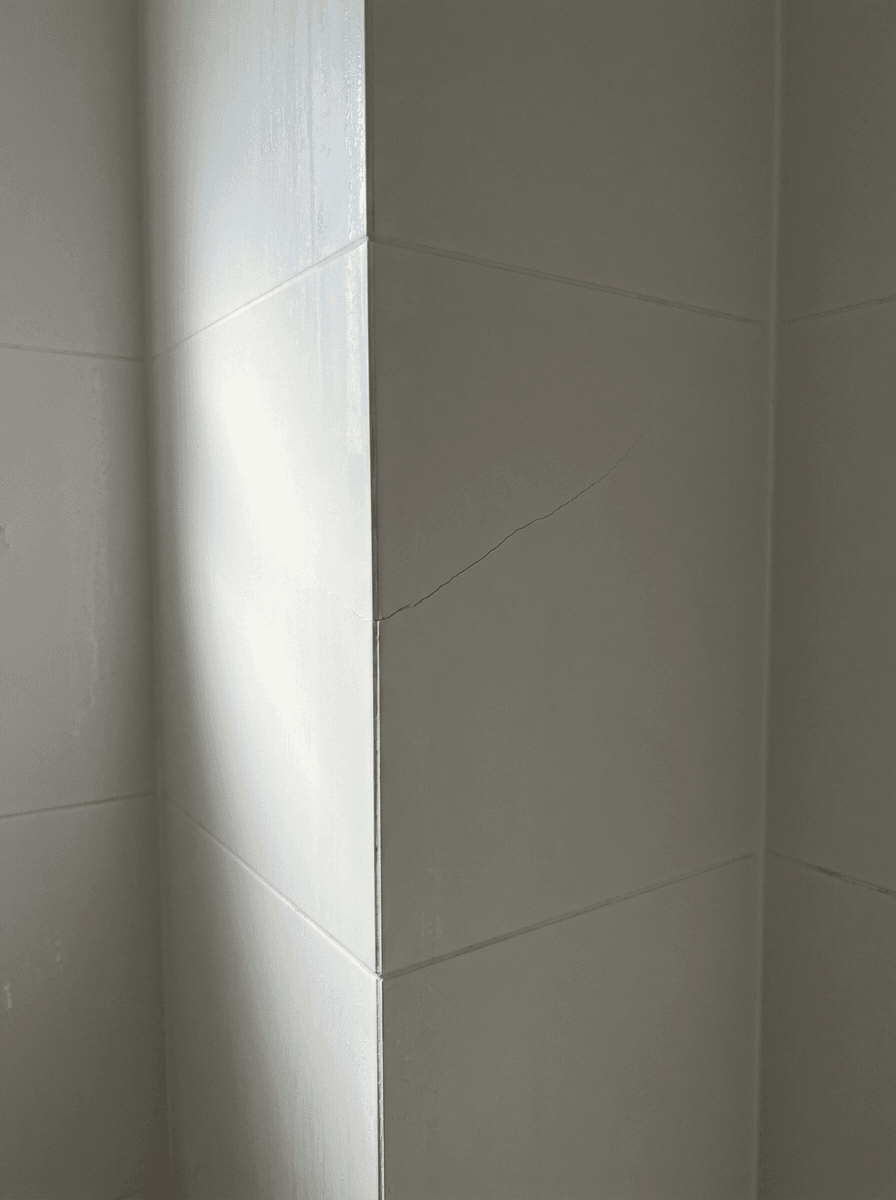
On site the useful thing is to separate two failures that look similar and have opposite causes. Take a key or a screwdriver and drag it along the joint. If the whole line is soft — it powders, sheds sand, and gives way along its length wherever you press — that is a hydration failure: the grout never cured, for one of the four reasons above. If instead the line is hard but split — a clean fracture running along the joint or jumping from joint to joint, with sound grout either side — that is a movement failure: the grout cured fine and then something moved, a missing expansion joint or a deflecting substrate, and the rigid line had nowhere to go. Powder is a chemistry problem in the joint; a crack is a mechanics problem in the building. The fix is completely different, so the thirty seconds it takes to tell them apart is the most valuable half-minute on the job.
When you can save it, and when the problem is underneath
If the read says crumble, the repair is honest and cheap: rake the soft grout out to a sound depth and re-grout properly — the right water dose, a joint wide enough to fill, and the patience to let it cure and to clean it late. The joint was the problem, and the joint can be replaced. If the read says crack, re-grouting is a trap: you will fill the line, it will split again in the same place within a season, because the grout was never the fault — the movement underneath it was, and that needs a movement joint or a look at the substrate, not another bag of grout. The whole of this short series turns on that distinction. A grout line is the last and thinnest mortar in the entire system, and it fails for reasons that are almost always written into how it was mixed, when it was worked, and what moves beneath it — not into the bag it came from. Next week we take on the myth that the bag was ever supposed to keep water out at all.
Part 1 of 3 on the grout line. Save this for the next “bad batch” argument. → Subscribe here.
- India’s waterproofing market and the premium paradox
- Waterproofing membrane standards across five countries
- Flexible cementitious waterproofing: mortar to membrane
- Why tiles fall off: inside a tile-adhesive failure
- Open time, setting time, pot life, adjustment time: four clocks the whole market runs as one — and the one that quietly pulls the tiles off the wall.