
Independent author of Built by Chemistry. Every edition sourced from EN / ANSI / BIS / ASTM standards or peer-reviewed literature. About →
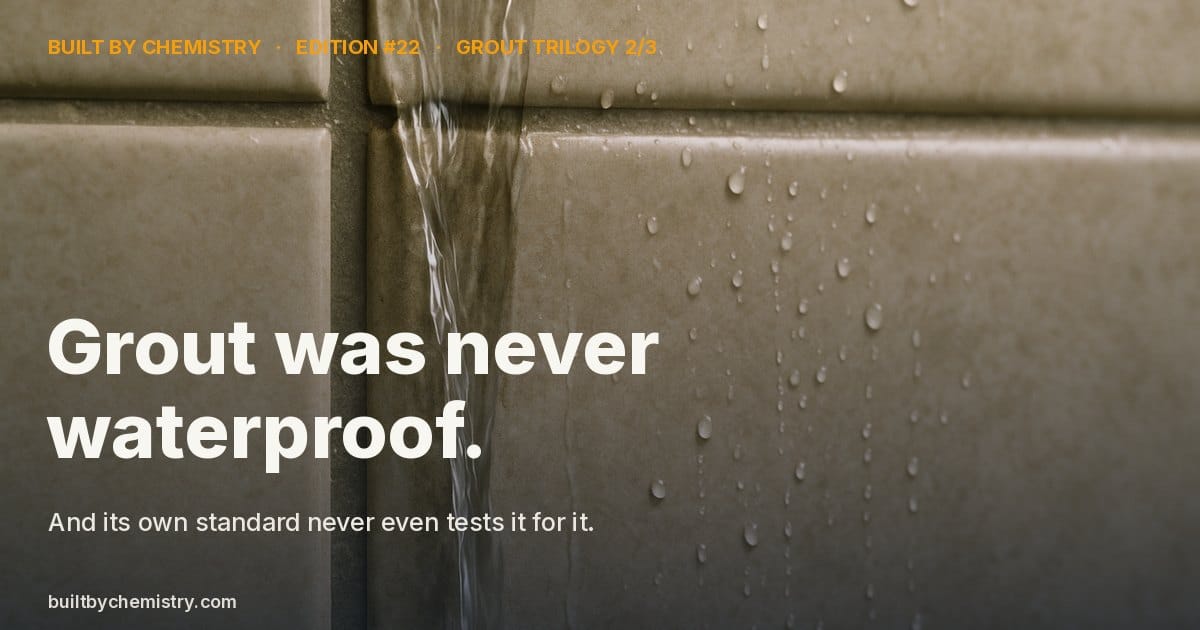
A shower keeps weeping at the base of a wall. So the grout gets raked out and replaced; a month later, the damp patch is back. The joints get sealed with a bottle of grout sealer; the patch returns. Somewhere in that loop is a belief so common it is almost never questioned: that the grout is what keeps the water out. It isn't, and it never was. Cementitious tile grout is porous by design - and the clearest proof is that its own standard never even asks it to be waterproof. This is Part 2 of our three editions on the grout line: last week it crumbled; this week we bury the myth that it was ever a barrier.
Its own standard never asks it to be waterproof
Open the European grout standard, EN 13888, and look at what a cementitious grout is actually tested for: compressive and flexural strength, shrinkage, abrasion resistance, and water absorption. That is the whole list. There is no water-impermeability test. Nowhere does the standard put a head of water on one side of a grout and check whether it comes through the other - because nobody expects it not to. Contrast that with the membrane standard we decoded in Edition #19, EN 14891: that one has an explicit watertightness test, where the product must show no penetration of water at all. Two cement-based materials, a few millimetres apart in the same wall, are asked two completely different questions. The membrane is asked "do you let water through?" The grout is only asked "how much do you soak up?" A product is never certified for a property its standard doesn't test.
What the "W" actually buys
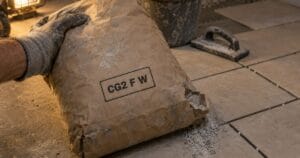
This is where the label misleads. A grout can carry the letter W - "reduced water absorption" - and buyers read it as "waterproof." Read the number instead. Under EN 13888 the test (EN 12808-5) stands a grout prism in water and weighs how much it draws up by capillary action. A normal CG1 may absorb up to 5 grams; to earn the W, a grout has to come in at or under 2 grams. India's IS 17190 measures the same thing as a percentage and is blunter still: a normal grout may absorb up to 15 % of its weight in water, an improved one up to 10 %. The letter is "reduced," not "none."
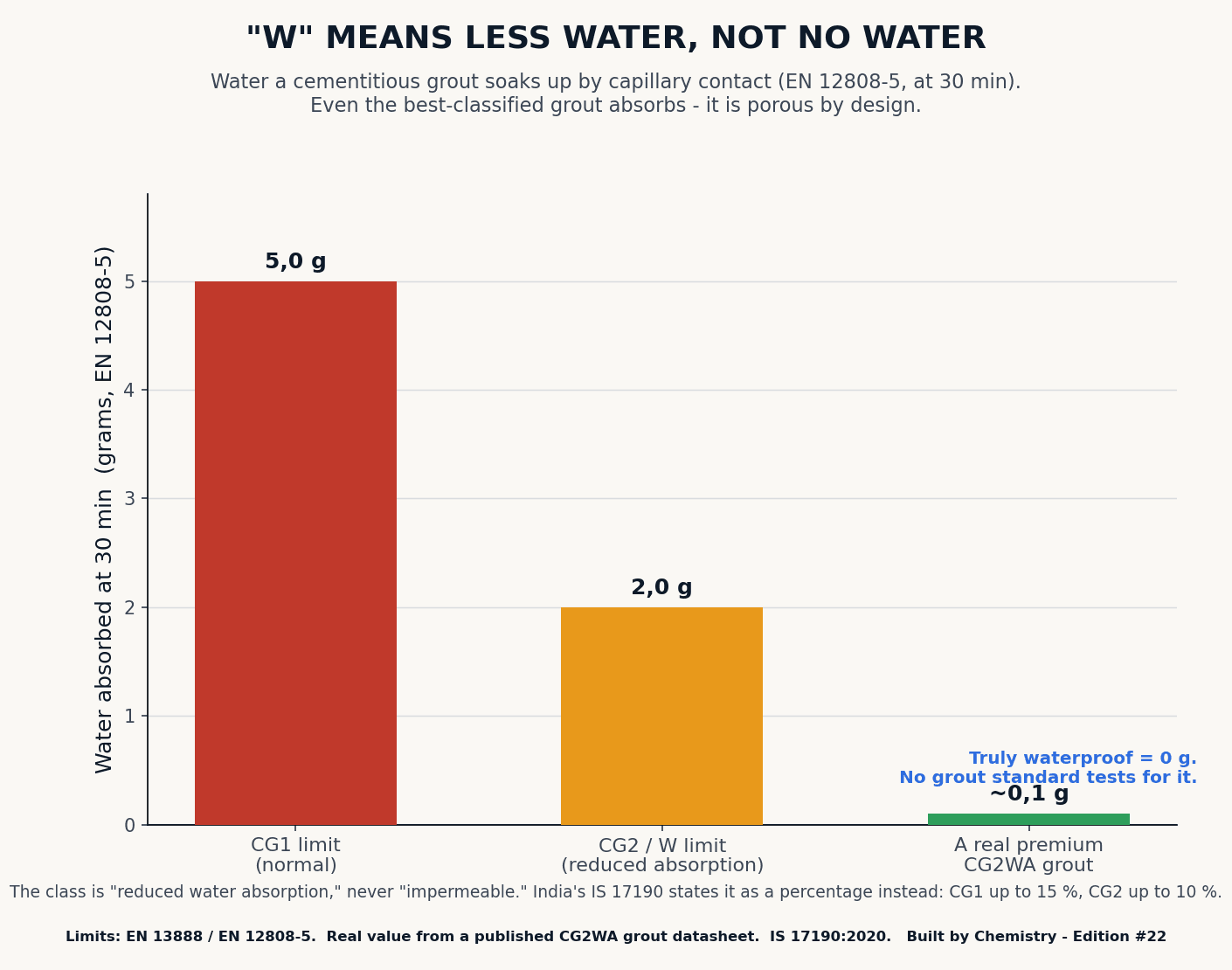
A genuinely good, water-repellent CG2WA grout does far better than the limit - a published high-performance product soaks up around a tenth of a gram in the same test. That is excellent, and it matters. But it is not zero, and zero is the whole point of "waterproof." The best grout on the shelf still takes on water; it just takes on less, more slowly. The class tells you it will stain less, resist freeze-thaw better and bloom less efflorescence - real, useful things. It does not tell you it will hold water back.
Why cement grout is porous in the first place
The porosity isn't a defect; it is the nature of hydrated cement. As cement reacts with water it builds a solid skeleton threaded with a fine network of capillary pores - the space the mixing water once occupied. Those pores connect, and connected pores wick water. A dense, well-cured, low-water grout has fewer and finer pores to begin with - which is exactly why the crumbly, over-watered joint from Part 1 is also the thirstiest. You can also treat those pore walls so that water beads instead of climbing - the pearl effect we come to next - but you cannot admixture your way to a solid barrier out of a material that sets as a sponge, however fine. And the joint has help letting water in: it is thin, it shrinks slightly as it cures, and it meets two tile edges along hairline interfaces. Water rarely needs to soak straight through the face of a joint - it runs down the tile and finds the line where grout meets tile, and any shrinkage crack along it.
The pearl effect: how a grout is made to bead
Watch clean water hit a good modern grout and it does something almost theatrical: instead of darkening and soaking in, it pulls itself into round, standing beads that sit on top of the joint and roll off at the slightest tilt. On site it is called the pearl or beading effect, and it is the single most convincing "waterproof" demonstration anyone can show you. It is also the most misread. That bead is not the grout stopping water. It is the grout's surface refusing to wet - and the two are not the same thing.
The effect is chemistry you can dose. Left alone, hydrated cement is hydrophilic: its pore walls are covered in the kind of chemical groups water clings to, so a droplet spreads flat and wicks straight into the capillaries. A water-repellent admixture - most often a silane or siloxane, which is to say a silicone - is blended into the dry grout at a small percentage. As the grout cures, the siloxane bonds onto the cement hydrates and lines the pore walls with a molecular layer of water-hating groups. The surface energy collapses. Water can no longer spread: its contact angle climbs past 90 degrees, often past 120, and the droplet is forced up into a near-sphere - the same reason a drop stands up as a perfect bead on cocoa, or on any very fine, dry powder. The pore is still there and air still passes through it; what changed is that liquid water is no longer welcome to climb in.

This is exactly what the "W" buys, made visible. A CG2 W grout beads because it is dosed to bead; that is the same admixture that pulls its absorption under 2 grams instead of 5. But look hard at what the bead proves and what it doesn't. It proves the flat face of the joint is hydrophobic today. It says nothing about the hairline where grout meets tile, nothing about a shrinkage crack, nothing about the adhesive bed below. Water on a real wall rarely has to soak through the face - it runs down the tile and finds the edges. A joint can bead water beautifully on its surface and still pipe it down its own margins. And the repellency is a surface treatment, not a law of nature: it wears with abrasive cleaning, it can be overwhelmed by standing water or a real head of pressure, and it does nothing at all once water is already behind the tile.
So use the bead the way it is meant to be used. A drop of clean water on a cured joint is a genuinely good field check: if it beads and stands, the surface is repellent and the grout is doing its upstream job; if it darkens and drinks within a minute, the joint is thirsty, under-cured, or the repellency has failed or was never there. Read a beading joint as good housekeeping - never as proof the wall is watertight. Beading is how a grout keeps less water loitering at the surface. It is not how a wall is kept dry.
One sourced construction-chemistry read every Thursday. No brands, no spin. → Subscribe.
Follow the water, not the joint
Trace where the water actually goes and the "seal the grout" instinct falls apart. It enters at the joint line and its edges, and once past the surface it is inside the bed - the adhesive layer under the tile, complete with the coverage voids we mapped in Edition #9. A hollow under a tile is a reservoir; water spreads through it sideways and comes up two tiles away, which is why the wet patch is so often nowhere near the joint that let it in. The only thing standing between that water and the structure is what was laid under the tile: the waterproofing membrane. As Edition #18 showed, that membrane is engineered and tested to hold water back. The grout's real job is upstream of it - to decide how much water reaches the membrane, and how fast, and to keep the surface clean and durable while it does. Sealing the grout tightens one small part of the intake. It does nothing about the edges, the shrinkage cracks, or the reservoir in the bed, which is why it so rarely fixes a leak.
When the water letter does matter
None of this makes the W class pointless - it makes it a complement, not a defence. In a shower, a pool surround, a balcony or any permanently wet or exterior area, a reduced-absorption grout earns its price: less staining and efflorescence, better resistance to freeze-thaw, a cleaner and more durable surface, and less water loitering in the joint to reach the membrane in the first place. Over natural stone, low absorption also means less picture-framing and staining. So specify the W - and, where chemicals or pools are in play, look ahead to the epoxy and reaction-resin grades we take on next week. Just specify it as the second line, over a membrane rated to EN 14891, never as the barrier itself. The right mental model for a wet room is simple: the membrane keeps the water out; the grout, the tile and the bed manage what happens above it.
The throughline
Grout was never waterproof, and it was never supposed to be. It is a thin, porous, hard-wearing cement mortar whose job is to close the gap, take the traffic and the cleaning, and slow the water down - not to stop it. Its own rulebook says as much by what it declines to test. Ask a grout to be the barrier and you will re-seal joints forever and still find the damp patch; give the barrier to the membrane below and let the grout do the job it is actually built for. Next week we finish the series with the part everyone gets wrong on the label: what CG1, CG2, W and A really certify, and the Indian table that sits quietly beside the European one.
Part 2 of 3 on the grout line. Save this for the next "just seal the grout" conversation. → Subscribe here.
- Why your C2TE-S1 stops working at 60×60
- Your adhesive is not drying. It is hydrating, and the weather sets the clock.
- Hormuz, Bab el-Mandeb and your tile adhesive (2026)
- Grout classification, decoded: CG1, CG2, W, A, F
- Why tile grout crumbles: the joint that can't cure