
Independent author of Built by Chemistry. Every edition sourced from EN / ANSI / BIS / ASTM standards or peer-reviewed literature. About →
A few weeks ago I sat in a meeting room with the commercial director of one of the top five cement producers in northern India. We were talking about a tile adhesive trial. Halfway through the meeting he asked me, almost in passing, whether my plant in Kishangarh had tested any of our mortars against an LC3-based substrate. I told him I had run a handful of small lab plates. He nodded and said something I have not stopped thinking about: “By 2027 half the cement we sell in this state may not be OPC. Your formulations need to be ready.”
The technology he was referring to has existed in peer-reviewed form since at least 2018. It is sitting on the shelf in three Indian institutes. It carries a published Indian Standard since 2023. And almost nobody on the construction site of the building going up across the road from my office is using it.
This edition is about why, what is about to change, and what construction chemicals R&D should be doing right now.
What LC3 actually is
Limestone Calcined Clay Cement is a ternary blended cement developed by École Polytechnique Fédérale de Lausanne (EPFL) in Switzerland, in collaboration with the Central University of Las Villas in Cuba and, since 2013, with IIT Delhi and IIT Madras in India. The Swiss Agency for Development and Cooperation funded the early work. The most studied formulation, known as LC3-50, contains 50% ground clinker, 30% calcined clay, 15% limestone and 5% gypsum.
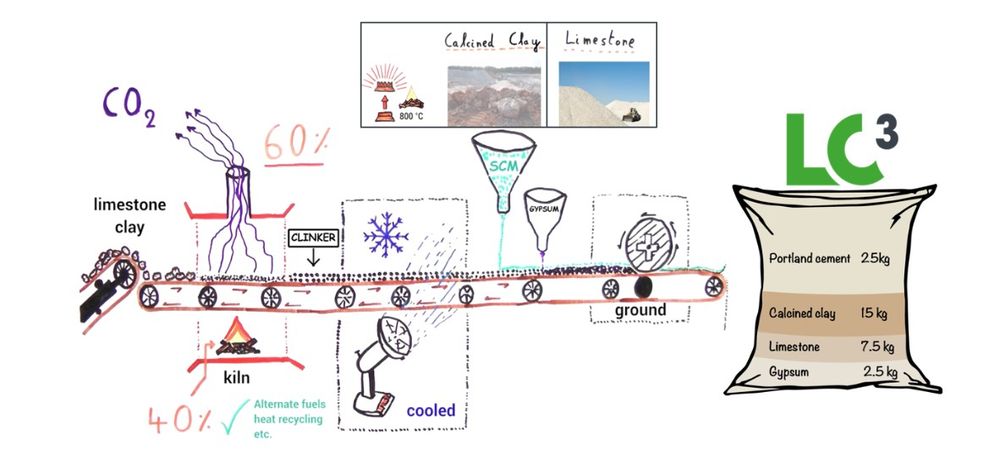
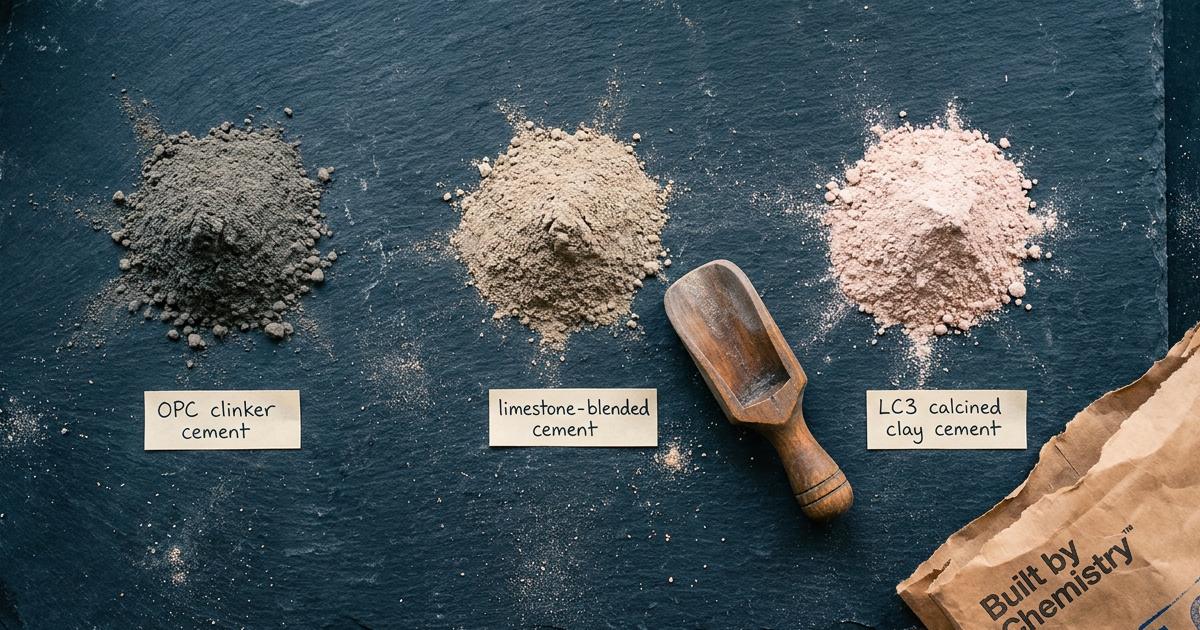
The chemistry behind it is the synergy between calcined kaolinitic clay and limestone. The calcined clay supplies reactive aluminates. The limestone, normally inert in plain OPC, reacts with those aluminates to form additional carboaluminate phases. Together they refill the porosity that would otherwise open up when half the clinker is removed. The result is a binder whose 28-day compressive strength is comparable to OPC made from the same clinker, with measurable improvements in durability — particularly in resistance to chloride ingress and sulphate attack, both well documented in Scrivener and colleagues’ 2018 review in Cement and Concrete Research.
The carbon arithmetic is straightforward. Cement clinker production releases roughly 0.56 tonnes of CO2 per tonne of clinker through the calcination of limestone alone, before fuel emissions are added — the process emission factor used in India’s own carbon trading scheme. LC3-50 substitutes half the clinker with materials whose energy and emissions footprint is a fraction of that. The result, as published independently by EPFL, RMI India and several IIT teams, is between 30 and 40% reduction in embodied CO2 per tonne of cement produced, depending on the source of the calcined clay and the local power mix.
The CCTS scheme — 186 facilities and what changes
On 16 April 2025, the Ministry of Environment, Forest and Climate Change notified the Greenhouse Gases Emission Intensity Target Rules 2025 under India’s Carbon Credit Trading Scheme (CCTS). The rules cover 282 plants across four hard-to-abate sectors. 186 of those plants are cement facilities. Each facility received a baseline GHG emission intensity from FY 2023-24 and a legally binding reduction target for FY 2025-26 and FY 2026-27.
The scheme is intensity-based, not absolute. Each facility’s target is measured in tonnes of CO2-equivalent per tonne of cementitious material. Facilities that beat their target earn Carbon Credit Certificates (CCCs) issued by the Bureau of Energy Efficiency. Facilities that miss it must buy CCCs on the compliance market or face penalties of twice the prevailing market price. Sectoral analysis published by Climate-Decode in early 2026 expects the cement sector to be a net supplier of credits — a structural surplus of roughly 27 to 33 lakh CCCs annually across FY 2029-30 scenarios, worth around ₹1,287 to ₹1,320 crore at the current price band of ₹830 to ₹1,000 per tonne.
The Union Minister for Power has indicated that the first compliance trades will take place by October 2026. The grandfathering window for facilities to invest, retrofit and start producing blended cements before they are graded against the baseline is therefore very short.
This is where LC3 stops being a research topic and starts being a survival question.
What the EPFL and IIT research actually shows
The research base is unusually well consolidated for a technology of this age. The foundational paper, Scrivener, Martirena, Bishnoi and Maity, Cement and Concrete Research 114 (2018), established the LC3-50 formulation as commercially equivalent to OPC at 28 days. A follow-up study by Avet and Scrivener, Cement and Concrete Research 107 (2018), mapped the dependence of hydration kinetics on the calcined kaolinite content of the clay. The work by Dhandapani and colleagues at IIT Madras, also in Cement and Concrete Research, demonstrated durability advantages of LC3-based concrete over both OPC and fly ash blended cement under aggressive exposure.
Two more recent papers shift the picture toward long-term performance. Zunino and Scrivener (2022), Cement and Concrete Research 153, tracked microstructural development of LC3 pastes over three years of hydration and showed continued strength gain well beyond the standard 28-day window. A 2025 review in Coatings (MDPI) synthesised seventy-plus studies and concluded that LC3 systems consistently match or exceed OPC in mechanical and durability terms once the clay reactivity is controlled, and that the remaining bottlenecks are industrial rather than scientific.
The Indian work has its own pedigree. IIT Delhi, IIT Madras and the Society for Technology and Action for Rural Advancement (TARA) have run a decade of trials on Indian clays, limestones and clinkers. Their published summary notes that limestones generally rejected for clinker production are perfectly suitable for LC3 blends, identifiable by weight-loss measurements between 700 and 800 °C combined with X-ray diffraction. That insight alone unlocks an enormous resource base on the books of every Indian cement company.
The Bureau of Indian Standards published IS 18189:2023 — Portland Calcined Clay Limestone Cement — Specification to give the technology a domestic regulatory anchor. The standard exists. The product can be sold under it. The market has not yet caught up to either.
Why India hasn’t adopted LC3 at scale
If the chemistry is settled and the standard is published, the obvious question is why the cement aisle of the building material shop in Jaipur this week still sells almost entirely OPC and PPC.
Four reasons, in roughly the order I see them on the ground.
The clay supply chain is informal. Kaolinitic clay reserves in India are well mapped, but the calcination infrastructure that turns them into a reactive supplementary cementitious material is mostly in the hands of the cement producers themselves. Setting up a flash calciner at a plant requires capital, permitting, and an integration plan with the existing kiln line. Few mid-sized producers have either the technical bandwidth or the financial appetite to take that step before the carbon price makes it obvious.
The customer asks for a brand. The buyer at the gate asks for “UltraTech” or “Ambuja” or “Shree”, not for an emissions intensity. As long as the bag on the shelf delivers grade 43 or 53 strength at the price point the market expects, the customer does not separate the chemistry. Blended cements have grown in India — PPC and PSC have eaten into OPC’s share over the last decade — but the blending is mostly with fly ash and slag, both of which are now becoming constrained as thermal power and steel sectors clean up.
The construction chemicals supply chain has not been tested. This is the part I see in my own laboratory. Tile adhesives, renders, repair mortars and waterproofing membranes are formulated and tested against OPC substrates. The pH profile, alkalinity, water retention behaviour and surface chemistry of an LC3-based screed are not identical to OPC. The differences are small enough that nobody is panicking, but they are not zero, and the data is thin. The cementitious adhesives I wrote about in my edition on the AAC blocks and tile adhesive mismatch needed reformulation when the substrate changed. The same conversation will happen with LC3 — only nobody has had it yet.
The economics until now did not justify the switch. Until the Hormuz blockade pushed pet coke costs up sharply — a development I covered in the Hormuz blockade and construction chemicals supply chain edition — OPC could absorb its own cost increases. With kiln fuel now structurally more expensive and CCTS adding a carbon liability to every tonne of clinker, the maths of substituting half the clinker with locally calcined clay shifts the other way.
What the largest producers have already committed to
The big cement groups are not waiting. UltraTech Cement Limited, the country’s largest producer at 116.8 MTPA, has committed under the Science Based Targets initiative to reduce Scope 1 GHG emissions by 27% per tonne of cementitious material by 2032, from its 2017 baseline, with Scope 2 falling by 69% over the same window. By FY 2024 it had already delivered a 16% Scope 1 reduction against that base.
Ambuja Cements, part of the Adani portfolio, holds an SBTi-validated near-term target of 20% Scope 1 reduction per tonne of cementitious material by 2030, from a 2020 baseline, alongside a 43% Scope 2 cut. Ambuja and ACC became, in June 2025, the first Indian cement companies to have net-zero targets validated by the SBTi for 2050.
These targets are not LC3-specific. They are technology-agnostic emission caps. But the cheapest, most scalable lever available to the integrated cement producers between now and 2030 — at the volumes the SBTi numbers imply — is clinker substitution at higher rates than current PPC and PSC blends allow. LC3 is the only published, standardised technology that achieves the substitution depth required without unproven supply chains.
What this means for construction chemicals R&D
Three questions are now sitting on the desk of every formulation chemist I know.
Does the adhesion of a polymer-modified mortar to an LC3 substrate match its performance on OPC? The early data from the IIT Madras work suggests yes within a measurable margin, but the test protocols used for adhesion classification under EN 12004 and IS 15477 were established against OPC reference substrates. The classification number on the bag, as I wrote in my edition on what construction chemicals datasheets don’t tell you, is only as good as the conditions in which it was measured.
Does the open time of a thin-bed adhesive change on a substrate with different water-retention properties? LC3-based screeds retain water differently from OPC, particularly during the first 24 hours. Open time is the variable most sensitive to substrate suction. This is the kind of question that needs to be answered with field-conditioned tests in Rajasthan summer, not laboratory data at 23 °C / 50% RH.
Are waterproofing membranes — both liquid-applied and sheet — compatible with LC3 substrates over their service life? This one I genuinely do not know. The chloride and sulphate resistance of LC3 itself is better than OPC’s. But the bond chemistry between the membrane and the substrate has not been mapped at the level it has been for OPC. The failure mode I documented in the edition on membrane bonding failures is interface-driven — and the interface against LC3 has barely been studied.
The companies that get the answers first will write the next round of datasheets for the construction chemicals industry in India. The companies that wait for somebody else to publish first will be selling against specifications they did not help define.
Next week — what C2TE-S1 actually means on a tile adhesive bag, decoded line by line.
The interface chemistry between these lower-clinker substrates and bituminous or synthetic waterproofing membranes is something I pick up directly in my edition on flat roof waterproofing and LC3 as a waterproofing substrate, using three peer-reviewed failure cases as the starting point.
— Guillermo
Ed #11 — what the C2TE-S1 classification means for tile adhesives on LC3-based substrates.
When LC3 changes the concrete’s capillary structure, it affects more than tile adhesive open time. Ed #13 looks at how the shift in surface porosity narrows the moisture window for liquid waterproofing membranes on LC3 substrates.
The market view of that same India construction shift is Part 3 of the membrane trilogy: another India construction shift — the market behind the premium bag.
- C2TE-S1: six characters, eight test methods, one classification most contractors cannot read
- Single buttering above 30-35 cm tiles: TCNA, BS 5385, DIN 18157, UNE 138002
- 70 metres of water. The hydrostatic head test India doesn’t require.