
Independent author of Built by Chemistry. Every edition sourced from EN / ANSI / BIS / ASTM standards or peer-reviewed literature. About →
Last winter, Mumbai basement. Contractor presentation. The product was a polyurethane liquid membrane. The site engineer asked one question: what’s the hydrostatic head rating?
The rep paused. Reached for his phone. Read a number off the international datasheet. Seven metres. Nobody in the room reacted. They moved on to coverage rates.
I’ve thought about that exchange a lot since.
Seven metres is the difference between a basement that survives a monsoon and a basement that doesn’t. It’s also a number that nowhere in the Indian regulatory landscape is anybody legally obliged to ask for, test for, or guarantee. The contractor read it from the international datasheet because the contractor wanted to sound credible. Not because the Indian code asked him to.
This edition is about that gap.
What is hydrostatic head and why does it matter for waterproofing?
Hydrostatic head is the pressure of a column of water, expressed in metres. A 10 metre head means the membrane is being pushed against by a column of water 10 metres tall. Multiply by roughly 9.8 kPa per metre and that’s your pressure load.
Every waterproofing application has a head requirement, whether the spec mentions it or not.
- A flat residential roof — 50 to 100 mm of ponded water in heavy rain. Under 0.01 m of head.
- A planter box terrace with 300 mm of soil and saturated drainage — up to 0.5 m.
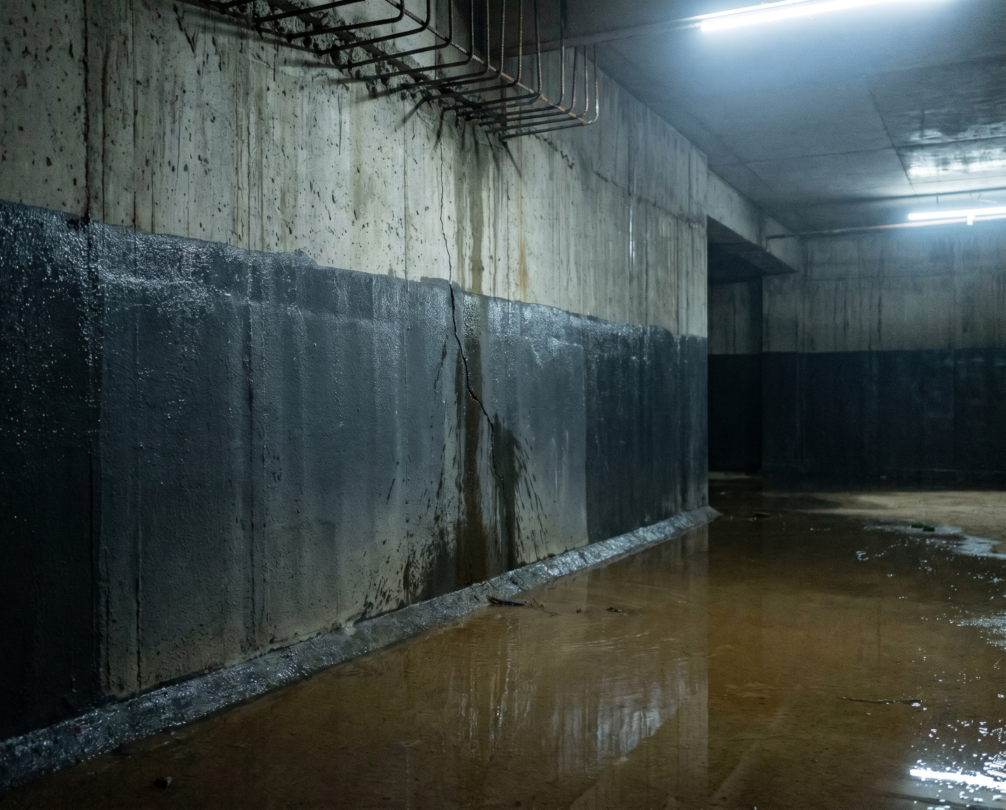
- A basement wall five floors below grade with a high water table — 5 to 10 m.
- A swimming pool floor — 2 to 3 m permanently.
The membrane either resists that head or it doesn’t. The chemistry doesn’t care what the brochure says. The wall behind the membrane doesn’t care either. What decides whether the application survives is whether the membrane was tested to a head higher than what the application will see — and tested in conditions that resemble reality.
There are two international test methods that do this. India has neither.
ASTM D5385: how the US tests waterproofing to 70 metres of water
ASTM D5385 is the American test for hydrostatic pressure resistance of waterproofing membranes. The current version is ASTM D5385/D5385M-25, published in 2025, superseding the 2020 revision. A passing result indicates the membrane resisted hydrostatic pressure equivalent to 231 feet — roughly 70.4 metres — of water head, without failure.
The procedure isn’t subtle. The specimen is clamped over a substrate with controlled gaps that simulate cracks. Water pressure is applied and increased stepwise every hour using compressed air. Leakage is monitored at specified intervals. To pass, the membrane has to bridge the simulated crack and resist increasing pressure without water tracking through.
A waterproofing membrane that passes ASTM D5385 is, by definition, capable of resisting any pressure load that a residential or commercial building will ever see in its service life. The test doesn’t say the membrane will survive — it says it can survive a worst case. That floor is what makes the rest of the specification meaningful.
EN 1928: the European version, with two pressure levels
EN 1928:2000 is the European equivalent for flexible waterproofing sheets — bitumen, plastic, and rubber. Unlike ASTM, EN 1928 doesn’t test to a single maximum pressure. It defines two methods.
Method A subjects the specimen to a pressure of 60 kPa for 24 hours — roughly 6 metres of water head. This is the procedure for low-pressure applications: low-slope roofs, vapour control layers, underlay sheets.
Method B is the high-pressure procedure. It uses a slotted disc to apply pressure directly to a specific area of the membrane, simulating a substrate crack under serious hydrostatic load. This is the test for submerged applications — basement tanking, water tanks, foundations below water table.
EN 1928 connects to a wider European framework. EN 13967 specifies plastic and rubber sheets for damp-proofing including tanking. EN 14891 covers liquid-applied waterproofing under ceramic tiling. EAD 030378-00-0605 covers fully bonded pre-applied sheets for basement waterproofing and uses procedure B of EN 1928 at minimum 60 kPa as its baseline.
The European framework forces the manufacturer to declare a head rating. The architect can then specify a minimum head for the application. The contractor can be held to it. The chain works.
What the Bureau of Indian Standards actually publishes for waterproofing
This is where the conversation gets uncomfortable for the Indian industry.
The relevant BIS standards on waterproofing sit under sectional committee CED 41 — Waterproofing and Damp-Proofing. The active codes of practice for residential waterproofing:
- IS 1346:1991 — Code of practice for waterproofing of roofs with bitumen felts. Last reaffirmed. Original text from 1991.
- IS 9918:1981 — Code of practice for in-situ waterproofing and damp-proofing with glass fibre tissue reinforced bitumen. Published in 1981.
- IS 3036:1992 — Code of practice for laying lime concrete for waterproofed roof finish.
- IS 1322:1993 — Specification for bitumen felts for waterproofing and damp-proofing.
- IS 1580:1991 — Specification for bituminous compound for waterproofing.
- IS 16532:2017 — APP modified bituminous waterproofing and damp-proofing membrane with polyester reinforcement.
Notice the dates. Most of the active Indian standards for residential waterproofing predate the year 2000. The newest one, IS 16532, covers a specific product format — APP modified bitumen — and is the exception that proves the rule.
What none of these standards do is require a hydrostatic pressure test as an acceptance criterion for residential waterproofing. They specify application methods, materials, and workmanship. Performance under pressure load is not the gating factor.
NBC 2016 — the national building code, updated by amendments in November 2024 and July 2025 — references the BIS standards for materials. It doesn’t add a separate hydrostatic performance requirement on top. The amendments have focused on fire safety, accessibility, seismic detailing, and energy efficiency. Residential waterproofing performance under hydrostatic load isn’t on that list.
So what gets tested in India? The product to its own BIS specification. The application to a code of practice from 1991. The system as a whole — membrane plus detail plus substrate, under pressure — gets tested by the monsoon.
Why the spec-to-install gap keeps producing failures
The Indian construction chemicals industry sells membranes that, on the international datasheets, list hydrostatic head ratings derived from manufacturers’ own EN 1928 or ASTM D5385 testing. The good companies do this voluntarily. They publish a number because the global customer base asks for it.
But the architect specifying the membrane on a Pune basement isn’t legally required to ask. The procurement manager comparing three Indian-made membranes isn’t required to verify the head rating. The contractor pouring the system into a slab isn’t required to demonstrate continuity of performance across the detail.
I see the consequence on site. I wrote about it in edition 5 on waterproofing failures and again in edition 2 on the wall on my morning drive. The pattern is the same. The membrane gets blamed. The membrane isn’t always the problem. But sometimes — and this is the part nobody wants to write down — the membrane is the problem, because nobody asked it to resist what it was being asked to resist.
A residential rooftop in Delhi with 200 mm of cement concrete topping and no drainage channels will pond water at any rainfall above 80 mm/hr. Several events of that intensity were logged in 2024 alone. The IMD Monsoon 2024 report documented 2,632 very-heavy and 473 extremely-heavy rainfall events — the highest in five years.
That’s a real pressure load on a real membrane. A membrane that has been tested to 60 kPa under EN 1928 Method A is fine. A membrane that has only been tested to the requirements of IS 1346:1991 — which doesn’t specify a hydrostatic test — is a coin flip.
Will BIS introduce a hydrostatic head requirement?
CED 41 — the BIS sectional committee for waterproofing — is the body that would have to introduce a hydrostatic head requirement. Sectional committees update standards periodically. New ISs do appear: IS 16532 in 2017 was one. Whether CED 41 introduces a performance test aligned with EN 1928 or ASTM D5385 in the next revision cycle is something I’d very much like to know. Publicly available information about its current work programme is limited.
What I can say is that the gap between what Indian standards specify and what international standards require is the same gap I keep pointing at in this newsletter. It’s the same gap I covered when I wrote about insulation and the missing spec in residential India. The chemistry exists. The trained applicators exist, in limited supply. What’s missing is the performance specification that forces everyone to declare a number and be held to it.
Until that changes, the contractor in the Mumbai basement will keep reading hydrostatic head ratings off the international datasheet because the Indian datasheet doesn’t have to print one. The building owner will assume the membrane is fine because it complied with IS 1346:1991. And nobody in the room will know whether the system can hold 7 metres of water, or whether it falls apart at 2.
What should an architect specifying waterproofing in India ask today?
Until BIS publishes a hydrostatic head requirement, the architect bears the responsibility. Three questions to put on every spec sheet:
- What is the declared hydrostatic head rating of the proposed membrane, in metres, tested to ASTM D5385 or EN 1928?
- What head rating does this application require — flat roof, planter terrace, basement wall, water tank?
- Does the system include the membrane plus the details plus the substrate, or only the membrane?
If the contractor can’t answer the first question, the conversation hasn’t started. If the contractor can answer but the architect didn’t write the number into the spec, the project hasn’t started either.
Next week — what a construction chemicals datasheet is actually trying to hide.
The Hormuz closure that broke those supply chains — and the RDP and HPMC shortages it forced into every Indian R&D lab — is the subject of edition 7 on the Hormuz supply chain shock.
The five things manufacturers leave off the datasheet — and how to read between the rows — is the subject of edition 8 on what construction chemicals datasheets don’t tell you.
The same gap between what the test measures and what the assembly actually does on site is the subject of my edition on flat roof waterproofing failures and EN 1928, where I look at three documented failures and the one test that would have caught them before year three.
— Guillermo
The hydrostatic head data from India I described here becomes the design baseline for a more complex failure. Ed #13 examines what happens when crystalline admixture and liquid membrane are combined on the same wall — and why W3-E design against W4-E reality is where the sequence problem starts.
Ed #14 follows the water into the concrete — the chloride front that builds up at the reinforcement, the IS 456 cover requirements that set the corrosion clock, and what EN 1504 repair classes mean once the damage has already started.
Part of the pillar
Waterproofing Systems — below-grade membranes, flat roof failures, and where every system fails at the interface. Read the full cluster overview.
- C2TE-S1: six characters, eight test methods, one classification most contractors cannot read
- LC3 cement: -40% CO2, same compressive strength. India's cement industry doesn't use it. Here's why.
- Single buttering above 30-35 cm tiles: TCNA, BS 5385, DIN 18157, UNE 138002