Independent author of Built by Chemistry. Every edition sourced from EN / ANSI / BIS / ASTM standards or peer-reviewed literature. About →
Last week I wrote about roofs. The interface that fails, not the sheet that passes. Same problem shows up underground. Bigger, wetter, more expensive to fix.
A friend who runs geotechnical for a Delhi developer sent me photos last February. Residential tower, three basement levels, water table one metre above the deepest slab. The design had a crystalline admixture in the concrete mix plus an acrylic-modified cementitious liquid membrane on the outside. Belt and braces. On paper it should have been bulletproof.
By month six the lower carpark had a slow perpetual weep at the construction joint between the raft and the vertical wall. Not a leak that ruined the finishes. The kind that shows up as a two-centimetre damp band across a hundred metres of parapet and nobody knows exactly when it started. Both waterproofing systems present. Both notionally correct. And the interface between them — that had never been thought through.
This edition is about the three ways to waterproof a basement wall, why combining them looks smart on the drawing, and the one thing that decides whether combination is defence in depth or defence in confusion.
Key takeaways
- Crystalline admixtures self-seal hairline cracks up to ~0,5 mm through insoluble needle-shaped calcium silicate hydrate crystals that grow in the presence of moisture. ACI 212.3R.
- DIN 18533-1:2017 defines 4 water load classes (W1-E to W4-E) for elements in contact with soil. Most Indian and Spanish pliegos don’t specify the class.
- BS 8102:2022 classifies basement waterproofing into Grade 1-3. Grade 3 (habitable) demands two independent forms of protection.
- EN 14891:2017 covers liquid-applied membranes beneath ceramic tiling — a below-grade equivalent still relies on national codes plus ETA (European Technical Assessment).
- Combined systems fail on sequence, not on chemistry. The crystalline needs capillary water to activate; the liquid membrane blocks capillary water. Applied too early, the “defence in depth” is one and a half systems.
What are the three ways to waterproof a basement wall?
Three approaches dominate below-grade construction in 2026. Each solves a different physical problem. Each has one specific failure mode you see three to seven years into service.
Crystalline admixture in the mix — chemicals blended into the concrete at batching, typically at 1-3 % by cement weight. The admixture reacts with calcium hydroxide and unhydrated cement particles in the presence of water to form insoluble crystals that block capillary paths. Recognised by ACI 212.3R Chapter 15 as a Permeability-Reducing Admixture, hydrostatic (PRAH). It’s the only system that doesn’t sit on a surface — it is the surface. It fails at construction joints and around penetrations.
Liquid-applied membrane on the positive face — a polymer or polymer-modified cementitious slurry brushed, rolled or spray-applied on the outside of the finished wall. Cures into a continuous film 1-3 mm thick, bonded to the substrate. Classified under EN 14891:2017 for tile applications; below grade it operates under national codes and ETAs. It fails by puncture during backfill or by adhesion loss on damp substrates.
Sheet membrane — a pre-formed HDPE, PVC or bituminous sheet mechanically fixed or self-adhered to the outside. Overlapping seams welded, taped or self-fused. Classified under EN 13967 for damp proof or EN 13969 for tanking. It fails at seams, at penetrations, and at the transition where it meets the horizontal slab.
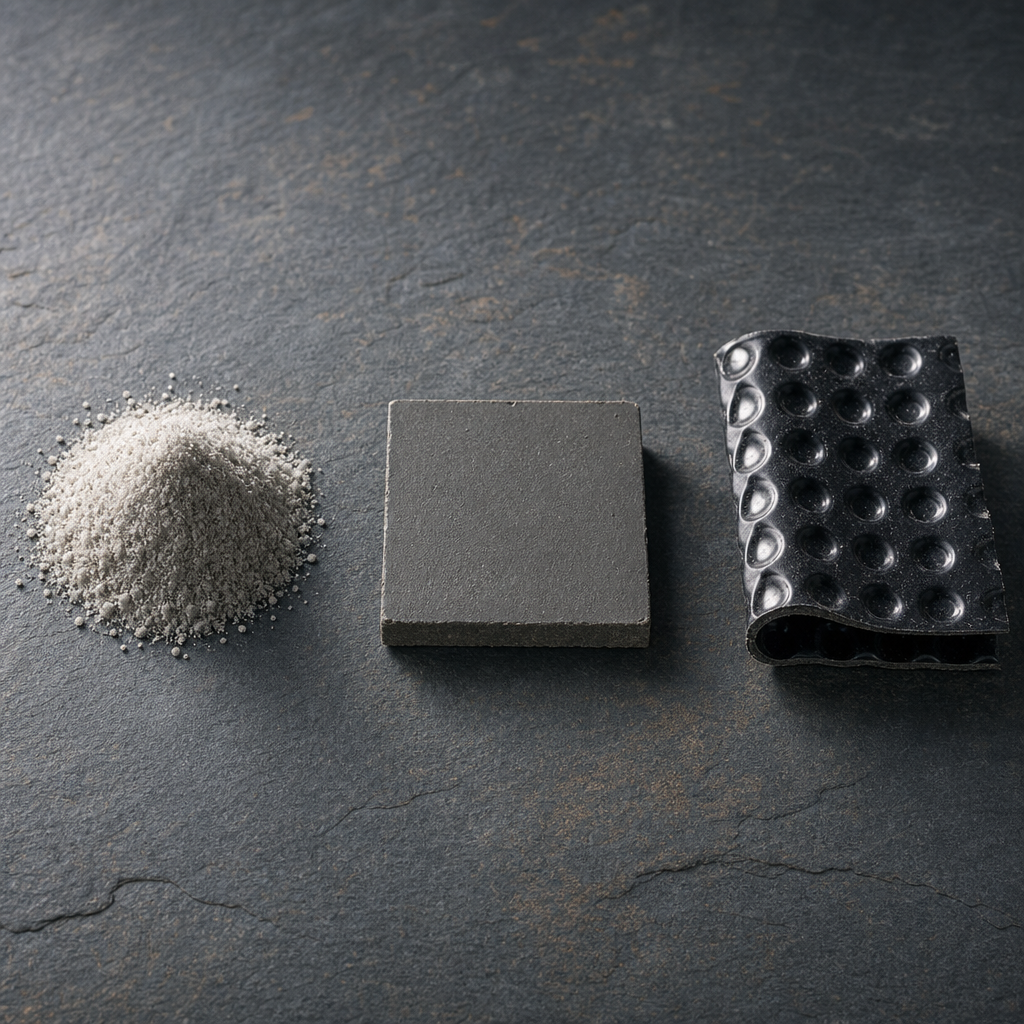
Every below-grade specification in the world uses at least one of these. The interesting question is what happens when you use two.
What does a crystalline admixture actually do?
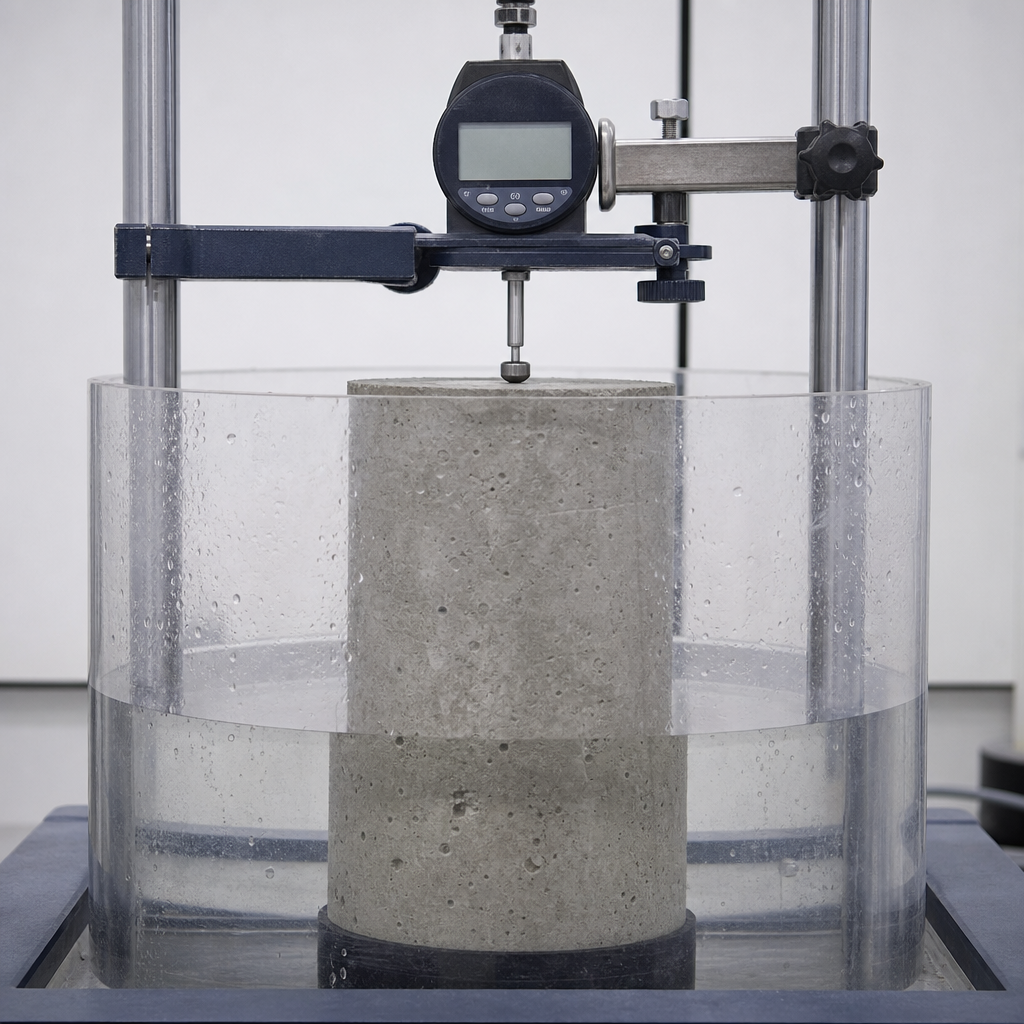
A crystalline admixture is a hydrophilic chemical that reacts with water and unhydrated cement to grow insoluble needle-shaped crystals in the capillary pores of concrete. The reaction closes pathways that water would otherwise use. It self-heals hairline cracks up to about ~0,5 mm wide when moisture reintroduces the reaction.
The chemistry sits between the cement itself. Not on top of it. That’s the key difference from every other approach — there is no substrate-to-membrane interface to fail.
When cement hydrates you get calcium silicate hydrate (C-S-H) as the main strength phase, plus a lot of calcium hydroxide (Ca(OH)₂) as a by-product. The Ca(OH)₂ is what crystalline admixtures react with. It converts what would otherwise be a chemically vulnerable, moisture-loving compound into insoluble crystal structures that physically block the capillary transport.
Pazderka and Hájková at Czech Technical University in Prague measured the effect in their 2016 Acta Polytechnica study. Their tests showed that crystalline admixtures reduce the water vapour permeability of concrete by 16-20 %, and that the full waterproofing effect becomes measurable around the 12th day after placement. Compressive strength at 2 % dosage stayed within noise of the plain reference at 28 days — you don’t pay for the waterproofing with structural performance. ACI 212.3R Chapter 15 documents the broader curing window of 21-28 days for the underlying pozzolanic and crystal-growth reactions to reach the designed self-sealing capacity across the pore network.
The catch is boring and structural. Construction joints have no cement matrix. The crystals grow inside the concrete pores; they cannot bridge the gap between two pours that were separated by twelve hours of curing. The kicker-to-wall joint, the base slab to vertical wall junction, the day-work joint on a large basement pour — these are where crystalline systems fail. Not the sheet of concrete. The joint between the sheets.
The industry answer is a hydrophilic swellable waterstop at the joint, a bentonite-based strip or a swelling polyurethane, installed before the second pour. It works when installed correctly and hydrated fully. It fails when it swells prematurely from rain during construction, or when installation is done by a subcontractor who has never been told what the strip is actually meant to do.
What does a liquid membrane actually do?
A liquid-applied waterproofing membrane forms a continuous polymer film adhered to the concrete face. It provides a barrier to liquid water plus a limited resistance to hydrostatic pressure — typically up to 0,5-1,5 bar depending on chemistry, thickness and substrate quality.
Two families dominate. Polymer-modified cementitious systems (PMC), where a cement powder is mixed with an acrylic or SBR latex to produce a semi-rigid coating. Reactive polymer systems — polyurethane, polymethyl methacrylate, or two-component epoxy — that cure by polymerisation into a fully flexible, chemically distinct film.
Both are chemically related to the polymer powders I wrote about in my edition on tile adhesive additives. Same VAE and SBR chemistry backbone, tuned for different service conditions. The one that survives the wetter substrate wins. Note that the substrate itself is a moving target too — as low-clinker LC3 cements enter Indian residential builds, the surface porosity and capillary drying profile of the concrete shift, and the moisture window for polymer application narrows with it.
The performance envelope of a liquid system depends almost entirely on substrate condition at application. Substrate moisture above 4 % by mass, or free water on the surface, and the polymer will not achieve full adhesion. This is where the Delhi tower I mentioned at the top fell apart. The crystalline admixture was fine. The acrylic-modified liquid over it was applied at week two of curing, when the concrete surface was still shedding water at the capillary level. The membrane adhered in patches. Six months later, water was tracking behind the membrane along the wet stripes and coming out at the joint.
The other failure mode is mechanical. Backfill against a liquid membrane at 200 mm below the top surface is what most contractors do. A stone in the backfill, a pointed shovel, a compaction plate not properly held off — and you have a 5 mm puncture that nobody sees because it’s underground and covered.
What does BS 8102 and DIN 18533 actually require?
BS 8102:2022 is the UK code of practice for protection of below-ground structures against water from the ground. It defines three grades of internal environment — Grade 1 for basic utility (seepage tolerated), Grade 2 for better utility (no water penetration but damp acceptable), Grade 3 for habitable (dry environment with active ventilation control). Grade 3 requires two independent forms of waterproofing protection — and that’s the standard most modern residential basements need to meet.
DIN 18533-1:2017 replaces the entire DIN 18195 series and introduces something the older code lacked: four water load classes (W1-E to W4-E). W1-E for capillary water and non-pressurised seepage. W2-E for moderately pressing water. W3-E for non-pressurised water from horizontal surfaces. W4-E for pressurised water — meaning permanent contact with a water column above the element. The standard is complete in three parts: Part 1 sets the load classes and general requirements, Part 2 covers bonded waterproofing systems, and DIN 18533-3:2017 addresses sheet waterproofing elements. Every waterproofing product is classified against these load classes. The pliego either specifies the class or the contractor picks one that hits the price target.
Most Indian and Spanish pliegos I’ve read pick a system by product name, not by exposure class. That’s a large part of why the same product on the same building gives different results in the M-30 tunnel than it does in a hillside villa near Alicante.
The classification exists. The specification rarely uses it.
Why the combination fails on site — the sequence problem
The theory of combining crystalline admixture with a liquid membrane is clean. Crystalline handles the concrete body; membrane handles the joints and the substrate face. Defence in depth. Two independent barriers between the water table and the interior finish. The hydrostatic head test data from India I covered earlier this year shows exactly what a single-barrier system delivers in W3-E conditions — enough of the time to look correct, not enough of the time to be design-safe.
The practice depends on one variable the drawings never show: the order and the gap in time between the two systems being applied.
Crystalline admixture activates through capillary water transport. Pazderka and Hájková measured the full waterproofing effect at 12 days; ACI 212.3R sets the practical design window at 21-28 days for the reaction to grow crystals into the pore network and reach the designed self-sealing capacity. During this window the concrete surface is expected to remain damp enough for the reaction to complete.
The liquid membrane requires the opposite condition. Its adhesion depends on substrate moisture below the manufacturer’s limit — usually 4 % — with no free water at the surface.
These two conditions are incompatible in time. If you apply the liquid membrane too early, you starve the crystalline reaction of the moisture it needs to develop. The self-sealing capacity — the whole point of adding the admixture — never fully activates. You’ve paid for two systems and you have one and a half.
If you delay the membrane long enough for the crystalline to fully activate (say five to six weeks), the schedule takes a hit that most developers won’t absorb without a fight. So the membrane goes on early, the crystalline underperforms, and the assembly looks correct on the completion certificate. The failure shows up years later, at the joint that was supposed to be redundantly protected.
The sequence problem is what killed the Delhi tower. Two systems on the drawing. One and a bit in reality.
The hydrostatic case — one metre of water column
Below the water table, hydrostatic pressure is unavoidable. Every metre of column adds ~9,81 kPa — call it 0,1 bar. A basement wall sitting one metre below the local groundwater sees a permanent load of about 0,1 bar acting through every square metre of surface. Not much per square metre. Multiplied by 200 square metres of wall face, it’s twenty tonnes of force pressing water into every capillary path.
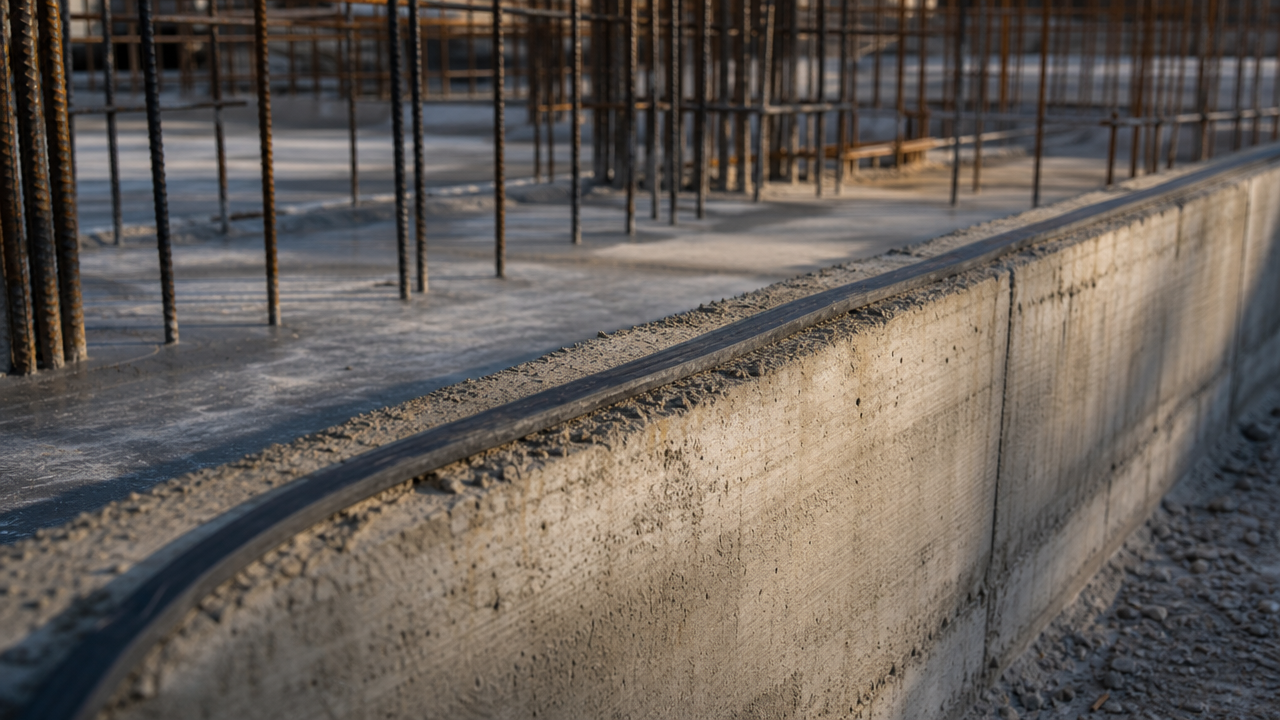
This is where the DIN 18533-1:2017 W4-E class comes in and where the BS 8102:2022 Grade 3 double-barrier requirement earns its keep. A single membrane, however well applied, has a finite chance of a small defect. The crystalline system compensates for local defects by self-sealing the concrete matrix. The combination — when it actually works — provides genuine belt and braces.
The Delhi case had W3-E design and W4-E reality. That distinction alone was worth the whole conversation.
Three procurement questions that change the outcome
What DIN 18533 water load class or BS 8102 grade is specified, and does the design match it? A pliego that names two waterproofing systems without naming the exposure class or the water table depth is half a specification. Ask for the geotechnical report line that establishes the design water level. It costs nothing to add. It changes what the contractor prices.
What is the sequence between the crystalline activation window and the liquid membrane application, and who owns the delay? The 21-28 day crystalline curing window is real. The membrane application schedule needs to accommodate it or the redundancy is fictional. In every project I’ve walked, this line is missing from the method statement and the site manager makes the call the morning of application.
Will an independent moisture and adhesion pull-off test be run on the assembled system before backfill? Two tests. Substrate moisture at four points per hundred square metres before membrane application. Pull-off adhesion on the cured membrane at 28 days. Cost per project is trivial. Failure to run either one leaves everyone on the same phone call at year three.
Next week — the membrane is doing its job. The concrete behind it is being eaten by chloride ions. The most expensive failure in the building has already started. Nobody can see it from outside.
— Guillermo
That edition is now published. Ed #14 — Concrete cover is a corrosion clock — takes the chloride mechanism apart: Fick’s second law, IS 456 cover requirements, and what EN 1504-3 R1–R4 repair classes mean when the steel has already started to corrode.
Part of the pillar
Waterproofing Systems — below-grade membranes, flat roof failures, and where every system fails at the interface. Read the full cluster overview.
Ed #18 opens the membrane trilogy — what’s actually inside that flexible layer: how a polymer-modified mortar becomes a flexible membrane, why “flexible” has a temperature, and the EN 14891 O-class that decides whether it survives a cold morning.
Related — the standards side: Edition #19 lines up how five regions (EU, US, AU/NZ, China, India) certify the same flexible cementitious membrane — and why the numbers don't convert. Which standard the membrane answers to matters as much as the system it sits in.
- The flat roof that leaks at year three. Three real cases. One test nobody runs.
- Waterproofing Failures Are Almost Never the Membrane's Fault