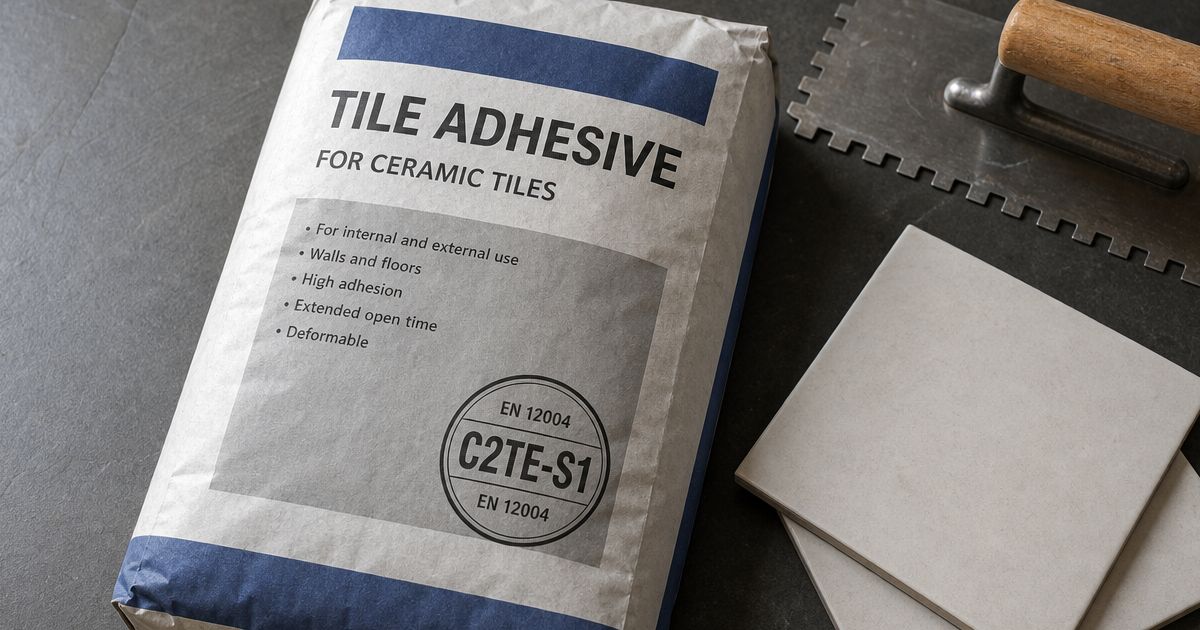
Three months ago I wrote about a procurement manager who sent me three technical datasheets for what he believed was the same tile adhesive. All three carried the same classification stamp on the bag — C2TE-S1, EN 12004. All three reported the same headline tensile adhesion: 1,0 N/mm². He wanted to know which one to specify.
I asked him three questions about the substrate, the curing condition and the test method used. Within ten minutes he had identified two of the three products as essentially undefined claims. The classification was not lying. The classification was simply silent on everything that mattered.
This edition is about how to read a tile adhesive classification line by line — what the EN 12004-1:2017 standard actually obliges the manufacturer to declare, and what it leaves at the manufacturer’s discretion.
What EN 12004 actually is
The European standard for ceramic tile adhesives is published in two parts. EN 12004-1:2017 sets the requirements, the classification system, and the marking rules. EN 12004-2:2017 specifies the eight test methods used to verify the declared performance. Together they form the regulatory anchor cited on almost every tile adhesive bag sold in Europe and, increasingly, across India and the Middle East where local codes either adopt them directly or harmonise with them through the ISO 13007 series.
The standard recognises three families of adhesive: C (cementitious) powders mixed with water on site, D (dispersion) pastes ready for use straight from the bucket, and R (reaction resin) two-component systems based on epoxy or polyurethane chemistry. The classification structure I am going to decode in this edition — C-number-letters-S — applies to the cementitious family, which accounts for the vast majority of the bagged adhesive market in residential and commercial tile installation.
A point worth stating up front. Every test in EN 12004-2 is run under controlled laboratory conditions: (23 ± 2) °C, (50 ± 5) % relative humidity, air velocity below 0,2 m/s, on a reference polished concrete slab at least 35 mm thick with surface water absorption between 0,5 and 1,5 cm³ in four hours. The classification on the bag is true under those conditions. The question of whether it is also true at 42 °C and 22 % humidity on an AAC block, which is to say on a typical Rajasthan summer site, is the question the bag does not answer.
The C — Cementitious
The first letter declares chemistry. C means the binder is hydraulic cement — typically white or grey Portland — mixed with sand graded for thin-bed application, supplemented with hydratable additives. The two additives that do almost all the heavy lifting in modern cementitious adhesives are cellulose ethers (MHEC and MHPC, methyl-hydroxyethyl and methyl-hydroxypropyl celluloses respectively) for water retention and rheology, and vinyl acetate-ethylene (VAE) redispersible polymer powders for adhesion, flexibility, and bond strength to non-porous substrates such as porcelain. The companies producing these speciality additives at industrial scale are mostly European and Asian — Wacker, Celanese, Shin-Etsu, SE Tylose — and the development of modern tile adhesive chemistry tracks the publication history of their patents far more closely than it tracks any building code.
D adhesives, by contrast, are organic-binder pastes that never see hydraulic chemistry, and R adhesives polymerise without water at all. The trade-offs are predictable: C is cheap, durable on cement-based substrates, and demanding on application; D is forgiving but limited to dry interior work; R is the most powerful and the most expensive. Above ninety percent of the world’s tile installation is C. The rest of this edition focuses there.
The 1 vs 2 — adhesion strength threshold
The number that follows the C is the most quoted, most checked and most misunderstood part of the classification. It declares the minimum tensile adhesion strength measured by the test in EN 12004-2 §8.3: a 50 × 50 mm dolly bonded with the cured adhesive to a porcelain tile, pulled perpendicular to the substrate after 28 days at the reference conditions.
C1: tensile adhesion ≥ 0,5 N/mm²
C2: tensile adhesion ≥ 1,0 N/mm²
The number is a minimum, not a typical value. As I argued in my edition on what construction chemicals datasheets don’t tell you, the headline figure is the worst batch the producer is willing to ship — not the median performance. A confident manufacturer running tight quality control will routinely produce 1,3 to 1,5 N/mm² on the same C2 line, and will share the typical value plus the standard deviation with a customer who asks. A manufacturer hedging marginal compliance will print “≥ 1,0” and refuse to discuss the distribution behind the number. The refusal is itself useful information.
The 28-day clock matters too. C2 at 28 days is one number. C2 at the seven-day mark — the age at which the contractor often hands over the work and the developer signs the cheque — is a substantially lower number, typically 60 to 75 % of the 28-day value. The classification does not require disclosure of intermediate ages.
The T — reduced slip
The letter T means the adhesive resists vertical slip under load. The test in EN 12004-2 §8.2 takes a 100 × 100 mm porcelain tile, presses it into a freshly combed bed of adhesive applied to a vertical substrate, immediately attaches a 5 kg weight to the tile, and measures how far the tile has slid downwards after a specified time. To earn the T classification the slip must be ≤ 0,5 mm.
T is not “no slip”. T is “slip below half a millimetre under standard test conditions”. For a 100 × 100 mm tile that distinction is academic. For a 600 × 600 mm porcelain panel weighing several kilograms, mounted on a vertical wall in a Mediterranean summer, the same chemistry can produce visible alignment errors as the row of tiles drifts during the open time of the next row. Without T, large-format vertical installation is a category of work the adhesive is not formulated for.
The chemistry behind T is mostly a balance between cellulose ether viscosity grade — the parameter manufacturers describe as “modification” — and the fine fraction of the sand grading. A highly modified MHEC raises the yield stress of the fresh mortar to a value where the static weight of the tile no longer exceeds it. That same modification, as the published guidance from cellulose ether producers makes clear, also delays the cement hydration kinetics by several hours.
The E — extended open time
The letter E means the adhesive maintains bond strength after a longer-than-standard wait between combing the adhesive onto the substrate and pressing the tile into it. The test in EN 12004-2 §8.1 combs the adhesive at time zero and places the porcelain tile at 30 minutes. After 28 days of curing under the reference conditions, the tensile adhesion must remain ≥ 0,5 N/mm².
The trap is the reference conditions. Open time is the variable most sensitive to ambient temperature and relative humidity. The same E-classified adhesive that holds 30 minutes at 23 °C / 50 % RH can have an actual on-site open time of 8 to 12 minutes at 42 °C and 22 % RH — Rajasthan in May, Murcia in August, Phoenix at any time. The classification stays valid. The conditions for which it is valid disappear from the wall.
I have seen entire bathroom installations debond at the 18-month mark for exactly this reason. The product was C2TE-S1. The applicator worked to the bag claim. The bag claim was true under conditions that did not exist on the job.
The S1 vs S2 — deformability
The S-class is measured by the transverse deformation test in EN 12004-2 §8.6, cross-referenced to EN 12002. A cured adhesive specimen 280 × 45 mm is flexed to failure under three-point bending. The deflection at the moment of break is the deformation value.
S1 (Deformable): deflection between 2,5 and 5 mm
S2 (Highly deformable): deflection greater than 5 mm
S1 is what every major installation code I cited in my edition on single buttering above 35 × 35 cm effectively requires for large-format porcelain, for substrates with movement such as gypsum boards or screeds over underfloor heating, and for any tile-over-tile renovation. The chemistry that achieves S1 is the polymer powder content: VAE redispersibles at 2 to 5 % by mass of the dry adhesive, with the polymer film bridging the cement microstructure and absorbing the strain that would otherwise crack the bed.
S2 is the territory of exterior facades, ETICS systems, swimming pools and any application where thermal cycling, sustained loading or freeze-thaw exposure is part of the service life. The polymer content for S2 typically reaches 5 to 8 %, with the choice of polymer Tg — the glass transition temperature — tuned to ensure the film remains flexible across the service temperature range. For exterior cladding in northern Europe the formulation tracks one set of parameters; for vertical work in Indian summer, another.
The chemistry I wrote about in my edition on the AAC blocks and tile adhesive mismatch becomes critical here. An S1 adhesive on a high-suction AAC substrate without proper substrate priming or formulation adjustment will lose the polymer film to capillary absorption faster than the cement can hydrate around it. The S1 classification on the bag is valid. The S1 performance on the wall depends on what happens in the first thirty minutes of contact. The same warning will apply to the LC3-based substrates I covered in my edition on LC3 cement and CCTS in India — pH profile, alkalinity and water-retention behaviour of LC3 screeds differ from OPC, and the S-class chemistry has to be re-validated against that substrate before any spec relies on it.
What the classification does NOT tell you
Five things the classification does not oblige the manufacturer to publish:
One — the curing conditions on site. The lab is 23 / 50. The site is whatever the season decides.
Two — the typical value and the standard deviation. The classification is the floor, never the centre.
Three — the substrate used in the reference test. The default is polished concrete slab. AAC, gypsum, render rugoso and tile-over-tile all return significantly lower numbers — sometimes 20 to 40 % below the headline figure.
Four — the coverage rate actually achieved. A bag specifying 95 % coverage minimum under wet conditions cannot deliver its classification when single-side troweling produces 60 % bed contact on a 60 × 60 cm porcelain.
Five — batch-to-batch variation. Internal quality-control data from cellulose ether and polymer powder suppliers routinely shows ±15 to ±25 % variation in tensile adhesion between production batches of the same product code. The classification covers the worst batch the producer will ship. It says nothing about the batch you actually receive.
Three procurement questions that change the spec
What classification is specified, and against which substrate? A pliego that names only “C2TE-S1” without naming the substrate is half a specification. The manufacturer is entitled to default to polished concrete slab for the supporting data.
What is the internal typical value and the standard deviation from the last twelve months? A confident producer will share. A hedging producer will refuse. Either answer is informative.
Will a 1 m² site-conditioned trial be run before the work begins? Substrate, adhesive, tile, ambient conditions — all real. The trial costs almost nothing. The callback when the bag claim does not match the wall costs everything.
Next week — polymer-modified vs sand-cement adhesives: when the upgrade is real and when it is brand differentiation.
— Guillermo
Frequently asked questions
What does C2TE-S1 mean in EN 12004?
C2TE-S1 is a European classification for cementitious tile adhesives. C = cementitious binder, 2 = high adhesion strength (≥1 N/mm² after conditioning), T = reduced slip, E = extended open time (≥30 min), S1 = deformable adhesive (5-2,5 mm transverse deflection). It is the standard specification for large-format tiles on cement or gypsum substrates that will see thermal or structural movement.
When should you specify C2TE-S1 instead of plain C2TE?
Specify S1 when the substrate or tile assembly is expected to move — large-format tiles above 30×30 cm, radiant floor heating, substrates prone to thermal expansion (terraces, façades), or substrates that will still shrink after tiling (young concrete under 6 months). Plain C2TE without a deformability class is intended for stable substrates and small formats.
What is the difference between S1 and S2 deformability class?
S1 = deformable adhesive with transverse deflection between 2,5 mm and 5 mm on a mortar prism test (EN 12002). S2 = highly deformable, above 5 mm. Both classes absorb differential movement between tile and substrate; S2 is required only for very large-format porcelain (>60×60 cm), swimming pools, or extreme substrates. Specifying S2 when S1 is enough usually raises cost without adding real performance.
What does the T in C2TE-S1 stand for?
T means reduced slip, tested to EN 1308. A T-classified adhesive holds a 5 kg tile on a vertical surface without sliding more than 0,5 mm after application. It is the property that lets you set wall tiles top-down without spacers falling. T is not automatic — a C2E without T can slip on vertical work and cause line-up problems.
Why do most Spanish pliegos misuse EN 12004 codes?
Most Spanish specifications name a commercial product instead of the EN 12004 class it corresponds to. That leaves the contractor free to substitute a lower class than the site actually needs. The correct practice is to write the class (for example C2TE-S1 for large-format tile on heated screed) into the specification, plus the substrate condition and tile format, and let the product name be a compatible commercial reference — not the specification itself.
Ed #15 opens the T in C2TE-S1 — the slip test EN 1308 that earns that designation, the rheology of thixotropy that makes it possible, and why the same paste behaves differently once the wall runs at 35 °C.
Part of the pillar
Tile Adhesive Technology — how to read the datasheet, decode the class, and specify the right product. Read the full cluster overview.