Independent author of Built by Chemistry. Every edition sourced from EN / ANSI / BIS / ASTM standards or peer-reviewed literature. About →
I spent this week running material demonstrations for tile-adhesive distributors in India. Trowel in hand, tiles on a vertical board, the room at close to 35 °C with the humidity you get before the monsoon breaks. And I lost count of how many times the same confusion came up. Someone would watch the paste go soft under the notched trowel, snap back when the trowel lifted, hold a heavy porcelain tile dead still on the wall — and call it “open time.” Or “setting time.” Or “the gel.”
It isn’t any of those. What they were watching is thixotropy, and almost nobody in that room could define it, even the ones who sell it every day.
That gap matters, because thixotropy is the single property that decides whether a wall tile stays where you pressed it or slides a quiet centimetre down onto the row below while your back is turned. This edition is the first of three on how tile adhesives are actually tested. We start here, with the one word the whole industry uses and most of the industry gets wrong.
Key takeaways
- Thixotropy is a reversible, time-dependent drop in viscosity under shear, with recovery on rest. Not the same as ordinary shear-thinning — the time dependence and the recovery are what define it (Barnes, 1997; NIST SP 960-3).
- The “cream effect” is thixotropy at work: under the trowel the paste flows and is easy to adjust; the instant the force stops, its structure rebuilds and it holds the tile’s weight.
- A wall tile imposes a shear stress of τ = ρ·g·t on the fresh adhesive — density × gravity × thickness. It runs from ~112 Pa (light 6 mm ceramic) to ~530 Pa (a 20 mm stone slab), and it is independent of the tile’s face size.
- Slip is the field test for it. EN 1308 (run inside EN 12004-2:2017 §8.2): comb the adhesive, place a tile, wait, measure the slide. The “T” class means slip ≤ 0,5 mm.
- Thixotropy is formulated, not bought. It is tuned by the sand grading and fines, by thickeners, and above all by the cellulose ethers (MHEC / HEMC / HPMC).
- Temperature rewrites the datasheet. A cellulose ether’s thickening is far stronger at 40 °C than at 20 °C, and the dose has to be re-tuned to suit (Ling et al., 2025). A slip figure measured at 23 °C tells you little about a wall at 35 °C and 90 % RH.
What is thixotropy, exactly?
Thixotropy is the reversible, time-dependent reduction in viscosity of a material held under constant shear — and, just as importantly, its recovery when the shear stops. Shake it or trowel it and it thins; leave it alone and it thickens back. Both directions, repeatable.
The time dependence is the whole point, and it is where most definitions fall over. A simple shear-thinning fluid — ketchup is the tired example — drops its viscosity the instant you increase the shear rate and recovers it the instant you stop. That is pseudoplasticity, and it has no clock. Thixotropy adds the clock: the structure takes measurable time to break down under shear and measurable time to build back up at rest. In a tile adhesive that rebuild time is what lets you place a tile, step back, and watch it stay put as the paste stiffens underneath it.
The canonical definition comes from Barnes’ 1997 review in the Journal of Non-Newtonian Fluid Mechanics, and from the NIST guide to dispersion nomenclature (Hackley & Ferraris), which fix it precisely so the word stops being used loosely: a reversible, isothermal, time-dependent decrease in viscosity under flow. Everything a distributor calls “the gel” or “the body” is a loose shorthand for this one measurable thing.
Where did the idea come from?
Thixotropy was discovered in 1923 and named in 1927 — not in a mortar lab, but in colloid chemistry, watching iron-oxide gels turn to liquid when shaken and set again on standing. The construction industry inherited the concept a long way downstream.
The observation belongs to Schalek and Szegvári, working in Herbert Freundlich’s laboratory at the Kaiser Wilhelm Institut in Berlin. They found that aqueous iron-oxide gels became completely liquid on gentle shaking — indistinguishable from the original sol — and then solidified again after a rest, the cycle repeating without any permanent change to the material. Four years later, in 1927, T. Péterfi gave it a name, stitching together the Greek thixis, a touch or a stirring, and trepo, to turn. Touch it and it turns. By 1935 Freundlich had written an entire book, Thixotropie, on the phenomenon.
A century later the same reversible gel-to-liquid-to-gel behaviour is what a tiler leans on every time the trowel touches the mortar. The chemistry is different — cement, sand, cellulose, polymer instead of iron-oxide sol — but the physics Péterfi named is exactly the physics on the wall.
Why does a tile stay on the wall?
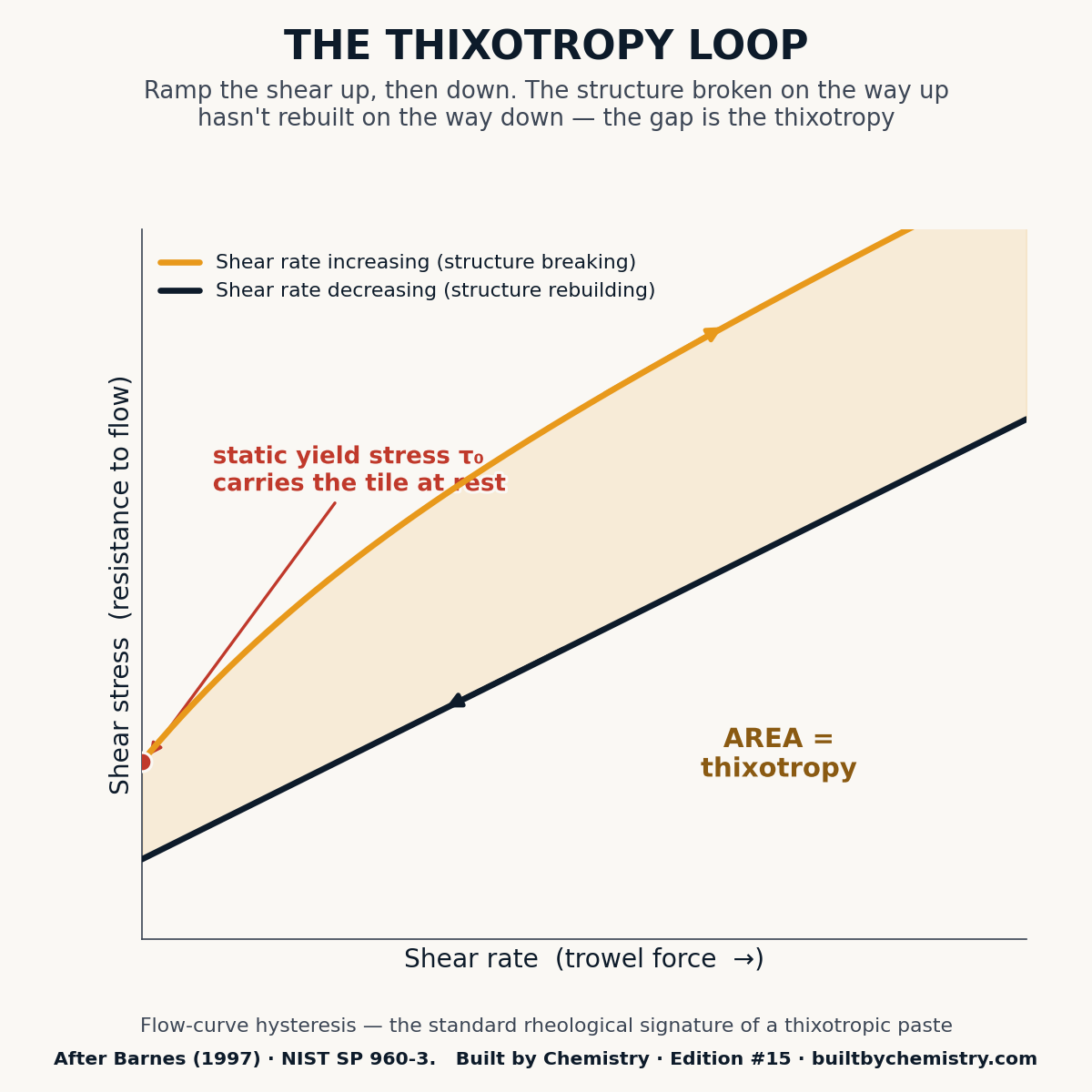
Because the adhesive’s static yield stress at rest is higher than the shear stress the tile’s own weight imposes. The tile hangs on a paste that has, in the seconds after placement, rebuilt enough internal structure to carry it.
Here the numbers are worth deriving, because they turn a vague “it holds” into something you can specify. A tile bonded to a vertical wall pulls down under gravity. The shear stress on the fresh bond line is its weight divided by the bonded area:
τ = F / A = (ρ · A · t · g) / A = ρ · g · t
The bonded area cancels. The shear stress a wall tile imposes on the fresh adhesive depends only on the tile’s density (ρ) and its thickness (t) — not on how big its face is. Run the numbers:
| Tile | ρ (kg/m³) | Thickness | Shear stress τ = ρ·g·t |
|---|---|---|---|
| Light ceramic wall tile | 1 900 | 6 mm | ~112 Pa |
| Porcelain 60 × 60 | 2 350 | 10 mm | ~231 Pa |
| Large-format porcelain 120 × 60 | 2 400 | 12 mm | ~283 Pa |
| Natural stone slab | 2 700 | 20 mm | ~530 Pa |
| Thick granite step riser | 2 750 | 30 mm | ~809 Pa |
The static yield stress of the fresh mortar has to clear these numbers, or the tile creeps. Two things the table makes obvious. First, a giant thin porcelain sheet is not, per unit area, harder to hold than a small one of the same thickness — the physics doesn’t care about the face size. Second, thickness and density are brutal: a 20 mm stone slab asks nearly five times what a 6 mm ceramic does. And the moment the contact is partial rather than full — the coverage problem I wrote about in the single-versus-double buttering edition — the denominator shrinks and the real shear stress climbs. At 60 % contact, that 283 Pa large-format tile is really imposing closer to 470.
So the adhesive has to do two contradictory things. Flow easily under the trowel so the tiler can bed and adjust the tile — low viscosity under high shear. Then, within seconds, rebuild a static yield stress above a few hundred pascals so the tile doesn’t move — high viscosity at rest. That contradiction, resolved in time, is thixotropy. Static yield stress to hold; low dynamic viscosity to place. The gap between them is the working window.
How do you actually measure it?
In the lab, with a rheometer tracing a flow curve; on site, with the slip test. The two answer different questions — one quantifies the structure, the other tells you whether the tile will move.
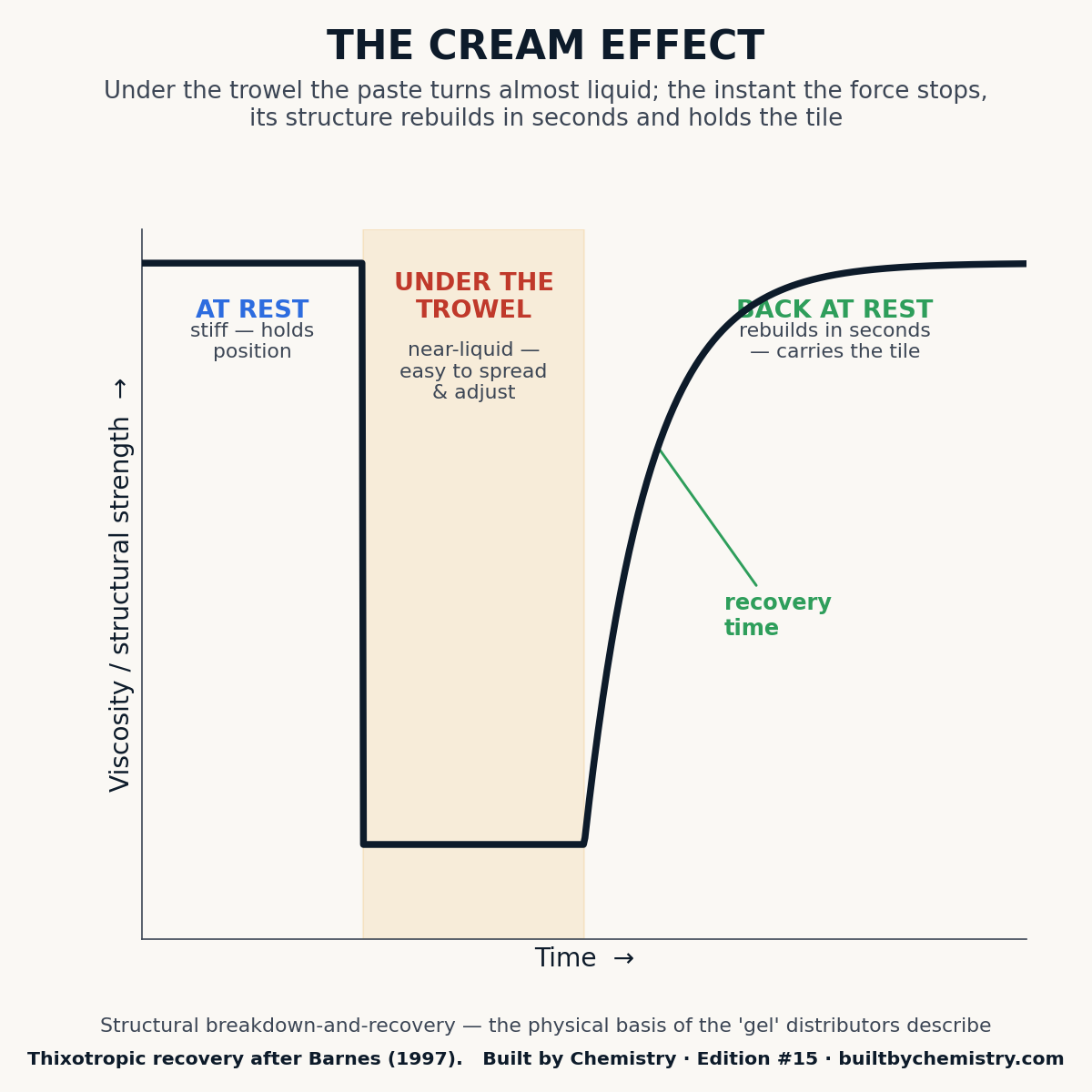
In a rheometer you ramp the shear rate up and then back down and plot shear stress against shear rate. A thixotropic material traces a hysteresis loop: the down-curve sits below the up-curve because the structure broken during the ramp-up hasn’t fully rebuilt by the ramp-down. The area inside that loop is the standard measure of how thixotropic the paste is. A second, more physical test holds the material at high shear to break it down, then drops to near-rest and watches the viscosity climb back — the structural recovery curve. That recovery is the “snap-back” the distributors were watching, made into a number.
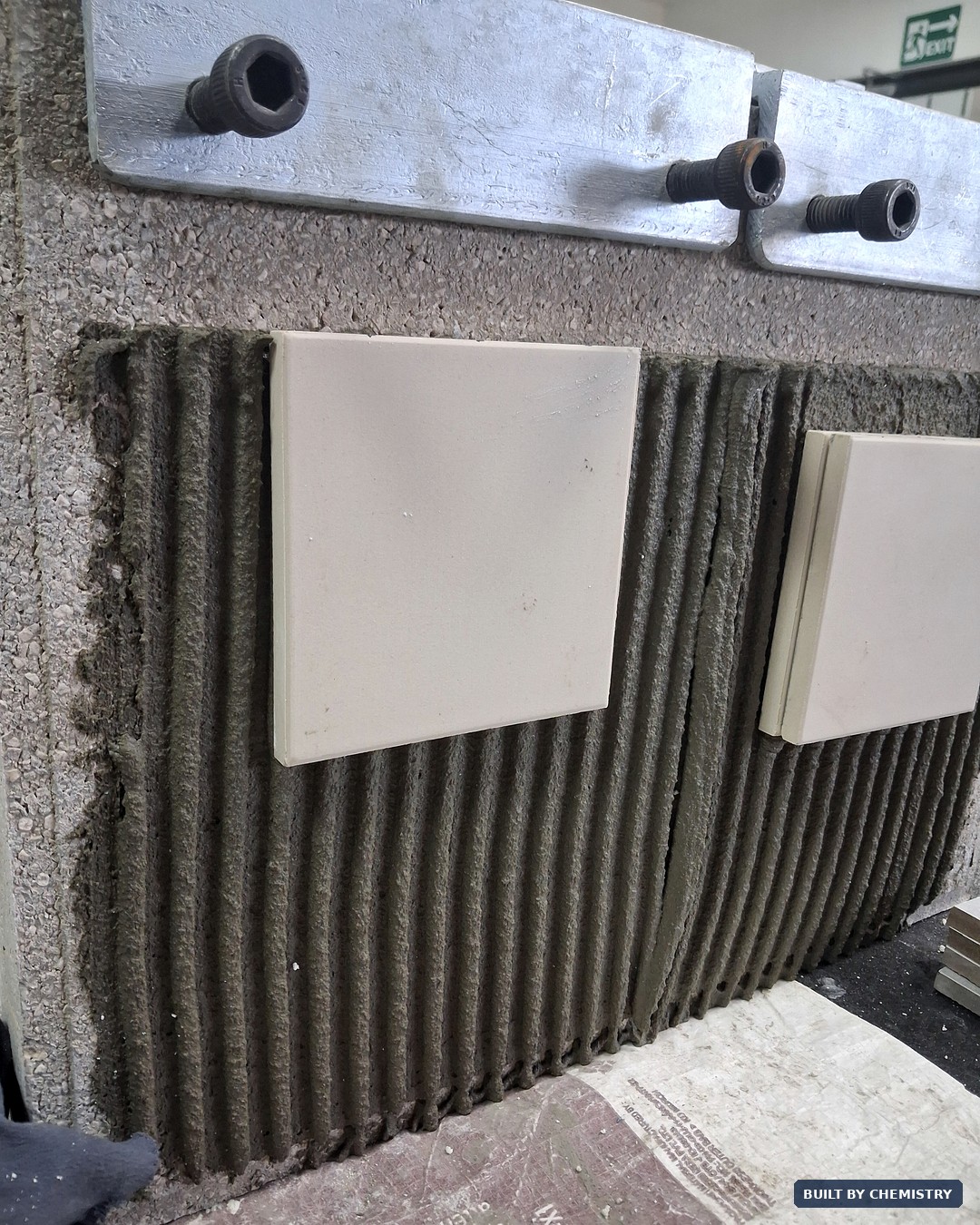
On site nobody runs a rheometer, so the industry uses slip. The method is EN 1308, now folded into EN 12004-2:2017, §8.2: spread and comb the adhesive, place a tile, and measure how far it slides down over a fixed time. If the slide is 0,5 mm or less, the adhesive earns the “T” designation in the EN 12004 classification — the same T that sits inside C2TE-S1 and every code I decoded in the classification edition. India’s IS 15477:2019 defines slip the same way, as the downward movement of a tile embedded in the combed layer.
There is also a neat halfway measure some researchers use: applying the fresh paste between two plates and reading how much its structure resists spreading, reported as a thixotropy percentage. A 2024 study using waste quartzite from Alwar in Rajasthan as the aggregate reported fresh-dough thixotropy values of 82–93 % by this two-plate method — high enough that the pastes held and tiled cleanly. It is a reminder that thixotropy is measurable, comparable, and real, not a marketing adjective.
What actually controls thixotropy in a tile adhesive?
Three formulation levers, working together: the sand grading and fines, the thickeners, and the cellulose ethers. None of them acts alone — thixotropy is the emergent behaviour of the whole packed, hydrated, polymer-bridged system.
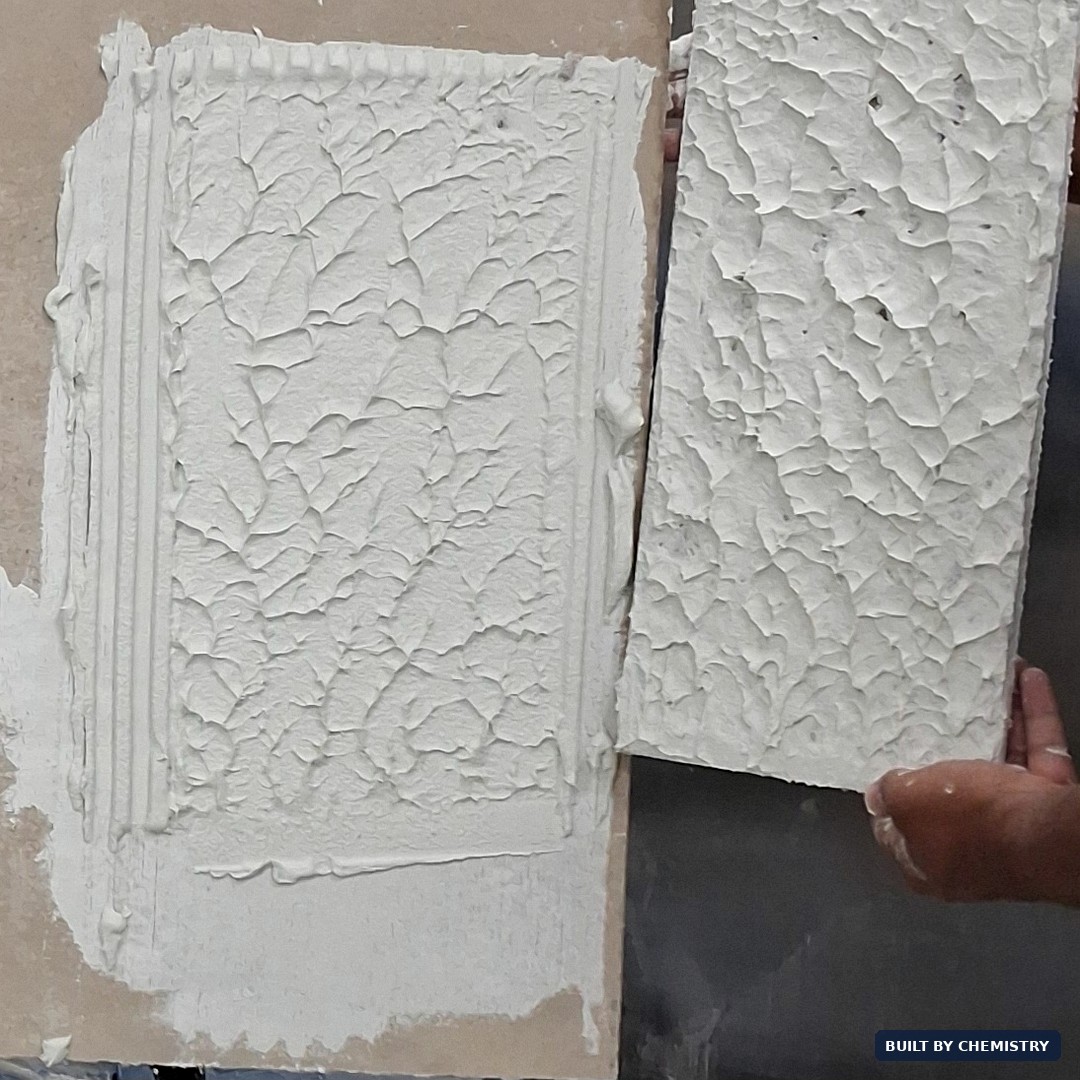
Start with the sand and the fines. The particle-size distribution sets how tightly the solids pack and how much they interlock under low shear. A well-graded sand with the right proportion of fines builds a particle skeleton that resists flow at rest and collapses under the trowel — the mechanical half of thixotropy. Too few fines and the paste has no body; too many, or the wrong shape, and it never flows cleanly. The rheology of a cementitious paste is governed as much by this aggregate packing as by any admixture, a point the aggregate-in-suspension literature makes repeatedly (Koehler & Fowler, ICAR / University of Texas at Austin).
Then the cellulose ethers — MHEC, HEMC, HPMC — which are doing far more than “retaining water”. Dissolved in the mix water, these long-chain polymers build a network that holds water against the substrate’s suction and raises the low-shear viscosity, giving the paste its stand-up body. The cellulose-ether literature — Pourchez, Patural and colleagues at Saint-Étienne, published across Cement and Concrete Research — traces exactly how these molecules govern water retention and the fresh-state consistency of the mortar. Change the cellulose type, its viscosity grade or its dose and you move the thixotropy directly.
Finally the thickeners and modern polymer admixtures, engineered to tune one property without wrecking another. This is the shift that separates a modern adhesive from a bag of “cement, sand and glue”: there are now highly modified additives designed for a single job — more stand-up, more open time, more slip resistance — that a formulator layers in deliberately. The days of a single cellulose doing everything are over. Get the combination right and you get a paste that spreads like cream and holds like a clamp; get it wrong and you get one that does one of those two things and fails at the other.
Why does the datasheet lie at 35 °C and 90 % relative humidity?
Because thixotropy is strongly temperature-dependent, and almost every datasheet figure is measured at 23 °C and 50 % RH. Move the same adhesive to a pre-monsoon wall in Rajasthan and its rheology is a different animal.
This is not hand-waving; it is measured. A 2025 study of a hydroxyethyl-methyl-cellulose (HEMC) in plastering mortar found that the polymer’s thickening effect was markedly stronger at 40 °C than at 20 °C — at 40 °C, a 0,25 % HEMC dose pushed the initial plastic viscosity to 14,4 Pa·s, a 133 % jump over the control. The authors’ recommended cellulose dose to hit stable rheology rose with temperature: roughly 0,05–0,10 % at 5 °C, but 0,15–0,20 % at 40 °C (Ling et al., 2025). A formula balanced for a Spanish spring is not balanced for an Indian May.
Temperature attacks from the other side too. Heat accelerates cement hydration, so at 30–40 °C the paste stiffens faster and the open time collapses — the same study measured how sharply the early structure builds as temperature climbs. Add the humidity swing and the substrate suction of a hot, dry block, and the number printed on the bag — slip measured in a 23 °C conditioning room — becomes almost decorative.
This is the whole reason a demonstration in the field lands where a datasheet doesn’t. What the datasheet says and what the material does on a hot wall are two different documents, and the gap is widest exactly where the climate is hardest. Two products at the same EN class, on paper identical, can behave nothing alike once they are troweled onto a vertical substrate at 35 °C — because the datasheet class was never a promise about that wall. It is the same lesson as the very first edition of this newsletter: the tile’s paperwork is not the tile’s behaviour.
Three questions to ask before you trust a thixotropy claim
Was the slip figure measured at your site’s temperature, or at 23 °C? A datasheet slip value with no stated conditioning is half a number. Ask for the slip result and the temperature and humidity it was measured at — and, if your wall runs at 35 °C, ask what the same test gives warm. A supplier who has run it will have the data; one who hasn’t is selling you a room-temperature promise.
What holds the thixotropy up — the fines, the cellulose, or a single additive doing everything? A formula that leans entirely on one high-dose cellulose is fragile to temperature. Ask what carries the stand-up body and whether the system was balanced for a hot, humid application. The answer separates an engineered adhesive from a repackaged commodity.
Does the static yield stress clear the tile you are actually laying? A 6 mm ceramic asks about 112 Pa; a 20 mm stone slab asks 530, and more with partial contact. If you are hanging heavy stone on a wall, “it’s thixotropic” is not an answer — the question is whether the fresh yield stress carries that tile before the bond develops. Specify the tile, not the adjective.
Next week — the second of the three. Open time, setting time, pot life, adjustment time: four different clocks that the whole market runs together into one. We pull them apart, and show why the one you care about depends entirely on which side of the trowel you are standing on.
— Guillermo
Part of the pillar
Tile Adhesive Application — single vs double buttering, thixotropy, and the 15 checks that catch a bad install. Read the full cluster overview.
Ed #16 continues this cluster — Ed #16 pulls apart the four clocks — open time, setting time, pot life, adjustment time — and shows why only one of them is written into EN 1346 and what it actually measures.
Ed #17 closes the trilogy — the autopsy of a real tile-adhesive claim, read from the back of a still-bonded tile.
Ed #18 opens the membrane trilogy — the same redispersible polymer family at roughly ten times the dose, where cement stops being the matrix and becomes the filler.
The same ether also sets how long the bed takes to harden in the cold: tile adhesive drying time.
- Why your C2TE-S1 stops working at 60×60
- Your adhesive is not drying. It is hydrating, and the weather sets the clock.
- Hormuz, Bab el-Mandeb and your tile adhesive (2026)
- Grout classification, decoded: CG1, CG2, W, A, F
- Grout was never waterproof - and never had to be