Why your C2TE-S1 stops working at 60×60
Large format tile adhesive: S1 or S2? What changes above 60×60, and the size rules India's IS 15477 and Spain's UNE 138002 write that EN 12004 never did.
Part of the Construction Chemicals hub - the parent category for every BBC cluster.
Tile adhesive technology is a language written in five letters and two numbers - C1, C2, T, E, S1, S2 - and most of the market buys the product without decoding a single one of them. The code on the bag is not decoration. Each character is the result of a specific laboratory test with a specific pass threshold, and reading them in order tells you exactly what the adhesive was proven to do, and what it was never asked to do.
Here is the thesis that runs through this whole cluster: the letter on the bag is not a promise about your wall. It is a promise about a test run at 23 °C. The same class code means one thing in a European conditioning room and something noticeably different on a rooftop in Rajasthan at 35 °C and 90 % relative humidity. Understanding tile adhesive technology means understanding both halves of that gap: what the code guarantees, and where the guarantee stops.
A cementitious tile adhesive is, at its core, three things: cement, graded sand, and a small but decisive fraction of chemical additives. The cement is the binder that hydrates and hardens; the sand is the skeleton that gives the mortar body and controls shrinkage; and the additives - often under 5 % of the total mass - are what turn a bag of grey powder into a product engineered for a specific job. Change nothing but the additives and you change almost everything the tiler feels and the tile experiences.
Each additive family has a distinct role, and tile adhesive technology is really the art of balancing them:
Those ingredients can be assembled into three chemical families, which are the top level of every classification system: cementitious (C), dispersion (D) - a ready-mixed paste - and reactive resin (R), typically epoxy or polyurethane. EN 12004-1:2017 fixes the European classes for all three; India's IS 15477:2019 maps the same products onto a Type 1 to Type 5 scale. The cluster begins with the class most of the world argues about, decoded letter by letter in the edition on C2TE-S1 tile adhesive classification decoded.
The string C2TE-S1 is not a product name - it is five separate test results stacked into one label. Read left to right, each character adds a proven property, and each is measured by its own European test method:
| Code | Meaning | Test & threshold |
|---|---|---|
| C | Cementitious binder | EN 12004-1 |
| 2 | Improved adhesion | ≥ 1,0 N/mm² tensile (EN 12004-2, 8.3) - vs ≥ 0,5 for class 1 |
| T | Reduced slip | ≤ 0,5 mm (EN 12004-2, 8.2) |
| E | Extended open time | ≥ 0,5 N/mm² adhesion after ≥ 30 min (EN 12004-2, 8.1) |
| S1 | Deformable | transverse deformation ≥ 2,5 and < 5 mm (EN 12004-2, 8.6); S2 is ≥ 5 mm |
So a bag marked C2TE-S1 has been proven to be a cement-based adhesive with high bond strength, resistance to a tile sliding on a wall, a generous window to place the tile, and enough flexibility to absorb movement without cracking the bond. Drop any letter and you drop the corresponding guarantee - a plain C2 says nothing about slip, open time or deformability, even though those are the three properties that most often decide whether a job survives.
This is where tile adhesive technology stops being a filing exercise and starts costing money. Every one of those thresholds is measured under a fixed laboratory climate. EN 12004-2:2017 conditions the tests at 23 ± 2 °C and 50 ± 5 % relative humidity. That is a mild European spring in a box - and it is nothing like the wall the adhesive actually meets.
Temperature rewrites the rheology and the chemistry. A 2025 study of a hydroxyethyl-methyl-cellulose in mortar measured that the polymer's thickening effect was far stronger at 40 °C than at 20 °C, and that the cellulose dose needed for stable behaviour had to rise with temperature (Ling et al., 2025, Materials, MDPI). Heat also accelerates cement hydration, collapsing the open time. An adhesive that reads perfectly at 23 °C can behave like a different product on a sunlit façade. This is the paradox the newsletter opened with in your tiles are lying to you - the datasheet paradox, and detailed in the hidden data a construction-chemicals datasheet leaves out.
There is a second, quieter gap: the standard itself is not the same everywhere. India's IS 15477:2019 conditions its tests at 27 ± 2 °C and 65 ± 5 % humidity - warmer and damper than Europe, deliberately closer to the country it serves - and it grades adhesives on both tensile and shear adhesion, where EN 12004 classifies on tensile strength alone. A European C2 and an Indian Type are not translations of each other; the conditions, the tests and the thresholds all differ. That distinction deserves an edition of its own, and will get one - the comparison below is the short version.
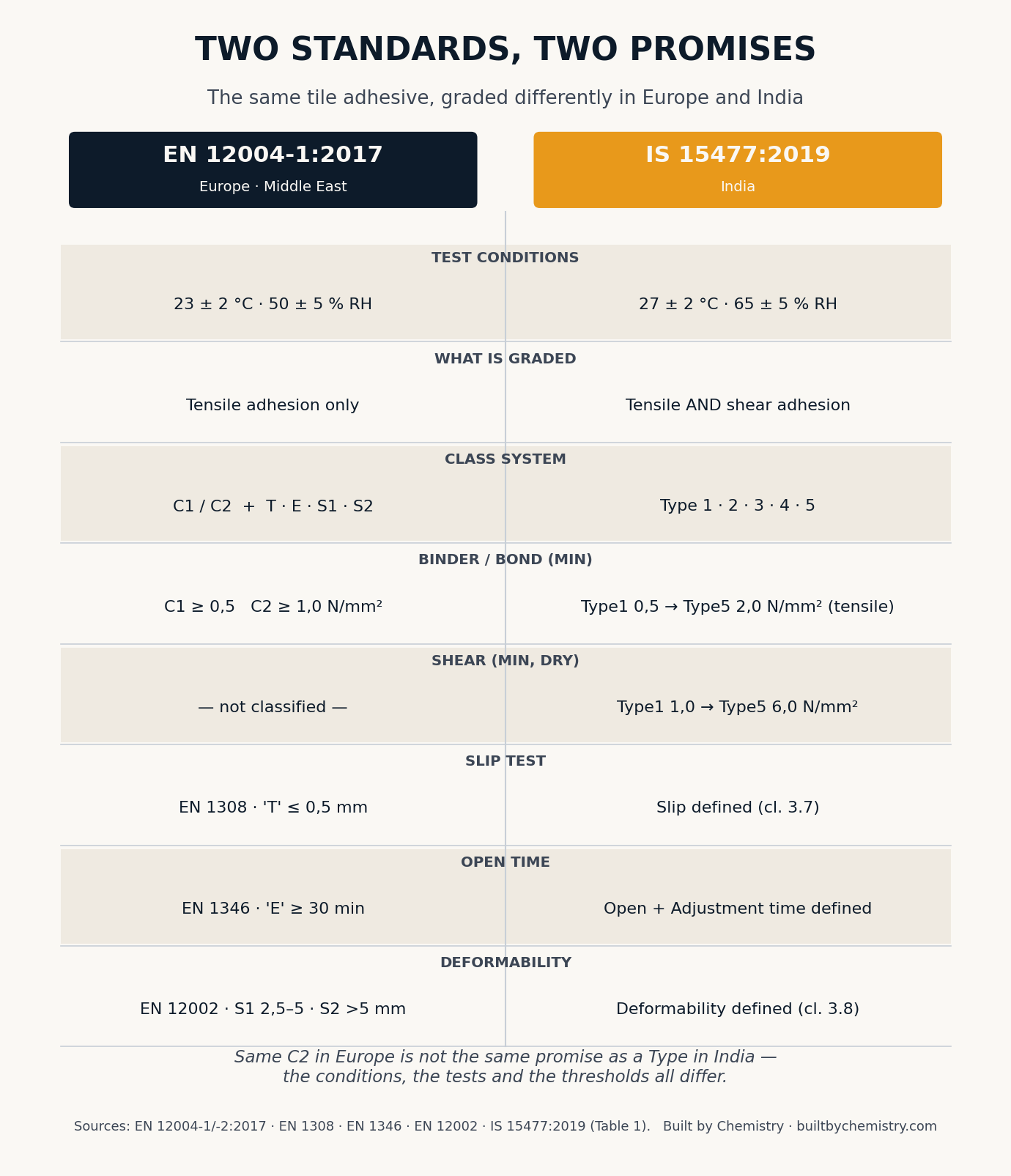
Read enough specifications and the same three mistakes appear again and again - and they split cleanly along a market line. Across Spain, the wider European market and the Middle East, C2 adhesives, with or without the S1 suffix, are now the norm, and the trade largely knows how to apply them; even the entry-level products are of solid quality and the application culture is professionalised. India is the mirror image. The best-selling products remain the basic Type 1 and Type 2, and the practice of blending different adhesives on site to "improve" them or shave cost is widespread - much as it was in Spain fifteen or twenty years ago, before the market matured.
Against that backdrop, the three recurring errors are:
None of these is a failure of chemistry. Every one is a failure of reading - of buying a code without decoding it.
The specification that survives a hot, fast, real jobsite answers three questions before the adhesive is ordered:


Related pillars: Tile Adhesive Application covers what happens on-site once you have specified the right class - buttering, thixotropy and site QC. And Waterproofing Systems covers the parallel decoding for membranes and below-grade protection.
Companion resource - the free 15-point Tile Adhesive Site QC Checklist distills these principles into a printable one-page routine a specifier can walk the job with.
Large format tile adhesive: S1 or S2? What changes above 60×60, and the size rules India's IS 15477 and Spain's UNE 138002 write that EN 12004 never did.
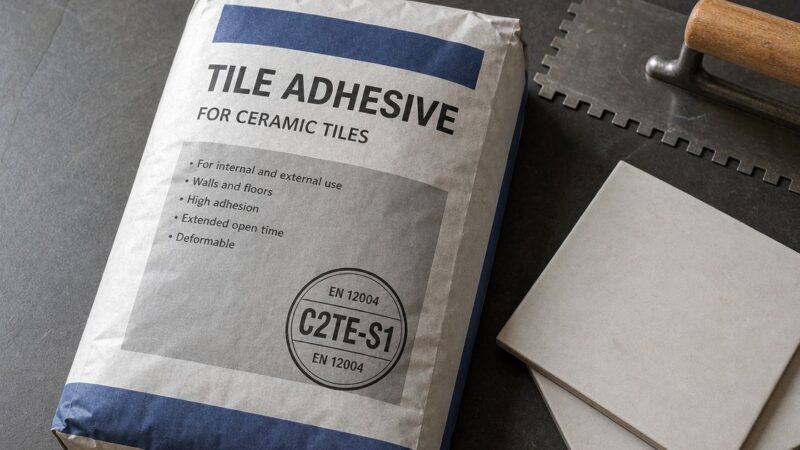
6 characters, 8 test methods, 1 tile adhesive class. C2TE-S1 decoded line by line - and the failure on site it quietly prevents. EN 12004.

Every construction chemicals datasheet tells you what the manufacturer wants you to know. Five things they leave out, and how to spot them before you specify.

The hollow knock test, vitrified tiles, and why the cement mortar your contractor trusts barely bonds to them. What EN 12004 C2TE-S1 actually means on site.
We use cookies to understand how readers use BBC and improve the newsletter. Read our Cookie policy.
Have a paper or a site failure the industry should know about?
We publish contributions from R&D chemists, field engineers and academics. Full byline, no brand ties.
Contribute →