Independent author of Built by Chemistry. Every edition sourced from EN / ANSI / BIS / ASTM standards or peer-reviewed literature. About →
A structural engineer in a coastal city handed me a concrete core last year. Grey cylinder, maybe 90 mm long, drilled out of a fifteen-year-old car park deck a few hundred metres from the sea. He’d had it tested. The chloride front had already reached the depth of the top mat of reinforcement. No stain on the soffit yet. No spalling. Nothing a client would ever notice on a walkthrough. And the steel had, on the numbers, already started to corrode.
That’s the uncomfortable thing about chloride attack. By the time you can see it, it has been running for years. Last week the membrane was doing its job and the water was being kept out. This week the water is already in, the chlorides came with it, and the most expensive failure in the building is happening behind a surface that still looks perfect.
This edition is about the one number that decides how long that takes — the concrete cover — why it behaves like a clock rather than a wall, and what the codes ask for. Keep two things apart as you read. Whether the steel corrodes at all is a concrete problem — set by the specification for the environment and by how well it was built, governed by IS 456 or EN 206. What you do once it has corroded is a repair problem — a different standard family, EN 1504, and the last third of this piece. They are not the same subject, and the fastest way to write nonsense into a pliego is to treat them as one.
Key takeaways
- Time to corrosion initiation scales with the square of the cover depth. Fick’s second law makes cover a clock: doubling the cover roughly quadruples the time before chloride reaches the steel. Going from 20 mm to 50 mm is a factor of about 6,25, not 2,5 — derived below from the error-function solution of the diffusion equation. Full review of chloride-induced corrosion (RSC Advances 2024, open access)
- IS 456:2000 sets nominal cover by exposure: mild 20 mm, moderate 30 mm, severe 45 mm, very severe 50 mm, extreme 75 mm (Table 16). For reinforced concrete the total acid-soluble chloride limit at placing is 0,6 kg/m³ (Table 7). IS 456:2000 nominal cover and chloride limits
- There is no single critical chloride threshold. The deemed-to-satisfy figure is 0,4 % by mass of cement, but measured values in real structures scatter from 0,04 % to 8,34 % (Angst et al.). The number in your spec is a convention, not a constant. Tang, Angst et al. 2018, RILEM recommendation on chloride threshold testing
- Corrosion has two phases (Tuutti, 1982): a long, silent initiation period and a short, visible propagation period. The stain on the concrete marks the end of the process, not the start.
- Corrosion is designed in or built in, not repaired away. It comes from specifying the wrong concrete for the environment, or from good concrete badly built. That is a concrete problem, governed by IS 456 / EN 206.
- Repair is a separate discipline with its own standard family. EN 1504 covers the products applied to already-hardened concrete afterwards. A repair mortar’s R1-R4 class is not a concrete grade, and the two must never be specified as if they were the same thing.
What does concrete cover actually do?
Concrete cover is a diffusion barrier, and its protective time scales with the square of its thickness. Chloride ions move through the pore water toward the steel. Double the cover and, all else equal, you don’t double the protection — you roughly quadruple the years before the ions arrive.
This is the part most site conversations get wrong. Cover is treated as a tolerance — a number you hit or miss by a few millimetres, like a setting-out dimension. It isn’t. It’s the exponent in a durability equation. A 10 mm error on a 40 mm design isn’t a 25 % problem. It changes the initiation time by roughly a third.
The alkalinity of the cover also matters as much as its thickness. Fresh concrete sits around pH 13, and at that alkalinity a passive iron-oxide film forms on the steel and holds. Two things destroy that film: chlorides reaching a critical concentration at the bar, and carbonation dropping the pH below about 9. Cover buys time against both. It is the only line of defence that costs almost nothing at the design stage and almost everything to add later.
The arithmetic of cover: why double the depth buys four times the life
Under Fick’s second law of diffusion, the depth a chloride front reaches grows with the square root of time — so the time to reach a fixed depth grows with the square of that depth. Quadruple the clock by doubling the cover. That is the whole mechanism in one sentence.
The derivation takes four lines, and it is what separates a rule of thumb from a number you can defend in a design review. The error-function solution of Fick’s second law — the chloride-ingress model at the core of the fib Bulletin 34 service-life design methodology (AASHTO/SHRP2) — gives the chloride concentration at depth x and time t as:
C(x,t) = C_s · [1 − erf( x / (2·√(D·t)) )]
where C_s is the surface chloride concentration, D the apparent diffusion coefficient of the concrete, and erf the error function. Corrosion initiates when C reaches the critical threshold C_crit at the depth of the steel. For one concrete in one exposure, C_s, C_crit and D are all fixed — which means the whole bracket x / (2√(D·t)) must hold a constant value. That single constraint forces x² ∝ t: initiation time rises with the square of the cover. The ratio between two covers is then simply (x₂ / x₁)², and no property of the concrete can move it. Twenty-five to fifty millimetres is (50/25)² = 4. Twenty to fifty is (50/20)² = 6,25. That is exactly where the takeaway figure comes from — not a rule of thumb, but the equation solved for the only thing that changes.
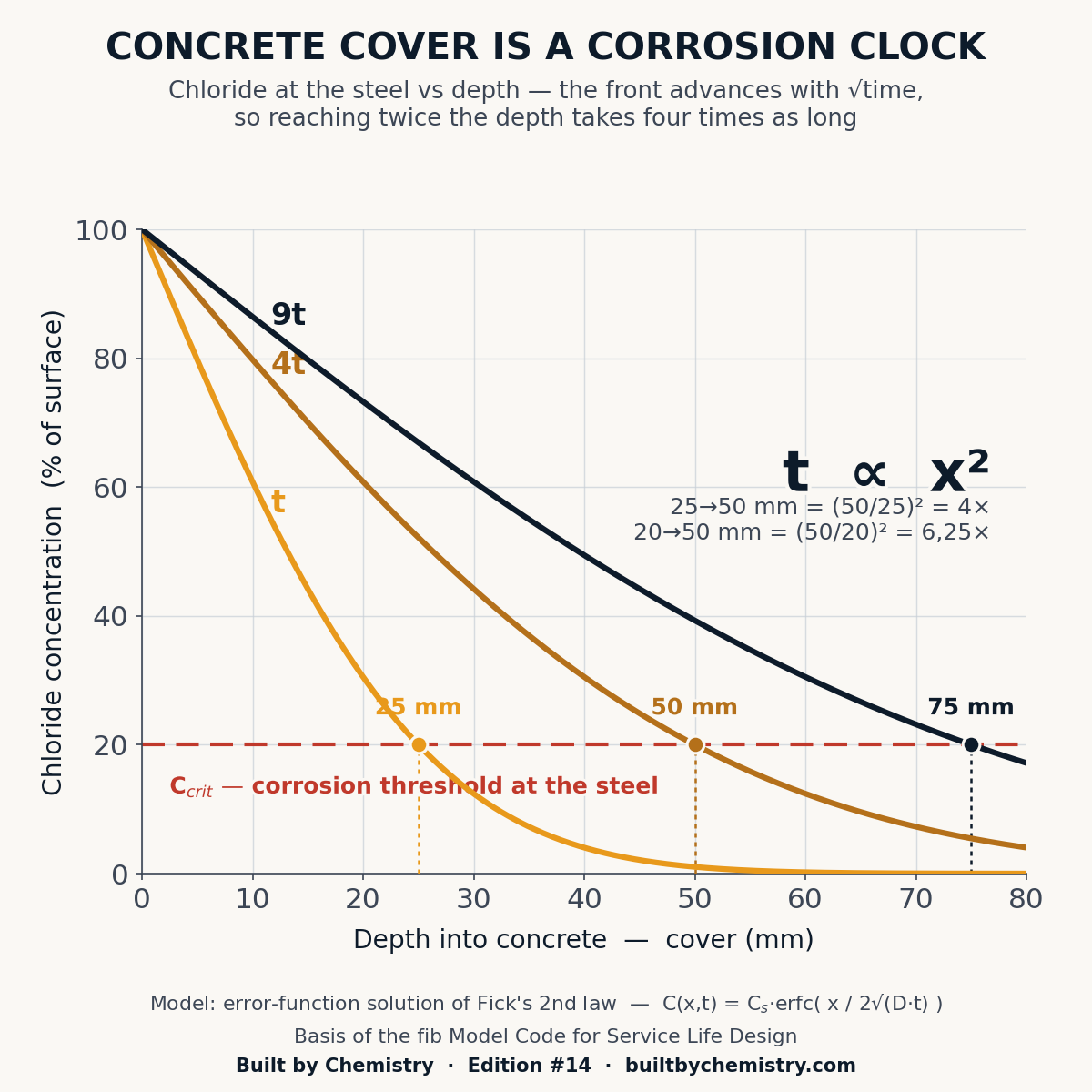
Work an illustrative example, because the shape matters more than any single number. Take an aggressive coastal exposure, a surface chloride around 3 % by mass of binder, a critical threshold around 0,4 %, and an apparent diffusion coefficient typical of a plain Portland concrete without supplementary materials. On those assumptions a bar at 25 mm cover starts to corrode in a handful of years; the same bar at 50 mm takes about four times as long; at 75 mm, roughly nine times. Change the concrete — add fly ash, slag or calcined clay and drop the diffusion coefficient — and every one of those times stretches out, but the square-law shape between them stays fixed.
Two honest caveats, because this is where over-confident specs fall apart. First, pure diffusion is the best case. Real cover cracks, and a crack is a motorway for chloride that ignores the square law entirely. Second, and larger: the critical threshold itself is not a constant. The 0,4 % by mass of cement that lives in every durability clause is a deemed-to-satisfy convention. When Angst & Elsener 2017, the size effect in chloride corrosion (Science Advances, open access) pulled the measured values from real structures and the literature together, they spanned 0,04 % to 8,34 % by mass of binder — a two-hundred-fold range driven by the steel-concrete interface, the binder, moisture and the test method itself. So the clock is real, and the square law is exact, but the alarm time carries a genuine uncertainty that no datasheet admits.
What does IS 456 require, and what actually gets built?
IS 456:2000 sets nominal cover by exposure class — 20, 30, 45, 50 and 75 mm from mild to extreme (Table 16) — and caps total acid-soluble chloride in reinforced concrete at 0,6 kg/m³ (Table 7). The code is clear. The gap is on site.
The five classes read straight off the exposure. Mild is protected interior. Moderate is sheltered exterior. Severe is driving rain or alternate wetting. Very severe is sea-water spray and corrosive fumes. Extreme is the tidal and splash zone. For a reinforced structure in or beside the sea, IS 456 also demands a minimum grade of M30 and caps the chloride you are allowed to build into the fresh mix at 0,6 kg/m³ — not to be confused with the corrosion threshold at the steel from the last section. One is a limit on what you pour in; the other is the level the front has to reach at the bar. These are deemed-to-satisfy minimums, below which the code offers no durability promise at all.
So the first cause of corrosion is a specification that doesn’t match the environment: a coastal deck detailed as if it were a sheltered interior, mild cover on a very-severe exposure. Match the class to the environment and the clock is long. Get the class wrong and no repair mortar on earth buys it back.
The second cause is workmanship, and it defeats even a correct specification. Cover is set by spacer blocks a subcontractor bought by price, checked — if at all — by eye, and quietly lost every time a top mat is walked on before the pour. A 50 mm very-severe specification delivered at 35 mm on the deck isn’t 30 % short. On the square law, it has surrendered roughly half its design life before the concrete truck has left. The same gap between what the classification says and what the pour delivers ran through the tile-adhesive edition earlier this year — the standard is exact, the execution is a range, and nobody measures the range.
How does the chloride front actually move?
Chlorides migrate through the concrete pore network by diffusion, drawn by the concentration gradient between a salty surface and a clean interior, until they accumulate at the steel above the critical threshold and break down the passive film. Then pitting corrosion starts, local and hidden. The same water that fails flat roof waterproofing membranes and drives hydrostatic head into below-grade structures is the vehicle that carries chlorides into the concrete pore network.
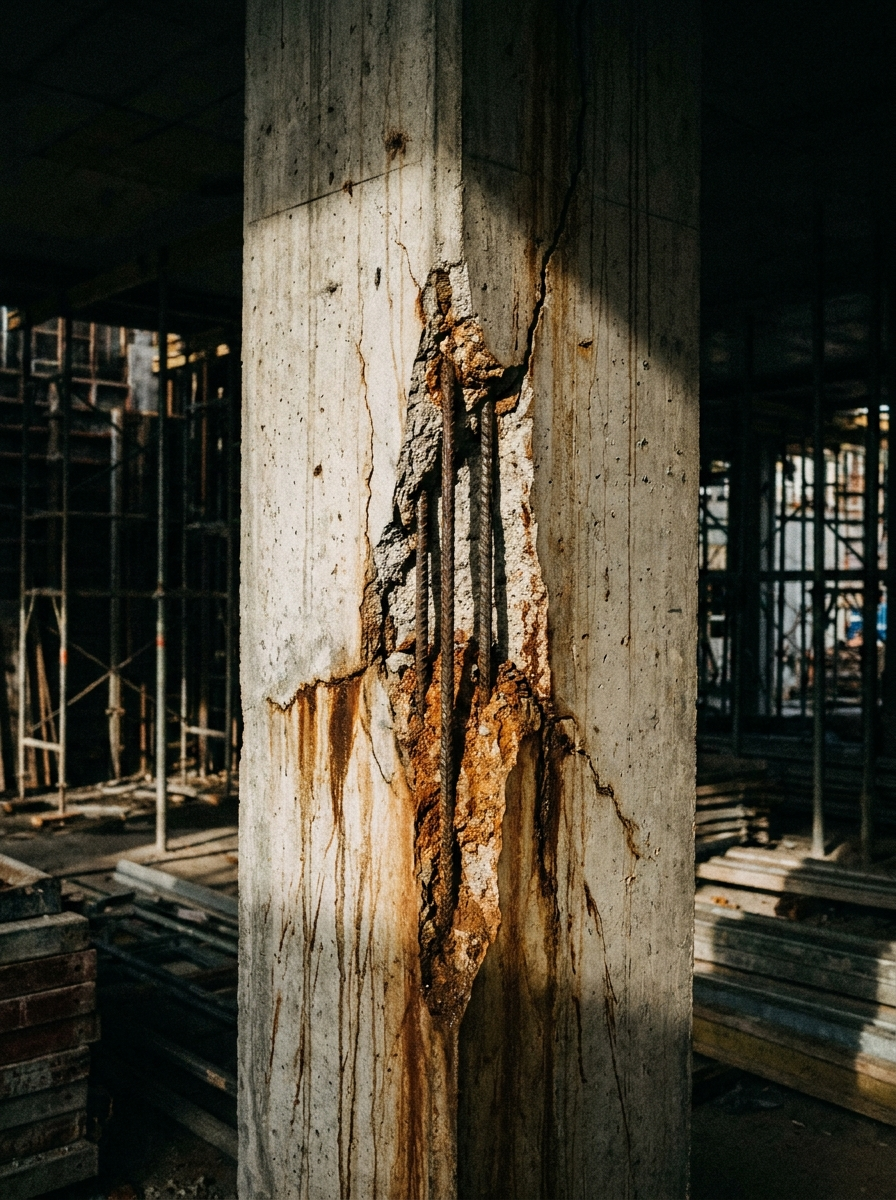
The mechanism is ionic, not mechanical. Rust is the visible end of an electrochemical process: an anode forms where the film breaks, iron dissolves, and the corrosion products occupy up to several times the volume of the steel they came from. That volume increase is what cracks and spalls the cover from the inside — the concrete is broken by its own reinforcement expanding.
The evidence base here is unusually good and unusually humbling. Angst and colleagues at ETH Zürich built an open, single-method database of critical chloride contents measured on real engineering structures — bridges, not laboratory prisms — precisely because laboratory thresholds had never agreed with field ones. The lesson from that work is not a tidier number. It is that the steel-concrete interface — the voids, the bleed water, the mill scale on the bar — governs when corrosion starts as much as the chloride dose does. This is why two columns in the same structure, same concrete, same cover, can corrode years apart.
When is the damage visible versus when did it already start?
Corrosion runs in two phases: a long, silent initiation period while chloride builds up at the steel, then a shorter propagation period once the bar is actively corroding. The visible stain marks the end of propagation, not the beginning. By the time it shows, the clock has already run.
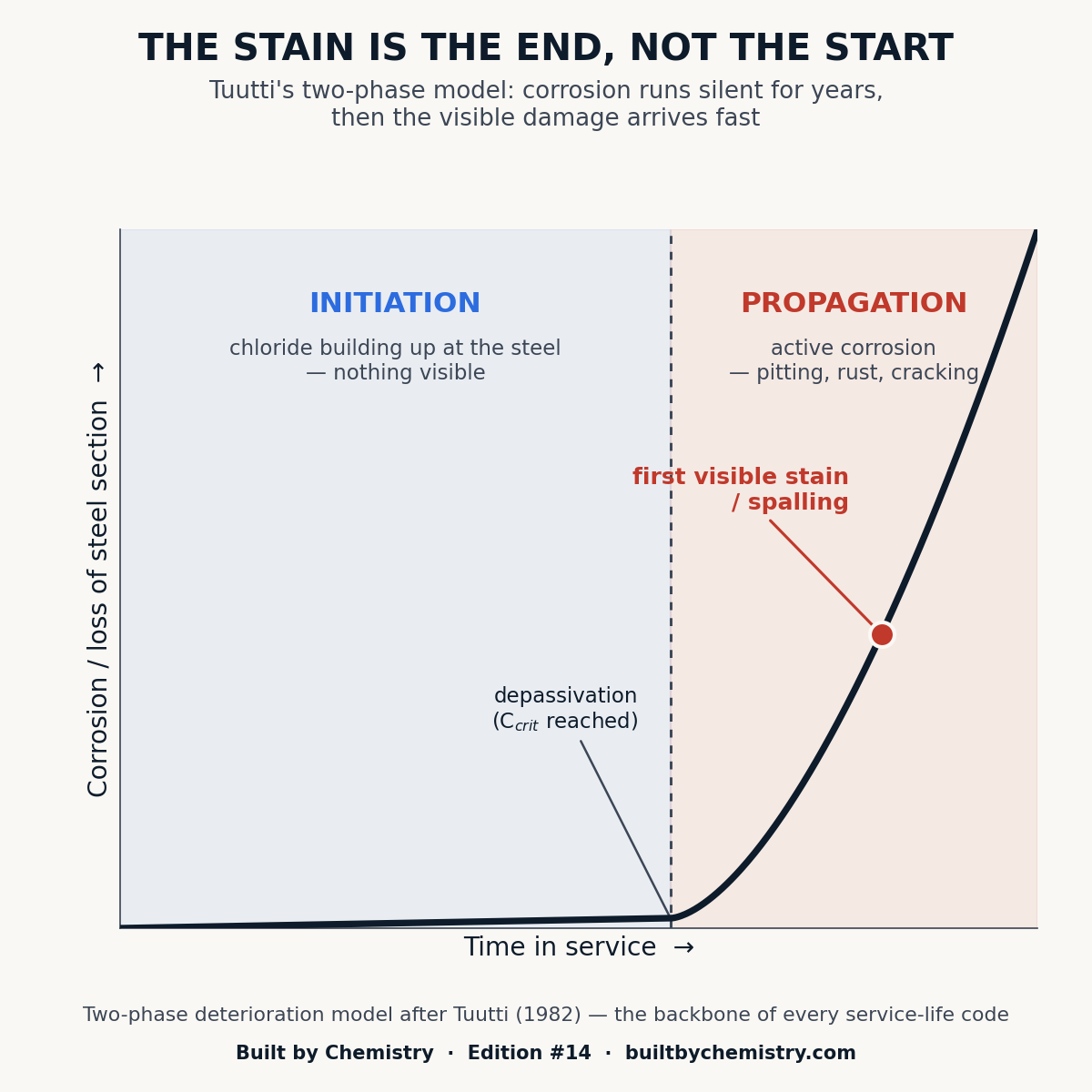
This two-phase picture is Tuutti’s model, from 1982, and it is still the backbone of every service-life code. Initiation can take decades or a couple of years, depending entirely on cover, concrete and exposure. Propagation — cracking, staining, spalling — is comparatively quick. The engineer’s core I opened with was deep in initiation with nothing to see. A client who repaints the soffit to hide an early stain is treating the symptom at the exact moment the structure most needs a diagnosis.
The practical consequence is brutal for procurement. You cannot inspect your way to durability after the fact. The cheap, decisive intervention — right exposure class, cover, concrete quality, a chloride-resistant binder — happens before the pour, in the concrete standard. Everything after the stain appears is a different discipline, a different standard family, and a much bigger bill. That is where EN 1504 begins.
EN 1504-3 repair mortars: what do R1, R2, R3 and R4 actually mean?
EN 1504-3:2005 grades repair mortars into four classes by compressive strength — R1 ≥ 10 MPa, R2 ≥ 15, R3 ≥ 25, R4 ≥ 45 — where R1 and R2 are non-structural and R3 and R4 are structural. The class is a system, not just a strength number.
First, the distinction that gets blurred on site more than any other. The concrete you poured is governed by a concrete standard — IS 456, or EN 206 in Europe — with its grades, cover and mix chloride limit. EN 1504 is a different family entirely: the standard for the products you apply to already-hardened concrete to repair and protect it. A repair mortar is not concrete, and an R-class is not a concrete grade. There is no such thing as an “R4 column” or an “M30 mortar” — mix those two up in a specification and you have written a line that means nothing.
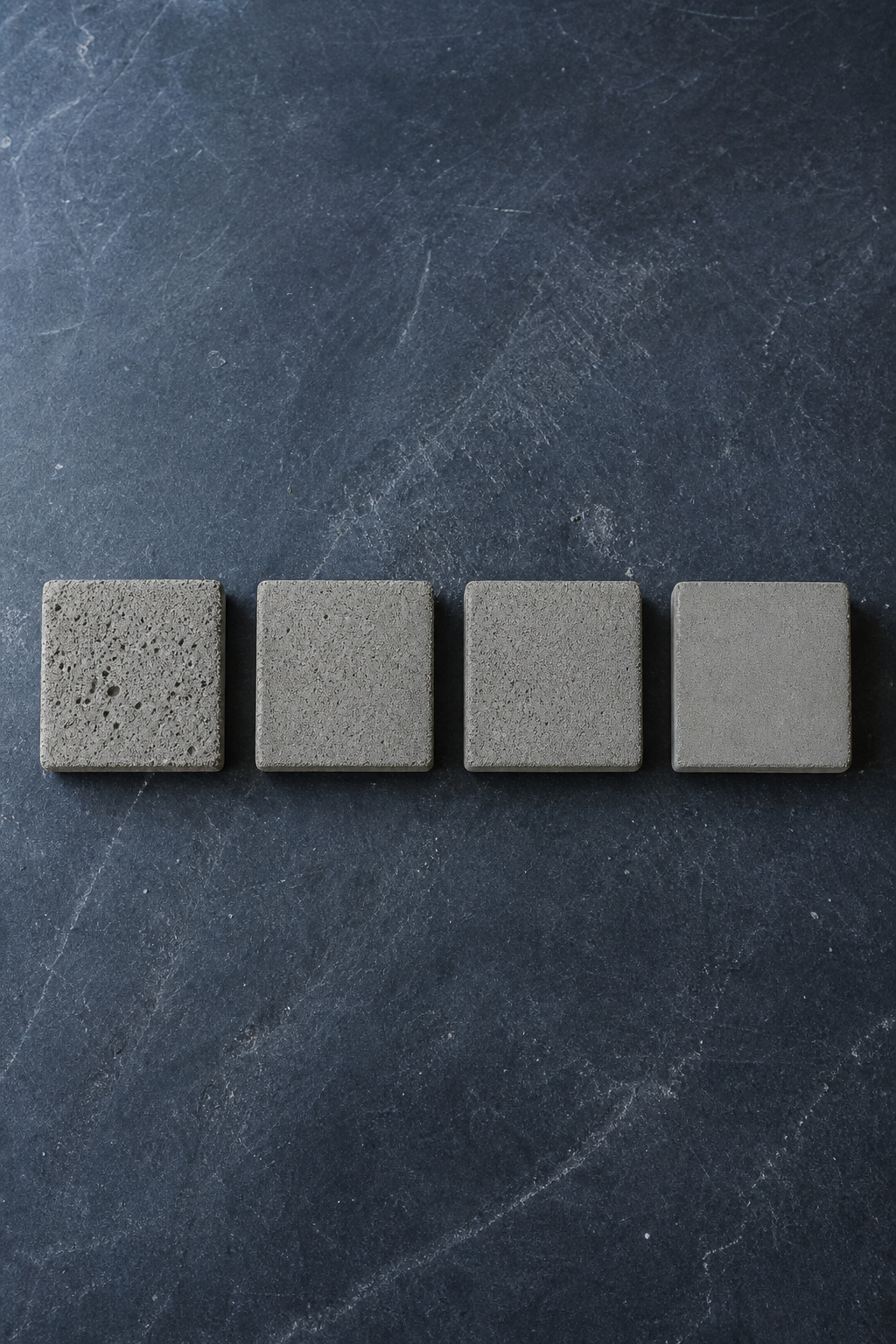
The full table carries more than compression. Bond strength to the substrate rises with the class — ≥ 0,8 MPa for R1 and R2, ≥ 1,5 for R3, ≥ 2,0 for R4, all measured to EN 1542. The structural classes add requirements the non-structural ones drop: an elastic modulus floor (≥ 15 GPa for R3, ≥ 20 for R4 to EN 13412), carbonation resistance, and thermal-cycling bond after freeze-thaw. One requirement is identical across all four classes and easy to miss: chloride content ≤ 0,05 %. A repair mortar that adds chlorides to the structure is feeding the corrosion it was brought in to stop.
Here is the trap, and it is the opposite of what instinct says. The instinct is to reach for the strongest mortar available — R4 for everything, on the logic that more is safer. But R4 only sets a minimum modulus, not a maximum. Patch a deteriorated, low-modulus old concrete with a stiff, high-modulus R4 and the two don’t share load. Under thermal movement and shrinkage the stress concentrates at the interface, and the “best” mortar debonds while a matched R3 would have held. The right class is the one compatible with the parent concrete, not the one with the biggest number on the bag.
How do you choose the class for the damage?
Match the repair principle to the failure first, then the class to the substrate — EN 1504-9 defines eleven principles, and chloride-driven corrosion mostly lives in Principle 7 (restoring passivity) and Principle 11 (control of anodic areas). The mortar is the last decision, not the first.
EN 1504-9 is the part nobody reads and everybody needs. It lists eleven principles of protection and repair — from Principle 3, straightforward concrete restoration, through Principle 7, preserving or restoring passivity by replacing chloride-contaminated concrete, to Principles 10 and 11, cathodic protection and anodic control. Reinforcement corrosion is a different problem from a spalled corner, and the standard treats them differently. Choosing an R4 mortar without first choosing a principle is answering a question nobody asked.
Depth and exposure then set the class. A cosmetic, non-load-bearing make-good in a dry interior is R1 or R2 territory. A structural patch on a corroded coastal column, carrying load and facing more chloride, is R3 or R4 — with the modulus matched to the substrate and the contaminated concrete cut back behind the bar, not just to its face. Leave chloride-rich concrete behind the steel and you have buried the problem, not repaired it.
Three procurement questions that change the outcome
The first two are about the concrete — preventing corrosion. The third is about repair — a different standard family. Keep them apart on the page and in the pliego.
On the concrete: what exposure class and nominal cover are specified, and who measures the delivered cover before the pour? A drawing that names M30 and 50 mm cover but has no cover-meter check on the top mat before concreting is half a specification. Ask for the hold point. A cover survey on the reinforcement cage costs a morning and protects the one variable that runs the whole clock.
On the concrete: what is the maximum chloride content specified for the fresh mix, and is it tested or assumed? IS 456 caps total acid-soluble chloride in reinforced concrete at 0,6 kg/m³ at placing — a limit on what you build in, so the steel takes longer to reach its own corrosion threshold. Ask whether that figure is calculated from the constituents or measured on the delivered concrete. The difference is a titration, and it is the difference between a number and a hope.
On the repair (EN 1504, a separate question): is chloride-contaminated concrete removed from behind the bar, to what class is the mortar matched, and is the mortar’s own chloride capped? The failure mode of a bad repair is a matched-looking patch that debonds in three years or seals live chloride against the steel. EN 1504-3 caps the repair mortar’s own chloride at 0,05 % — a repair that adds chloride is feeding the corrosion it was brought in to stop. Specify the removal depth behind the reinforcement, the modulus match to the parent concrete, and the mortar chloride limit, in writing, before anyone mixes a bag.
Next month the cluster opens again, and it moves out of the concrete and into the gaps between things — the sealants in a façade joint, the one component nobody specifies until a whole elevation is streaked with water. We have followed the water from the rooftop to the rebar. Next, the joints that were supposed to keep it out in the first place.
— Guillermo
- Two waterproofing systems on one basement wall. When the redundancy works, and when they fail together.
- LC3 cement: -40% CO2, same compressive strength. India's cement industry doesn't use it. Here's why.
- Polymer prices up 60%. Naphtha up 74% in 14 days. Hormuz is rewriting construction chemicals.