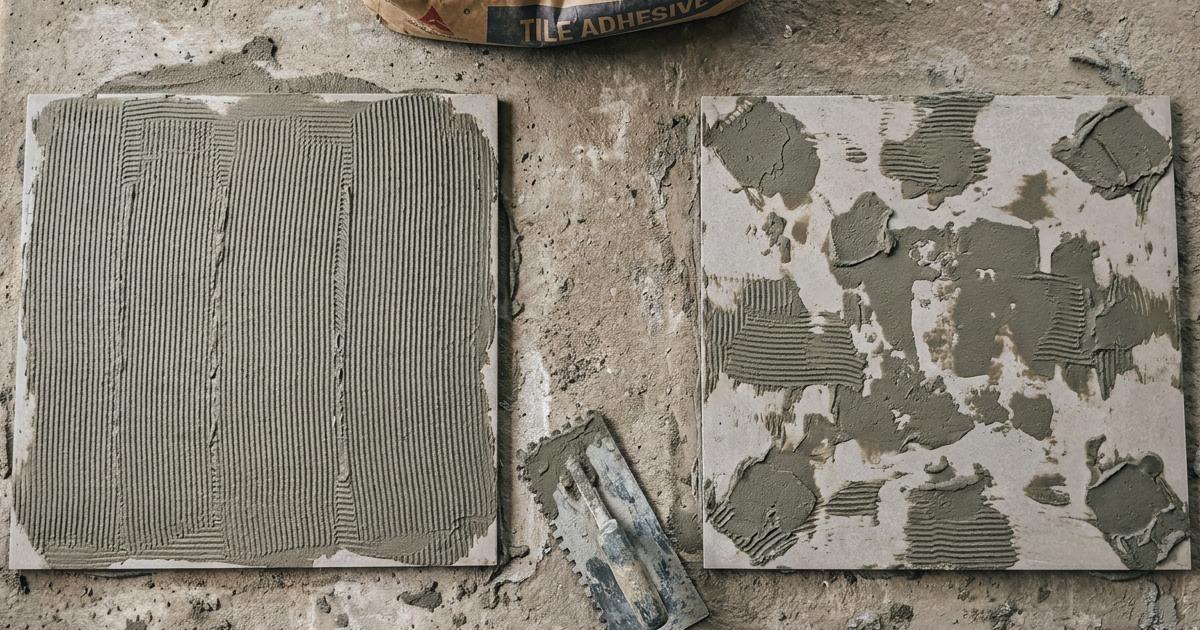
There is a sequence I see on every Indian tile installation, and on roughly half the Spanish jobs I visited last quarter. The mason combs adhesive across the substrate with a notched trowel. He places the tile, taps it once or twice with the rubber mallet. He moves on. Single buttering. Substrate side only. Three hundred millimetres of tile bonded to whatever the notched trowel managed to deposit underneath.
For tiles up to roughly 30×30 cm on a flat substrate in a dry area, this technique works. Below that threshold the geometry of the notch, the weight of the tile, and the embedding force from the mallet combine to produce enough bed contact to call the job done. Above that threshold — and almost every floor tile installed in India in 2026 is well above that threshold — the same technique fails the coverage requirements of every internationally recognised installation code I can find. TCNA in the United States, BS 5385 in the United Kingdom, DIN 18157 in Germany and UNE 138002 in Spain all converge on the same point: large tile, two-sided application, or the bed has voids the contractor cannot defend.
This edition is about that threshold, and what the four codes actually require above it.
What “single” and “double” buttering actually mean
The terminology is inconsistent across the industry, so let me define it precisely.
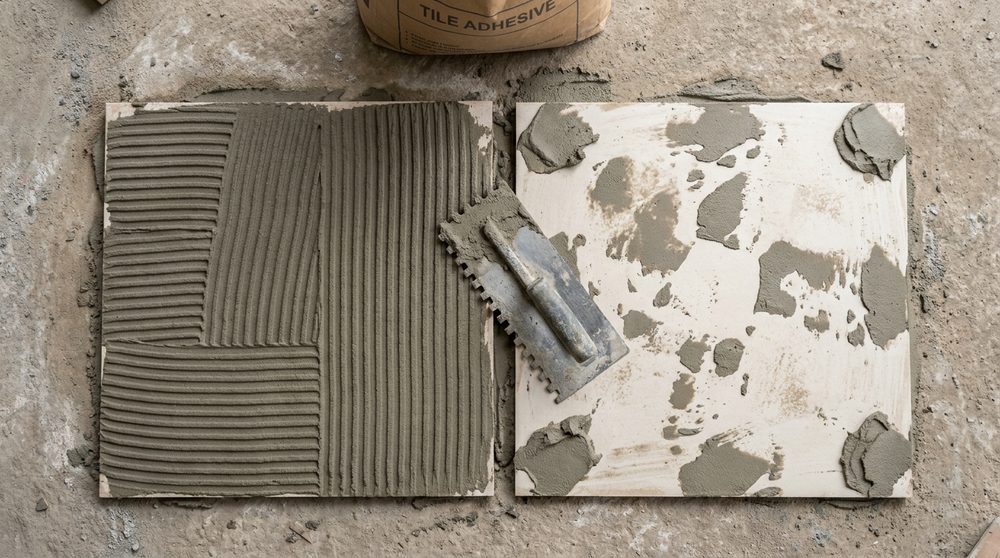
Single buttering is the application of adhesive only to the substrate, combed with a notched trowel. The tile is placed dry-backed and embedded by tapping or sliding into the ridges. This is the default technique on most Indian and Spanish sites.
Back buttering is a thin additional layer of adhesive applied to the back of the tile before placement. Flat-back troweling uses the flat edge of the trowel to “burn in” a skim coat. Notched-back troweling combs a thinner pattern of ridges on the tile back, oriented perpendicular to the substrate ridges so the two combs interlock when pressed together.
Double buttering is the combination — combed adhesive on the substrate plus burned-in or notched adhesive on the tile back. This is the only technique that reliably delivers the coverage percentages every international code requires above the size threshold.
What four major codes actually say
The Tile Council of North America Handbook is the most explicit and the most cited. Its current edition specifies, for natural stone in dry and wet areas, a minimum coverage of 95% with no voids exceeding 2 square inches and no voids within 2 inches of tile corners. For ceramic and porcelain in dry areas the threshold is 80% minimum. For wet areas — bathrooms, showers, pool surrounds — it rises to 95%, the same as stone. ANSI A108.5, the dimensional standard the TCNA Handbook references, states that “when 95% coverage is specified, back butter each tile with bond coat, or select a notched trowel sized to facilitate the proper coverage.”
The British Standards approach the same problem from a different direction. BS 5385-1:2018 for walls, recently updated in BS 5385-3:2024 for internal and external floors, and BS 5385-4:2015 for wet conditions all require solid bedding under specific tile-size and weight thresholds. The 2018 wall standard removed the old 50% coverage allowance for internal dry walls and now requires solid bedding for tiles with a surface area of less than 0.1 m² if they weigh more than 70% of the background’s load capacity, and for all tiles with a surface area greater than 0.1 m² — which is to say, anything around 32×32 cm or larger.
In Germany, DIN 18157 governs the thin-bed installation method for ceramic claddings. The standard is split into three parts, all revised in 2017: DIN 18157-1 for cement-based mortars, DIN 18157-2 for dispersion adhesives, and DIN 18157-3 for reaction resin adhesives. All three reference DIN EN 12004-1 for adhesive classification and DIN EN 14411 for tile classification. The German contract framework, DIN 18352 (VOB Part C — General Technical Specifications for Wall and Floor Tiling Works), incorporates DIN 18157 by reference, which means the standard’s coverage requirements are enforceable through standard German construction contracts. The published industry guidance from Deutsche Bauchemie is more explicit than the standard itself in recommending double buttering above 30 cm tile edge length, particularly for external and wet applications.
In Spain, UNE 138002 — Reglas generales para la ejecución de revestimientos con baldosas cerámicas por adherencia — is the country’s first technical standard dedicated specifically to ceramic tile installation, published in 2017 and revised in March 2023. It was developed by the UNE technical committee CTN 138, secretariat held by ASCER (the Spanish ceramic tile manufacturers association), with the active involvement of PROALSO (the national association of professional tile installers) and ANFAPA (the mortar and ETICS systems manufacturers association). The standard is based on the European report UNE-CEN/TR 13548 IN. Its adhesive selection tables key off three variables: the type of substrate, the longest side of the tile, and the water absorption of the tile. Above defined size thresholds the tables move from C1 to C2 and from no deformation class to S1 or S2, which in practice means a thin-bed cementitious adhesive applied with the two-sided technique. UNE 138002 is technically voluntary, but its citation in a project specification makes it contractually binding on the installer.
Four geographies. Four installation codes. One agreement: above roughly 30–35 cm tile edge length, single buttering is no longer accepted practice. The European framework behind all of them — EN 12004-1 for adhesive classification and the ISO 13007 series for global test methods — standardises the bond strength tests under controlled coverage conditions that assume the bed is properly formed. When the bed is not formed properly, the classification number on the bag is meaningless. The conditions for which it was tested no longer apply.
What contractors actually do, and why
I have asked maybe forty masons in India and a dozen in Spain why they don’t back butter. The answers cluster in three patterns.
The first is time pressure. Back buttering doubles the application time per tile. On a job priced at ₹40–60 per square foot of laying labour in India, the additional 30–40 seconds per tile is the difference between profit and loss for the contractor. Without a procurement specification that mandates and pays for back buttering, the contractor cannot justify the labour.
The second is trowel selection. Many contractors believe a larger notched trowel will compensate for the missing back-buttering layer. Sometimes it does. More often the trowel is one or two sizes too small for the tile, and the resulting bed depth is inadequate even before voids enter the picture. Laticrete’s published guidance for its 254 Platinum mortar requires back buttering of any tile larger than 200 mm × 200 mm to provide full bedding — and recommends a notched trowel matched to the tile size, typically a 9 mm notch or larger for 450 mm tiles. Most Indian sites I see installing that tile size use a 6×6 mm trowel and no back buttering at all.
The third is inherited practice. “This is how we have always done it and the walls do not fall down.” This is true, in the same way that a 20 mm rebar cover does not immediately collapse a building. The failure is in the timing. A void under a tile in a dry living room may never present a problem in fifteen years of service. The same void under the same tile in a bathroom will produce a hollow tap sound in eighteen months and a debonded tile in three years. The same logic applies to substrate selection — as I wrote in the edition on AAC blocks, the substrate decides as much as the adhesive does, and most procurement specifications never name either.
When the void becomes a failure
The pattern is predictable. Voids in dry interior installations remain dormant unless something stresses the bond — a heavy point load on a floor, a temperature swing through a south-facing wall, a small substrate movement. Voids in wet areas fail much faster because water tracks through the grout, finds the void, and the bond cycles between wet and dry until the adhesive interface degrades. This is the same failure mode I documented in the edition on waterproofing failures — water rarely fails the membrane first; it fails the interface between the membrane and whatever sits on top of it.
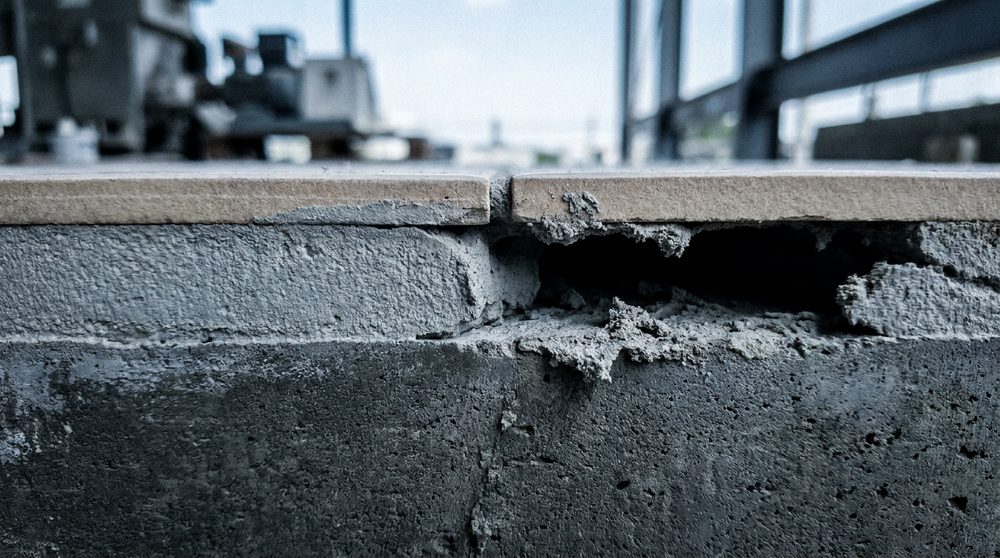
The most reliable field check is the tap test. A solid bed produces a flat, dull tone when tapped with the back of a metal trowel. A void produces a clear hollow ring. Contractors know this and most can identify a hollow tile by ear within thirty seconds. Few clients ask them to perform the check before signing off the work. Almost none ask them to lift a sample tile to verify coverage, which is the only definitive test the codes recognise.
Three procurement questions that change the outcome
The reason this technique persists is that the procurement specification almost never names it. Three questions, asked before the contract is signed, change the economics on site.
One. What is the minimum coverage percentage required, and how will it be verified? If the spec cites TCNA, BS 5385, DIN 18157 or UNE 138002 directly, the contractor knows what is expected. If it cites only “as per manufacturer instructions” — the most common Indian specification — the manufacturer’s instructions almost always include the back-buttering requirement, but nobody reads them.
Two. Above what tile size is back buttering paid for as a separate line item? Without this, the contractor absorbs the labour and skips the work. With it, the work happens.
Three. Will a random sample of tiles be lifted during installation for coverage inspection? The answer alone changes contractor behaviour. The cost of the inspection is trivial. The cost of replacing a debonded bathroom floor at year three is not.
I have written before about what construction chemicals datasheets leave out. The back-buttering recommendation is in the small print of almost every large-format adhesive datasheet I have seen — and it is the line nobody quotes when pricing the job. The bag will perform to the classification on the label. The installation will not perform to the bag.
Next week — a topic I will decide based on what this edition surfaces in your replies and comments.
— Guillermo
Ed #11 — the EN 12004 classification behind the S1 requirement for large-format tiles.
Ed #15 closes the loop — the coverage problem I laid out here shows up again as a shear-stress problem in tile adhesives, where partial contact raises τ = ρ·g·t on the fresh bond line and asks even more of the paste’s thixotropy.
Part of the pillar
Tile Adhesive Application — single vs double buttering, thixotropy, and the 15 checks that catch a bad install. Read the full cluster overview.