
Independent author of Built by Chemistry. Every edition sourced from EN / ANSI / BIS / ASTM standards or peer-reviewed literature. About →
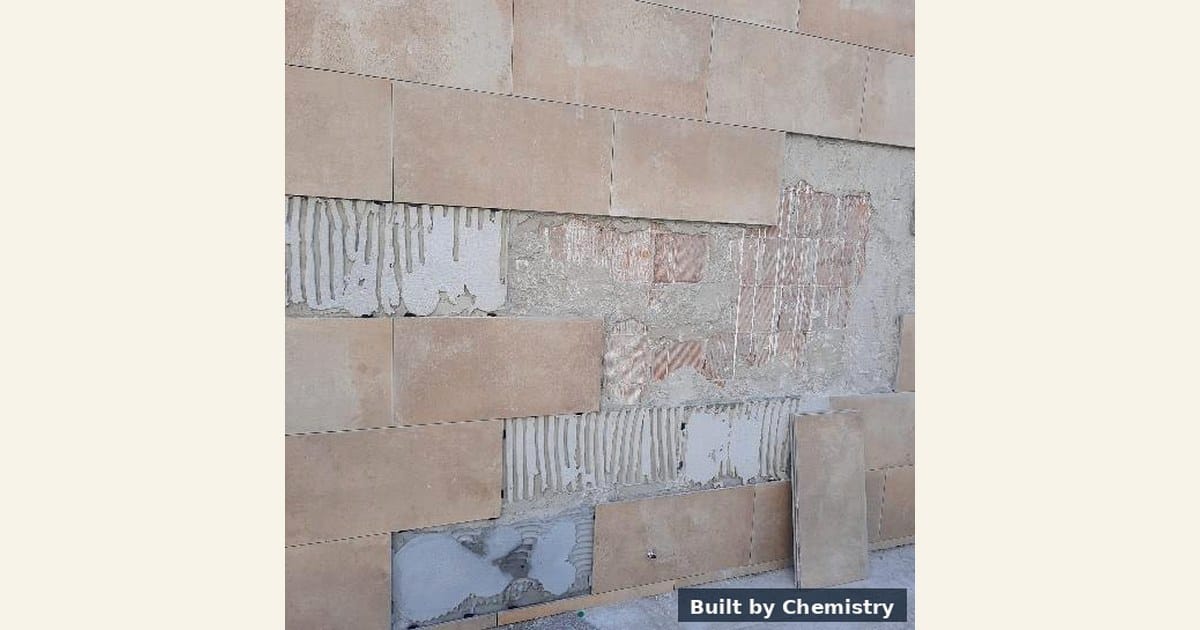
A tile comes off a façade. Sometimes one; sometimes a whole pane slides in the night after a cold snap. The phone starts ringing before anyone has turned a single tile over. And almost every call opens the same way: the adhesive was bad. It is the most human reaction on a building site — a claim is money, reputation and blame all at once, and the fastest place to send the blame is the bag, because the bag cannot defend itself. But the bag is also the one thing on the job that can be tested against a known reference. And when you test it, it usually passes.
This is the third and final part of our tile-adhesive testing series. In Edition #15 we looked at why fresh adhesive holds a tile against gravity, and in Edition #16 at the four clocks — open time, setting time, pot life and adjustment time — that the market keeps confusing. Here we close the loop the way a real claim closes it: on the back of a fallen tile, standing in front of an owner who wants an answer today.
First, the paperwork the panic wants to skip
Before touching chemistry, a fair investigation does the boring part. What was the batch number and the manufacturing date of the adhesive? Was the material checked on delivery — how, when, and by whom? Who mixed it, at what water dose, and how long did the combed bed sit before the tile went on? None of this is an accusation. It is the difference between an opinion and a finding.
Very often this first step already decides the case — not because it convicts anyone, but because the evidence has been destroyed. On one real job, nobody could say which pallet the "defective" bags came from: sacks had been swapped between pallets as they ran short, so the exact batch that supposedly failed could never be isolated or re-tested. If you cannot name the batch, you cannot blame the batch. Retaining one sealed bag per delivery, and mixing one bag on arrival, costs almost nothing and settles most arguments before they start.

The reference test that keeps exonerating the bag
A cementitious tile adhesive is graded by one number more than any other: tensile adhesion strength, the force needed to pull a tile straight off, measured per EN 12004-2:2017, clause 8.3, which in 2017 replaced the old EN 1348. A C2 adhesive must reach at least 1,0 N/mm². The elegant part of a claim is that you can reproduce this on the disputed material itself: mix a fresh reference specimen from the same product under lab conditions and pull it off.
In one façade claim, an external accredited lab pulled the product at 1,4 N/mm² — 0,4 above the norm — from material whose production date it had verified. The adhesive was not weak. It was, if anything, over-specified for the job. The tiles still came off. That single result reframes everything that follows: if the reference passes and the wall fails, the gap between them was opened somewhere between the bag and the tile.
So read the back of the tile
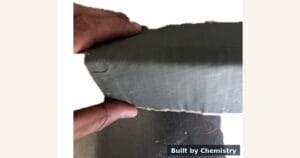
The most honest sample on the whole job is not the tile that fell — it is a tile that is still bonded. Lift one carefully, turn it over, and the adhesive has left a signed confession on the back.

Intact trowel ridges, dry to the touch. The comb lines are still sharp and the surface has a thin skin. This tile never wet its paste. Either the open time was exceeded — the bed formed a skin before the tile arrived (see Edition #16) — or the tile was placed but never beaten in. A sound bond crushes those ridges flat and transfers paste onto both faces. Sharp ridges mean no contact.
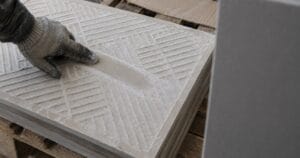
Islands of contact with hollows between them. The paste touches only in patches; dark voids sit in between. This is a coverage failure — no double-buttering on a format that needed it, circular troweling that traps air, or a bed that was never vibrated home. Every void is a weak point: a place where an impact will crack an expensive tile on the floor, or where condensation and thermal movement will lever it off a façade over months.
The four ways a wall is actually lost
1. Coverage, sacrificed to speed. The single most common finding is that most of the tile back was never in contact with adhesive. On large formats and on façades, the 2017 edition of UNE 138002 (revised in March 2023) made double-buttering mandatory above 30×30 cm — paste combed on both the substrate and the tile — precisely so that the two ribbon beds collapse into a full, closed layer. Skip it to save a bag and time, and you have built a wall of hollow tiles.
On large porcelain there are two checks before coverage: the back of the tile itself, and whether the class on the bag still fits the size. Both are in why C2TE-S1 falls short on large format.
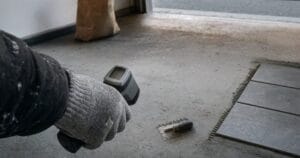
2. Open time, run down by heat. A crew combs a big area, walks away, and comes back to lay it. On a hot day — inside a plant during a heat wave, comfortably above 35 °C — the bed has already skinned. The tiles go down onto a surface that can no longer wet them, and months later a whole pane is loose at once. The datasheet open time was measured at 23 °C; the wall was built at 35 °C. The bag did not change. The clock did.
3. The wrong trowel motion. There is a reason installers are taught to comb in straight, parallel lines — and, in double-buttering, perpendicular between substrate and tile. Straight ribbons let trapped air escape out of the sides when the tile is pressed and slid home. Combing in circles or semicircles, as one report documented, seals air into closed pockets that never vent. Lift such a tile and the back tells the whole story: the difference between straight and circular troweling is visible at a glance.

4. Water, added to buy time. This is the quiet one, because it feels harmless. The paste is stiffening in the bucket, so a little more water goes in to keep it workable. It does — and it also drops the bond. Here is a real, anonymised comparison from a Spanish claim: the same adhesive, mixed at the specified 7 litres per bag versus an over-watered 9 litres, and pulled at four days.
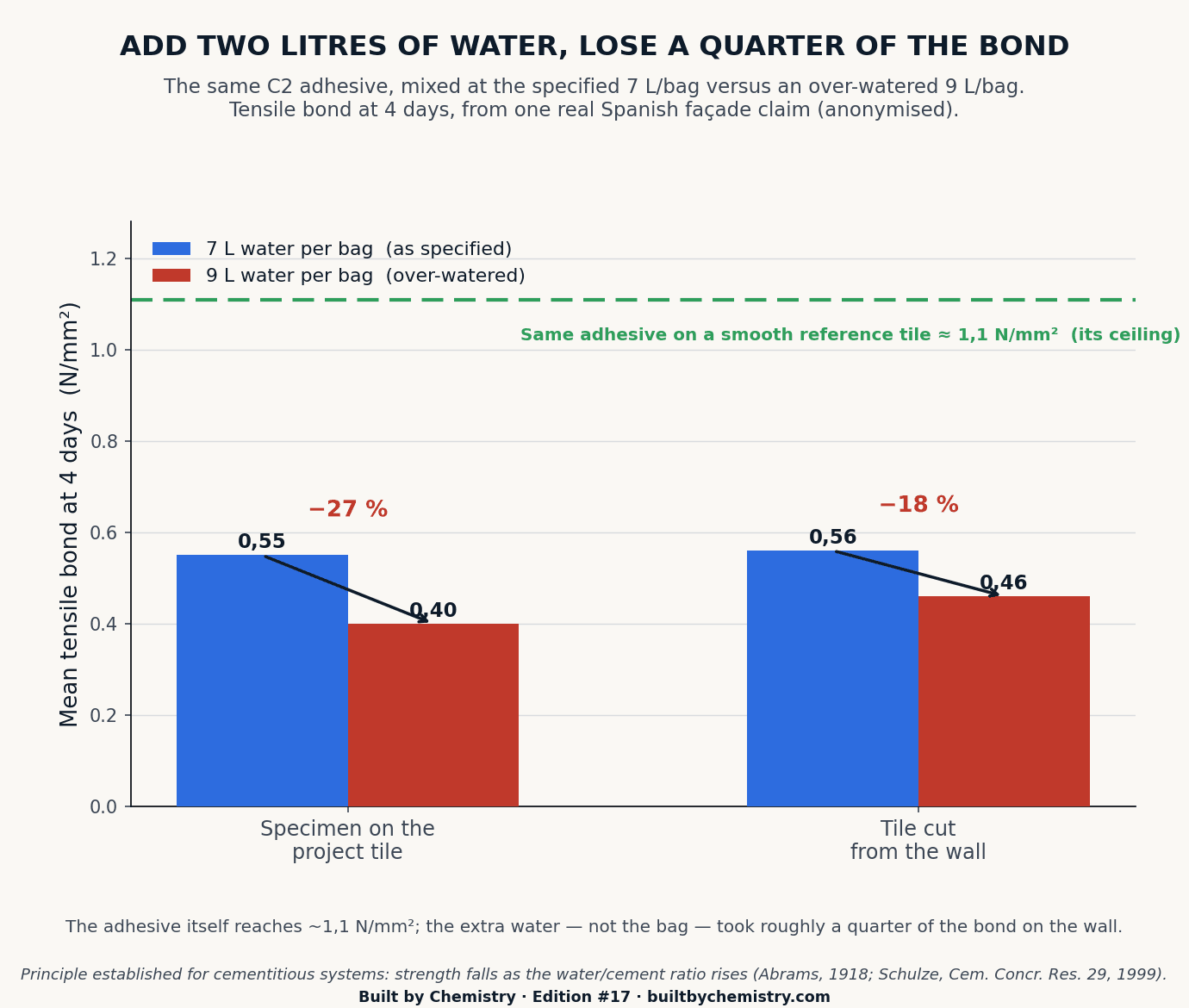
The same adhesive on a smooth reference tile reached about 1,1 N/mm², whichever way it was mixed. But on the actual tiles, the extra water cut the bond hard: a specimen made on the project tile fell from 0,55 to 0,40 N/mm² — a 27 % loss — and a piece cut from the finished wall from 0,56 to 0,46. (The on-tile figures start lower than the reference because the porcelain here had a textured, anti-slip back that shrinks the contact area — a separate story; what the water changed is the drop.) None of this is new chemistry. Strength falls as the water/cement ratio rises: Duff Abrams established it for concrete in 1918, and Schulze confirmed it specifically for polymer-modified mortars — the family a C2 tile adhesive belongs to — in Cement and Concrete Research in 1999. Extra water dilutes the binder, raises capillary porosity and adds drying shrinkage. The workability you buy in the bucket, you pay for on the wall.
Usually it is not one villain, but a stack of small ones
The cleanest cases are rarely a single mistake. On one façade of stone-effect porcelain, the tiles did not just loosen — whole plates jumped off the wall. Read backwards, the stack was obvious. The brickwork had been levelled with a fresh cement mortar, and the adhesive went on the next day, before that render had cured. A thirsty, uncured substrate behaves like a sponge: it pulled the water straight out of the adhesive, so the bed skinned from underneath within minutes. That wall faced east, into the morning wind, on the exact side being tiled — drying the surface faster still. The mix had been loosened with extra water to keep it workable in those conditions, which, as we just saw, only lowered the bond further. And the joints between plates were barely 1–2 mm, with no movement joints, so the first thermal or structural movement had nowhere to go but into the bond line.

No single one of those would necessarily have brought a wall down. Together they were decisive. That is how most real failures read: not one dramatic defect, but four or five ordinary shortcuts that each shaved a little off the margin until there was none left. And note what is missing from the list — the bag. On that job the adhesive tested exactly as it should.
One tile, or the whole job?
The last question a good investigation asks is about scope. An isolated failure that lines up with a weather event on one particular day is probably punctual — a bad hour, a skinned bed, a batch of tiles laid too late. But the same reading repeated across the wall — dry ridges everywhere, or hollow backs everywhere — is not bad luck. It is a job-wide application pathology: the way the whole thing was built.
There is a geography to this too, and it is not a moral one. In markets where installation is highly professionalised and factory production is heavily automated, both the bag and the hands tend to be consistent, and pure product failures are genuinely rare. In faster-growing markets — much as Spain looked fifteen or twenty years ago — the same formats are laid quicker, watered more freely, and rarely lifted to check coverage, because on piecework the installer's pride outranks the inspection. The fix there is not a better bag. It is quality control at the trowel: lift a tile, read the back, and settle the argument before it becomes a claim.
One sourced, no-brand construction-chemistry breakdown in your inbox every Thursday. Subscribe here.
The verdict is on the back of the tile
A claim is a hard place to be honest, because everyone in the room has something to lose and the easiest answer is the one that blames the absent bag. But the discipline is simple. Do the paperwork before the chemistry. Test the adhesive against its own reference — it will almost always pass. Then lift a tile that is still holding, turn it over, and read what the paste left behind. Nine times out of ten the failure was written during application: coverage sacrificed to speed, open time run down by heat, the wrong trowel motion, or water added to buy a few more minutes. The bag is rarely the culprit. The wall already told you who was.
Built by Chemistry — the construction-chemistry newsletter that reads the back of the tile. Independent, sourced, no brand names. Subscribe for Thursday's edition.
Related read → Why tile grout crumbles: the joint that can't cure — Part 1 of the Grout trilogy: another failure read from the surface.
- Why your C2TE-S1 stops working at 60×60
- Your adhesive is not drying. It is hydrating, and the weather sets the clock.
- Hormuz, Bab el-Mandeb and your tile adhesive (2026)
- Grout classification, decoded: CG1, CG2, W, A, F
- Grout was never waterproof - and never had to be