
Independent author of Built by Chemistry. Every edition sourced from EN / ANSI / BIS / ASTM standards or peer-reviewed literature. About →
A few months ago a procurement manager from a tier-2 Indian contractor sent me three competing datasheets for what was supposedly the same product — a C2TE-S1 tile adhesive for porcelain on cement substrate. He had highlighted what he thought was the relevant comparison row: tensile adhesion strength.
The three values read 1.0 N/mm², 1.0 N/mm², and 1.0 N/mm².
He asked me which to specify. I asked three questions back. Under which curing condition was the strength measured. To which substrate. After how many days. He went back to the datasheets and discovered, between the three products, that those three variables were either undefined, defined differently, or absent.
The three “identical” products weren’t identical. The datasheets had been written to hide that.
This edition is about what every construction chemicals datasheet leaves out, and how to read it correctly.
The datasheet is not a specification. The datasheet is a marketing document with footnotes.
What a datasheet is actually for
A datasheet has two audiences and two purposes. For the customer it’s supposed to be a technical specification. For the manufacturer’s legal department it’s a defence — a document that, if a failure ends up in court, can be cited to show that whatever happened was outside the conditions on which the product was tested.
These two purposes conflict. The customer wants performance under the conditions they will actually use the product in. The manufacturer wants performance under conditions favourable enough to print a competitive number on the marketing collateral. Where the two collide, the manufacturer almost always wins, because the manufacturer wrote the datasheet.
What follows is a list of the most common gaps. None are conspiracy theories. They are the trade conventions of a global industry, and once you know they exist they aren’t particularly hard to spot.
1. Curing condition undefined
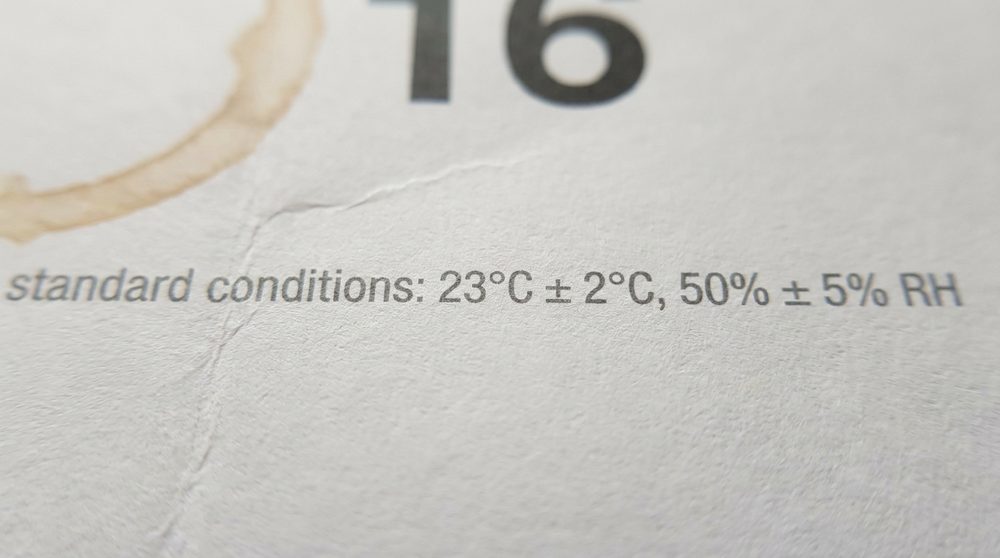
The single most slippery number on any datasheet is strength at X days under “standard conditions”. Read the small print and “standard conditions” usually resolves to 23°C ± 2°C and 50% ± 5% relative humidity. EN 12004-1 and ISO 13007 define these as the laboratory baseline. In Kishangarh in May, the site is closer to 38-45°C and humidity below 30%. A cementitious adhesive that hits 1.0 N/mm² after 28 days at 23/50 will not hit 1.0 N/mm² at 42/25.
The datasheet doesn’t tell you that. The datasheet tells you the laboratory number, because the laboratory number is what the test method requires.
What to look for: the small footnote that defines “standard conditions”. If the brochure shows only the headline number without conditions, the headline number is a marketing claim wearing technical clothing.
2. Performance ranges presented as single values
A typical cementitious mortar datasheet reads “≥30 MPa at 28 days”. The production distribution behind that ≥30 is a normal curve centred around 32-35 MPa. The “≥30” is a specification minimum, not a typical value.
Two products both rated “≥30 MPa” might consistently produce 33 MPa and 38 MPa. On a structural application that difference matters. The only way to find out is to ask for the typical value and the standard deviation from internal QC data — and only manufacturers confident in their consistency will share them.
A related trick: bond strength on a tile adhesive varies ± 20-30% batch to batch. The datasheet prints a single number — the median of favourable runs, not the worst-case batch you might receive.
3. Coverage rates: theoretical vs practical
This gap costs more money on Indian sites than any other. The bag of tile adhesive says 3.5-4.0 kg/m². With a 10 mm notched trowel on porcelain, the applicator hits 5.5-6.5 kg/m². Cost the project on the datasheet figure and you’re 40% short on day one.
The figure assumes ideal substrate flatness, the right trowel, perfect technique, and a thin-bed application. None of those four hold together on a typical Indian project. The realistic coverage hides in the small-print qualifier (“indicative — depends on substrate and application method”) that procurement never reads past the headline.
Same for liquid waterproofing. The datasheet says 1.5 kg/m² wet film for two coats. On textured substrate or roughcast concrete: 1.8-2.2 kg/m². Twenty to thirty percent of total material cost lives in that gap.
4. Substrate assumed but rarely declared
The bond strength of a tile adhesive is reported against a specific substrate — usually a polished concrete slab cast and cured under controlled conditions. The same adhesive tested against rough cement-sand render, against gypsum board, against AAC blocks, will produce significantly different values. AAC, as I wrote in the edition on AAC blocks, has a suction profile that interferes with hydration of the cementitious phase.
Some datasheets disclose this. They list bond strengths against three or four substrates and let you pick. Most don’t. Most print the highest number, against the most favourable substrate, and let you assume it applies to whatever you’re sticking to.
What to look for: a substrate declaration next to every adhesion or bond value. If there isn’t one, assume the substrate was the most favourable possible and discount the number accordingly.
5. Pot life, open time, working time — which one matters
Three terms routinely confused, sometimes deliberately. Pot life: how long the mix stays usable in the bucket. Open time: how long the adhesive bonds to a tile after combing on the substrate. Working time: a synonym for either, depending on who’s writing.
A C2TE-classified tile adhesive guarantees ≥30 minutes of open time tested per EN 1346 at 23°C / 50% RH. In Rajasthan summer (42°C / 22% RH), real open time drops to 6-10 minutes. The C2TE classification holds. The conditions for which it holds aren’t the conditions on which the wall is being tiled.
A reputable manufacturer gives adjustment guidance in a technical brief. A less scrupulous one prints only the classification and lets the contractor discover the gap on installation.
How to read a datasheet properly
Treat the datasheet as a starting point for a conversation, not as a specification. Three questions before specifying anything:
- Under what conditions were the headline numbers obtained? Demand the test conditions in writing — temperature, humidity, substrate, curing age, test method standard. If the manufacturer can’t provide them, the headline numbers aren’t specifications.
- What is the typical value and the standard deviation from internal QC? A confident manufacturer with consistent production will share. A manufacturer hedging marginal compliance will refuse. The refusal is itself useful information.
- What is the realistic consumption rate for the substrate and application method we will actually use? Get the answer from the technical team, not from the marketing datasheet. The number that comes back will usually be 20-40% higher than the bag claim.
If the manufacturer can’t answer these three questions for the product you’re specifying, that’s not a product problem. It’s an information problem, and the information problem becomes a project problem six months after installation.
What the industry could do — and won’t
European tile adhesive datasheets under EN 12004-1 have moved closer to honesty in the last decade, partly because the test methods are publicly standardised and partly because the EU’s product liability framework is more aggressive than India’s. The trend is good but incomplete.
Indian construction chemicals datasheets vary widely. The major brands generally print the right things. The grey market and the regional brands print whatever they need to clear procurement. The contractor in the middle has no easy way to tell which is which, except by experience and by the kind of question this edition is meant to teach.
I’ve spent a fair share of my time in R&D writing the small print on datasheets. I know what we declare and what we don’t. The honest declaration costs more, sells less, and is uncomfortable for sales. It’s also the thing that, in the long run, builds trust with the customer who actually checks.
The same gap between what a spec says and what a site delivers is at the root of the waterproofing failures covered in edition 5 and the hydrostatic head test gap in edition 6. The feedstock cost pressure that forces silent reformulation — RDP and HPMC up 60% after Hormuz — is covered in edition 7 on the Hormuz supply chain shock.
Related reading: single buttering above 35×35 cm — what TCNA, BS 5385, DIN 18157 and UNE 138002 actually require for large-format tile coverage.
— Guillermo
Ed #10 — the LC3 cement formulation and what it means for construction chemicals specifications in India.
Ed #11 — how to read a C2TE-S1 tile adhesive classification — every letter and number decoded.
Ed #15 takes the same argument to tile adhesives — the slip figure printed at 23 °C is a room-temperature promise, and the rheology behind the “cream effect” is what actually decides whether the tile moves on a 35 °C wall.
Part of the pillar
Tile Adhesive Technology — how to read the datasheet, decode the class, and specify the right product. Read the full cluster overview.
- Why your C2TE-S1 stops working at 60×60
- Your adhesive is not drying. It is hydrating, and the weather sets the clock.
- Hormuz, Bab el-Mandeb and your tile adhesive (2026)
- Grout classification, decoded: CG1, CG2, W, A, F
- Grout was never waterproof - and never had to be