
Independent author of Built by Chemistry. Every edition sourced from EN / ANSI / BIS / ASTM standards or peer-reviewed literature. About →
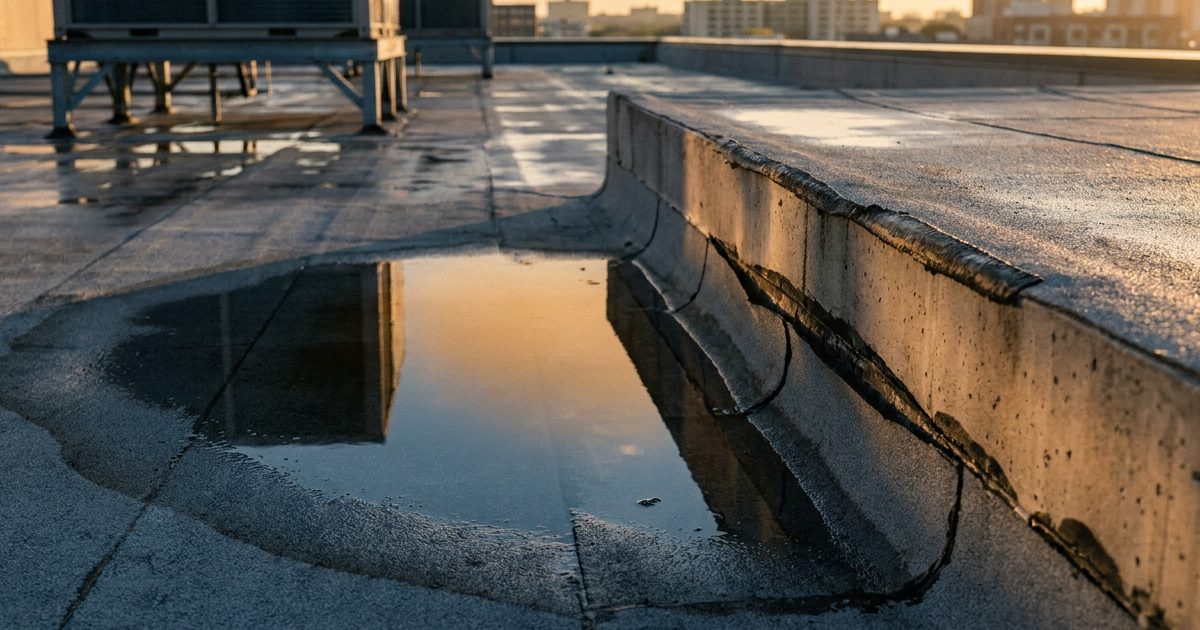
A structural engineer in Doha showed me a phone photo last November. The roof of an office tower he had signed off in 2018. Six years old. Water pooling in three separate spots after a single overnight storm. He had specified an SBS bituminous membrane, two layers, torched to a screed. The manufacturer had certified everything. The applicator had a fifteen-year track record. The building was under warranty.
None of it mattered. The bond between the membrane and the primer had failed at the perimeter kerbs. Not the membrane itself — the interface. And that’s the thing nobody tests on the finished assembly. EN 1928 measures a sheet, not a roof.
This edition is about three real failures, three different chemistries, and the one thing all three have in common.
Key takeaways
- Bituminous membranes lose bond strength between 15-30 % after just 24 weeks of accelerated UV + heat exposure. Silvestre et al. (2010), Construction and Building Materials.
- PVC-P membranes lose their plasticiser to dehydrochlorination and start failing dynamically at year 11-14 of service, even when manufacturer specs still hold on paper. Petránek et al. (2022), Polymers 14(6), 1201.
- The classification test EN 1928:2000 measures water tightness under 60 kPa hydrostatic head, but only on a virgin sheet in a lab. Nobody re-runs it on the installed roof.
- In a 207-inspection classification system developed at Instituto Superior Técnico Lisbon, debonding and perimeter defects account for over 40 % of documented anomalies on bituminous roofs. Silvestre & de Brito (2011), Construction and Building Materials.
- The failure appears at year 3 to 8 on average, but the chemistry has been degrading since the day the membrane was rolled out.
What happens on the flat roof at year three?
Water enters where the membrane meets something else. Not through the sheet itself. Almost never through the sheet itself.
The failure geometry is boringly consistent. Perimeter kerbs. Drain penetrations. Skylights. Movement joints. Rooftop plant fixings. Anywhere the membrane has to change plane, terminate against a substrate, or accept a foreign body. These are what the industry calls singularities, and every published survey I’ve read puts them at the top of the failure list. The pattern is the same one I documented in my earlier edition on waterproofing membrane failures — the interface, not the material, decides the service life.
Here’s the awkward part. The membrane itself is tested to death before it leaves the factory. EN 13956 for synthetic sheets, EN 13707 for bituminous, EN 13967 for damp-proof underlayers — every roll gets a batch certificate. What doesn’t get tested is the interface between that certified roll and the concrete kerb it’s meant to seal against. Nor the T-joint where three overlaps meet at the drain. Nor the corner detail where the applicator ran out of daylight and finished the last three metres by torch at 8 pm on a Friday.
I’ve walked enough of these roofs to know that the singularities are where the money and the risk sit. The sheet is the easy part. The chemistry between the sheet and the rest of the building is what fails.
The three membrane families, in plain terms
Three chemistries dominate a flat roof in 2026. Each one solves a different problem. Each one has a specific mode of failure that shows up when nobody’s looking.
Bituminous membranes — the trench-tested workhorse of European construction since the 1960s. Two big sub-families. SBS-modified (styrene-butadiene-styrene) stays flexible at low temperature; you see it in most residential and light commercial work in Spain, France, Italy. APP-modified (atactic polypropylene) handles high temperature better but goes brittle in the cold; more common in the Middle East. Both are torched to a screed with a heat gun. The reason people still specify them is the redundancy — you install two overlapping layers, so a puncture in one doesn’t kill the system.
Synthetic single-ply — the American obsession since the 1980s, now everywhere. EPDM (ethylene-propylene-diene monomer) is the black rubber sheet you see on warehouses. PVC-P (plasticised PVC) is the white or grey sheet you see on office blocks. TPO (thermoplastic polyolefin) is what the industry moved to when PVC-P started losing its plasticiser too aggressively. Single layer. Welded seams. Lighter, cheaper labour, and — when it works — the cleanest install of the three. The bond between the synthetic sheet and a cementitious substrate deserves its own conversation, and one detail I want to flag is the LC3 substrate case — I covered how these newer clinker-substitute cements retain water differently in my edition on LC3 cement and the CCTS scheme in India, because the same interface chemistry applies here.
Liquid-applied membranes — the one that solved the detail problem. PMMA (polymethyl methacrylate) cures in twenty minutes, works around any geometry, and gets specified where the singularity count is high. Polyurethane cures slower but stays flexible longer. The liquid family is what you use around the drain penetrations that no sheet can properly wrap. It’s also what fails when the substrate is wetter than the datasheet says it should be.
Every one of these families is EN-classified. Every one has a hydrostatic head test behind it. And every one fails in service for reasons the hydrostatic head test doesn’t measure.
What does EN 1928 actually measure?
EN 1928:2000 measures water tightness of a flexible waterproofing sheet under either a low pressure of 60 kPa for Method A or a higher pressure regime for Method B. Test conducted on a virgin sheet, 300 × 300 mm, in a lab.
That is what the test measures. It says nothing about the installed assembly, the bond to the substrate, the state of the sheet at year seven, or what happens at the T-joint where three overlaps meet.
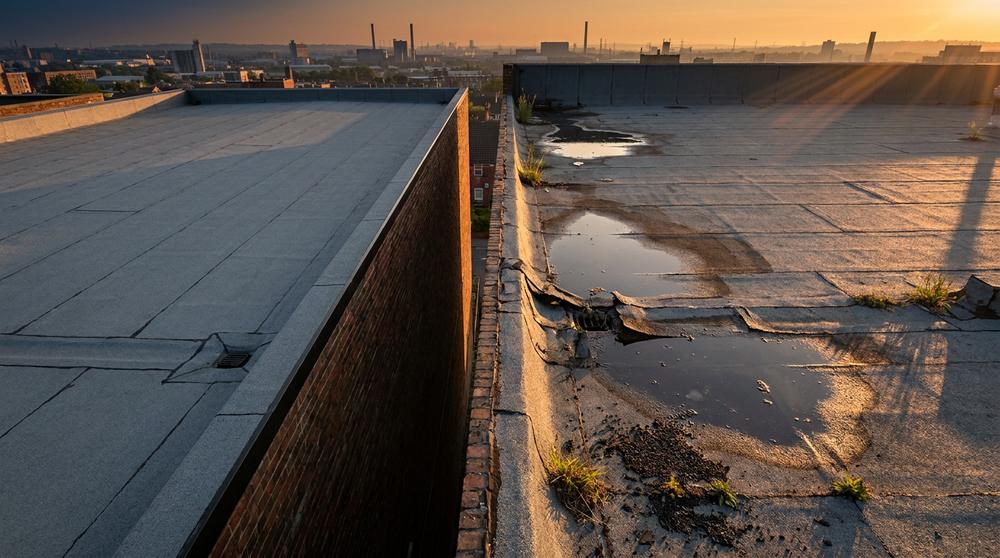
This matters because most procurement teams read the EN 1928 stamp as “this membrane is watertight”. What it actually says is “this virgin sheet, cut from this batch, tested by this lab, held 60 kPa for 24 hours without leaking through the sheet body”. Everything after that — the applicator, the substrate prep, the ambient conditions, the drain detail, the twenty-year service life — is outside the scope.
I wrote about a related test in my earlier edition on the hydrostatic head test in India, where the point was that BIS code doesn’t require the higher-pressure version even for below-grade work. The point on a flat roof is different but adjacent: the test exists, the number exists, and the assembly it’s supposed to verify never gets checked again after installation.
Three real cases, three chemistries, one common thread
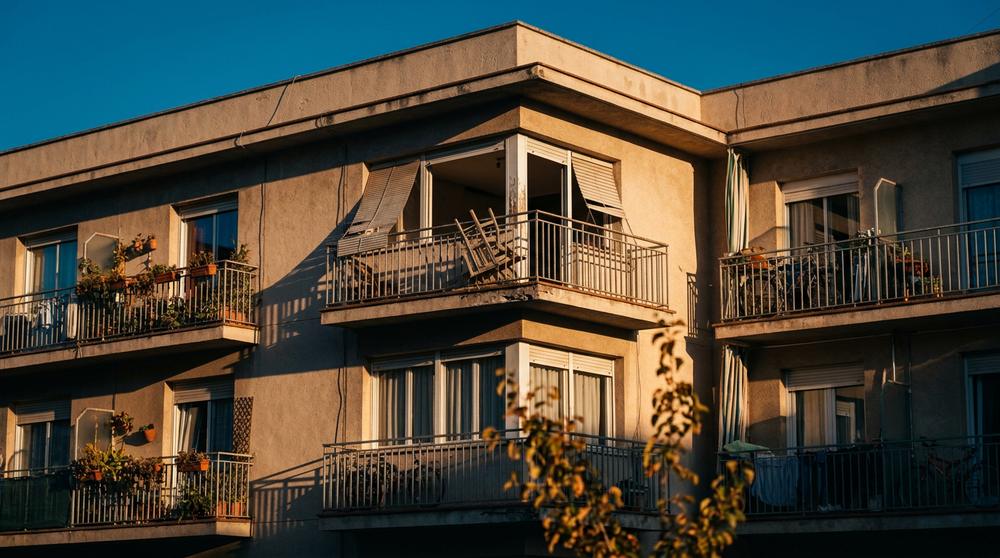
Case 1 — Madrid, L-shaped apartment block, 1973. A team led by Universidad Politécnica de Madrid documented the case in a 2021 paper published in International Journal of Environmental Research and Public Health (IJERPH 18: 12855). The top-floor flat had become uninhabitable. Not because of water damage as such — but because the coal-tar/SBS composite waterproofing that had been re-applied during a communal repair started off-gassing polycyclic aromatic hydrocarbons into the living space three decades after the roof was first laid. Core samples showed complete stratification failure. The occupants had already left. The chemistry that was supposed to protect the roof had become the problem inside the building.
Case 2 — PVC-P 11-year service study. Petránek and colleagues at the Slovak Academy of Sciences pulled samples from a real flat roof after 11 years in service and ran dynamic fatigue tests against fresh reference sheets. Published in Polymers 14(6), 1201 (2022). The mechanical properties on the static datasheet still met the declared values. The dynamic fatigue test — cyclic loading of the type the roof actually experiences from wind uplift and thermal cycling — showed accelerated degradation driven by dehydrochlorination of the polymer. The plasticiser had migrated out. The membrane had gone brittle without failing any of the tests the manufacturer’s certificate covered.
Case 3 — Portugal, 207 inspections. Silvestre and de Brito of Instituto Superior Técnico Lisbon built a classification system for flat roof anomalies based on 207 standardised inspections. Published in Construction and Building Materials (Silvestre & de Brito, 2011). The dominant cluster of failures was not in the membrane bulk — it was at singularities. Debonding at kerbs. Cracked joints. Ponding from bad falls. Perimeter lifting under wind uplift. The membrane bulk had held. The interface had not.
Three geographies. Three chemistries. Three time-horizons. One common thread: the test the classification is based on is not the test that predicts the failure.
The five failure modes you actually see on site
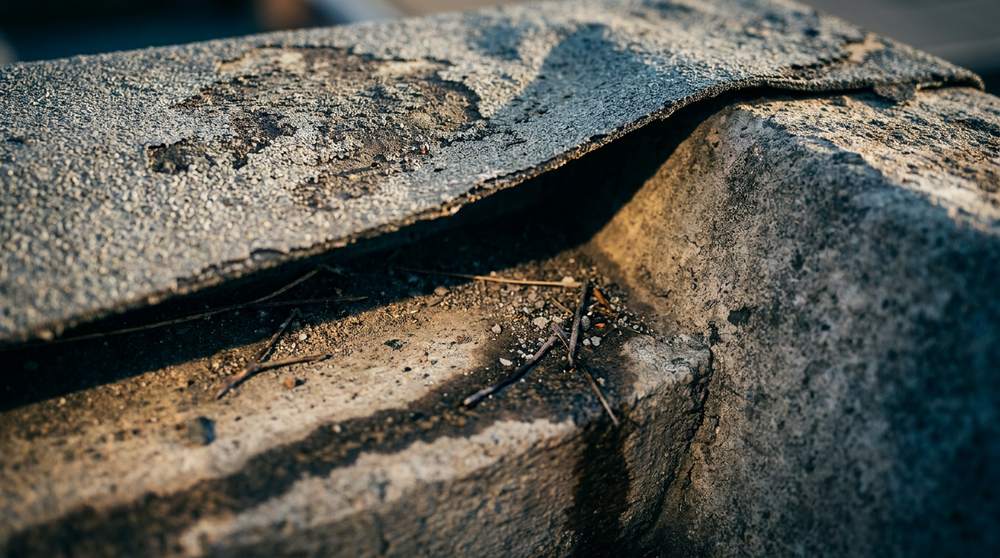
Debonding at the interface. The commonest, the least talked about. Happens when the primer wasn’t right for the substrate, or the substrate had residual moisture, or the applicator didn’t achieve full contact at the kerb. The sheet is fine. The interface is not.
UV degradation of the exposed surface. Bituminous membranes without proper mineral granule protection show micro-crazing within two summers of Mediterranean or Middle East exposure. The mineral finish is the barrier. When it debonds — see mode one — the bitumen underneath goes brittle in about eighteen months.
Chemical incompatibility. PVC-P in direct contact with bituminous primer degrades faster than either material would on its own. Same story for EPDM against certain plasticisers in insulation boards. The datasheet lists compatible materials. Site rarely checks.
Seam and joint failure. Welded seams on synthetic sheets fail when the welder was set 15 °C too cold, or the operator moved too fast, or the sheet had contamination at the overlap. On bituminous membranes the T-joints — three overlaps meeting — are the classic failure locus.
Mechanical puncture from later trades. HVAC installers walk on the roof six months after the membrane is down. A dropped tool, a set of ladder feet, a scaffold pole. The membrane looks fine from above. The puncture only surfaces when the insulation below it saturates.
None of these five modes gets caught by the batch certificate on the roll.
Three procurement questions that change the outcome
One. Will a pull-off adhesion test be performed on the installed membrane at the interface, not just on the sheet? The test method exists — ASTM D5385 covers hydrostatic pressure resistance and there are pull-off equivalents that measure bond strength between the membrane and the substrate. Cost per test point is trivial. Nobody specifies it.
Two. What is the manufacturer’s stated service life for the installed system, and what warranty covers labour vs materials? Most warranties cover the membrane. Few cover the labour or the assembly. The difference is where the whole cost sits when the roof fails.
Three. Will a moisture survey (infrared or capacitance) be repeated at years 3, 6 and 10 as part of a maintenance contract? This is what turns a fifteen-year roof into a thirty-year roof. It doesn’t cost much. It just requires somebody in procurement to build it into the O&M budget from day one.
I’ve walked roofs that were doing everything right at year twelve because the owner ran an annual survey. I’ve walked roofs that were toast at year five because nobody looked at them until the ceiling below started dripping. The chemistry is the same. The maintenance discipline is what separates them.
Next week — what happens when the water that should have stayed on the roof is now pressing against the basement wall. Same interface problem. Different geometry. Bigger repair bill.
— Guillermo
The same interface failure I described above applies underground too. Ed #13 examines what happens when you layer two waterproofing systems on a basement wall — and why the sequence between them decides whether you have defence in depth or defence in confusion.
Ed #14 follows what that water carries — the chloride front that builds up at the reinforcement, why the concrete cover is a corrosion clock, and what EN 1504 repair classes mean once the damage has already started.
Part of the pillar
Waterproofing Systems — below-grade membranes, flat roof failures, and where every system fails at the interface. Read the full cluster overview.
Related — the class letter, five ways: EN 1928 (this edition) governs sheet-membrane systems. For the liquid-applied cementitious side that competes with them, Edition #19 lines up how five regions (EU, US, AU/NZ, China, India) certify the same "flexible" material differently — and why the numbers don't convert.
- Two waterproofing systems on one basement wall. When the redundancy works, and when they fail together.
- Waterproofing Failures Are Almost Never the Membrane's Fault