
Independent author of Built by Chemistry. Every edition sourced from EN / ANSI / BIS / ASTM standards or peer-reviewed literature. About →
Picture two jobs in the same October week. Same bag of cement-based adhesive, same 6 mm notch, same line on the back: grout after 24 hours. One is a terrace on the Goa coast while the monsoon hands over; the India Meteorological Department flagged hot, humid weather over Konkan and Goa for 12-13 October. The other is a garage in the English Midlands, its slab at 6 °C after a night on cold ground while the air feels mild. Both get grouted the next morning, because the bag says so.
Composite scenes, not case files, but anyone who has worked both seasons knows them. The bag cannot tell them apart; the chemistry can.
Key takeaways
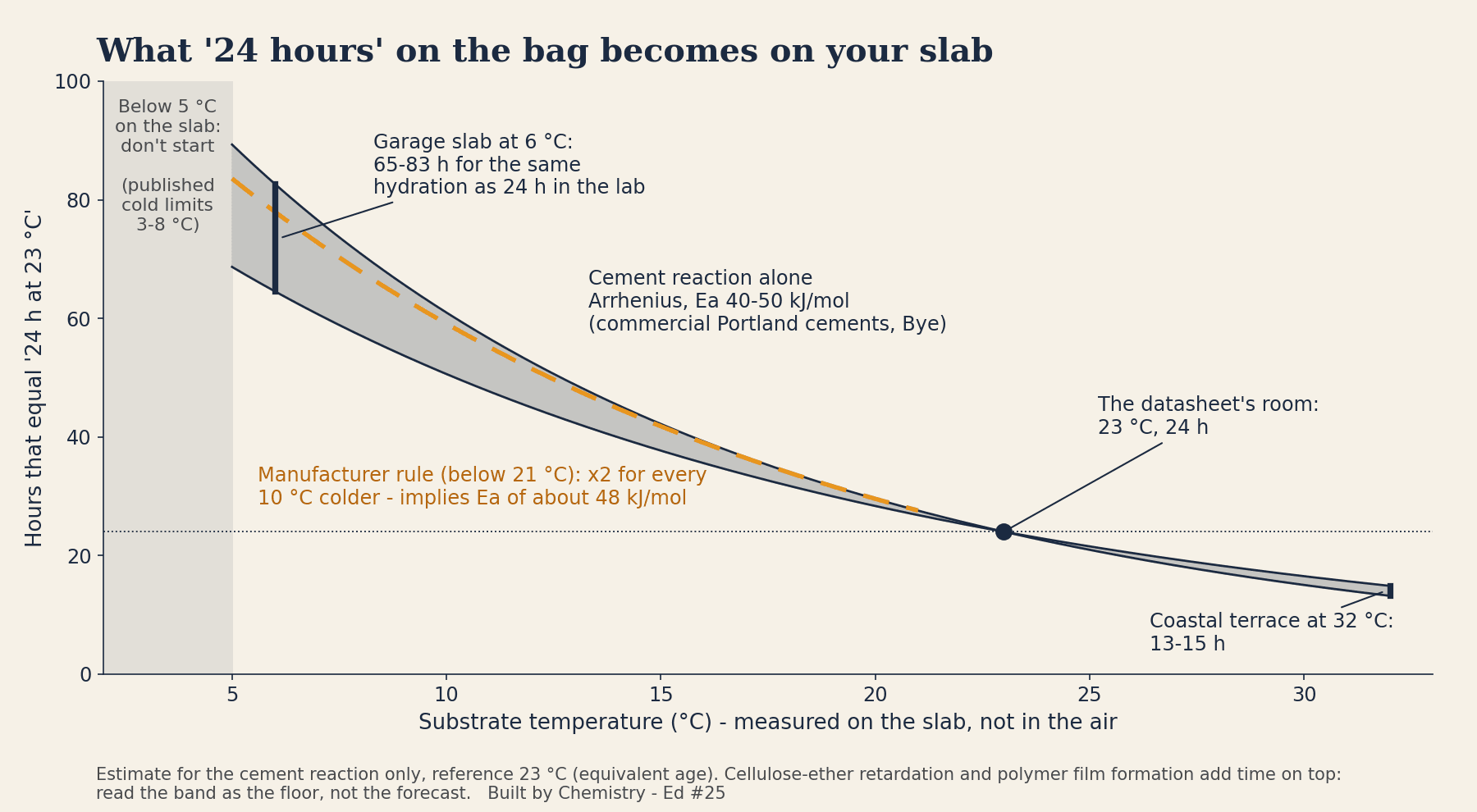
- Cement adhesive hardens by hydration, which slows in the cold: on a 6 °C slab, "24 hours" means roughly 65-83 hours.
- The rule "twice as long per 10 °C below 21 °C" implies about 48 kJ/mol, inside the range measured for cements.
- Humidity runs a different clock, drying: it delays the polymer film and the bed, not the cement.
- Measure the slab, not the air. Published cold limits run from 3 to 8 °C, and none is in the adhesive standard.
- Only an F-class adhesive has a tested first day: at least 0.5 N/mm2 within 6 hours.
The datasheet lives at 23 °C (and at 27 °C and 65 % in India)
Every number on a European adhesive bag comes from one room: (23 ± 2) °C, (50 ± 5) % relative humidity, air below 0.2 m/s (EN 12004-2:2017, clause 4), the room behind the C2TE-S1 edition and the four clocks, measured at 23 °C. India uses a warmer, damper room: 27 ± 2 °C and 65 ± 5 % humidity (IS 15477:2019, clause 6).
Less known: the two standards do not measure open time the same way. Europe runs a bond test. Tiles go onto the combed bed at intervals, cure and get pulled, and the adhesive must still give 0.5 N/mm2 after 20 minutes (EN 12004-1:2017; method in EN 12004-2, 8.1). India runs a look. Small tiles are pressed onto adhesive spread on gypsum board and flipped every few minutes, and open time is the last reading before the adhesive stops wetting half the tile (IS 15477:2019, Annex C). There is no fixed minimum either, only whatever the maker declares (clause 5.3). So "20 minutes" on a Delhi bag and on a Dortmund bag are different promises, and neither was measured at your slab's temperature.
Adhesive does not dry. It hydrates, and hydration keeps time by temperature
What the cement is doing
Press a thumbnail into the adhesive squeezed up in a joint the next morning. On a cold job it still marks, and everyone calls that "not dry yet". Wrong word. The strength comes from hydration, cement reacting with water to build new solids, and its rate follows temperature. For commercial Portland cements, calorimetry gives an apparent activation energy of about 40-50 kJ/mol (Bye, Portland Cement, 2nd ed., p. 136). Through the Arrhenius relation, what a bed gets in 24 hours at 23 °C takes about 50-60 hours at 10 °C, 65-83 hours at 6 °C, and only 13-15 hours at 32 °C.
Two details matter. Bye also reports measurements (Kjellsen and Detwiler, 1992) of the activation energy falling as hydration proceeds, from a steady 45 kJ/mol at 20-30 % hydration to around 10 kJ/mol at 70 %, so temperature bites hardest in the first day, exactly when the grout goes in. And the rule on an Australian maker's cold-weather sheet (07/2018), "for every 10 °C below 21 °C, cement materials take twice as long to cure", implies about 48 kJ/mol. It is a manufacturer rule, not a standard, but it sits inside the measured range.
What the cellulose ether and the polymer are doing
A tile adhesive is not neat cement. Its cellulose ether holds the mixing water against a thirsty substrate, which would otherwise leave the cement under-hydrated and weaker (Patural et al., Cement and Concrete Research, 2011), partly by forming a colloidal network film that slows water migration (Chen et al., Materials, 2020). It is also what the cellulose ether does to flow. The price is delay: these ethers retard hydration, and their methoxyl content is the controlling parameter (Pourchez et al., Cement and Concrete Research, 2006). In a plastering mortar at 40 °C, 0.10 % HEMC moved the onset of a solid network from 67 to 150 minutes (Ling et al., Materials, 2025).
The redispersible polymer that earns the S1 does not hydrate at all. It forms a film as water leaves, by evaporation and because the cement consumes it, and below its minimum film formation temperature it forms none (Jansen et al., ACS Omega, 2021). It is the same race inside a flexible membrane. Cold hits both clocks: the cement slows, and the polymer may wait as loose particles. That is why the band in the figure is a floor, not a forecast.
Humidity: the clock nobody sets
Most site advice treats a cement adhesive like paint. Damp air does not stop hydration; a UK masonry-mortar association data sheet even calls warm, humid weather favourable for curing (MPA Mortar, Data Sheet 07, 2023). Humidity slows the other clock: the water loss the polymer film and the bed need.
Above 65 % RH
The study quoted as proof that "adhesive fails above 70 % humidity" says something better. A 2020 Korean paper cured ceramic wall tiles at 50 % and 80 % humidity (the abstract says 70, the method says 80), comparing three ready-mixed air-drying adhesives with one cement-based mortar (Ki et al., KICT Autumn Conference 2020, pp. 153-154). In the damp room, on concrete, the air-drying adhesives lost about half their 28-day bond and some still moved under a finger after four weeks. The cement-based mortar passed in every condition.
Polymer-modified cement adhesives sit in between. A 2025 review reports extra polymer paying off under low-humidity cyclic curing, with a continuous film at the tile interface, but not under high humidity (Li et al., 2022, in Qadir et al., Case Studies in Construction Materials, 2025). That explains a Spanish manufacturer's line, word for word the same on its paste adhesive and its cement-based ones: do not apply below +8 °C or above 65 % relative humidity (03/2019). On the paste, that is the whole story. On the cement bag I read it as protecting the polymer and the drying, and I would rather the sheet said so.
Post-monsoon and coastal sites
As of 12 October, the IMD said conditions were becoming favourable for the south-west monsoon to withdraw from the remaining parts of the country over the next two to three days, with the north-east monsoon bringing a prolonged wet spell to the south. On the Goa terrace the bed is well hydrated by morning, because 32 °C is a fast clock, but it is still full of water, and under porcelain it can only dry through the joints. Grout at 24 hours and you shut the exit. I would give that bed an extra day, not for the cement but for the polymer.
Built by Chemistry is an independent weekly on construction chemistry: no brands, no sponsors, every number sourced. Subscribe before the next cold snap.
Cold: it is the slab that matters, not the air
5 °C and rising, measured on the substrate
In a new open-plan building the air warms by mid-morning while the slab stays cold all day. A UK adhesive maker's head of standards put it in a trade-journal column: 5 °C and rising, measured on the floor or wall, not in the air. He adds that standard-setting adhesives have been found not set hard seven days after application in the cold, against about 24 hours at 20 °C. Well past the Arrhenius band: near the point where hydration all but stops, the ether's delay stacks on top.
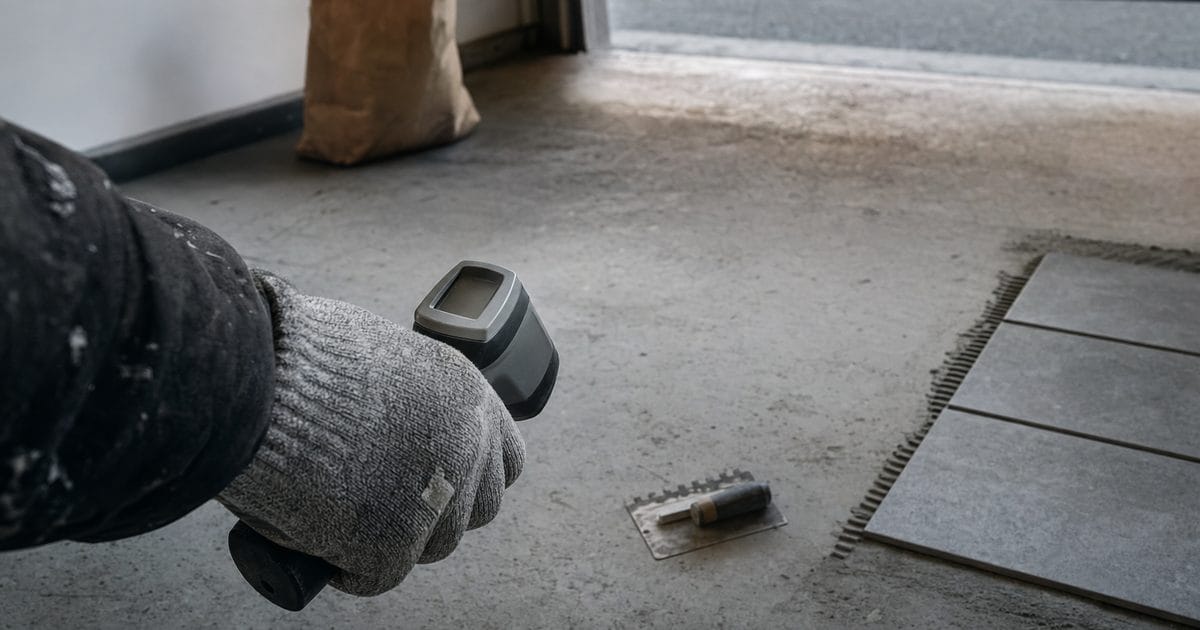
Line up the limits. That column says 5 °C on the substrate, the Spanish sheets +8 °C, the Australian sheet 4 °C with polymer-fortified mortars, and the UK masonry-mortar association stops at 3 °C air temperature because hydration generally needs more than 4 °C (a masonry rule, not a tile one). Four numbers, all manufacturer or trade rules; the adhesive standard only knows 23 °C. A 20-euro infrared thermometer on the slab is the cheapest quality control on the job.
The bag was formulated for 20 °C
The ether dose is a temperature decision. In Ling's study, the HEMC dose for stable rheology was 0.05-0.10 % at 5 °C, 0.10-0.15 % at 20 °C and 0.15-0.20 % at 40 °C, by mass of binder. That was a robotic plastering mortar measured for flow over two hours, not a tile adhesive tested for strength, so I won't turn it into a number for your bag. The direction holds: a bag tuned for 20 °C carries more retarder than a 5 °C slab needs.
One more cold trap: a bag left overnight in a van is a cold mix before it meets a cold slab. The UK column warns against it, the Australian sheet asks for 24 hours in a warm room first, and hot mixing water is no fix because it risks a flash set. Warm the bag, not the bucket.
When to grout: a decision rule, and the failure if you don't wait
My rule. Read the slab with the IR gun, not the wall thermometer. Below 5 °C, don't start, and if the bag's own limit is higher, that one wins. From 5 to 20 °C, scale the bag's grouting time with the figure, two to two and a half times at 10 °C and about three times at 6 °C, and treat it as a minimum. Above about 65 % RH in still air, expect the bed to hydrate on time and dry late, and add a day before closing the joints.
Skipping the wait looks harmless on the day. The float and sponge work over tiles on a bed that has not set, and the grout goes into a cold joint which, as the joint that could not cure showed, is already the hardest place in the system to cure. The UK column adds that cold raises the risk of efflorescence in grouts. The bill comes months later, as hollow-sounding tiles where the traffic is. I would not grout a 6 °C slab at 24 hours, and I would not trust a bag that says to without naming a temperature.
If the floor has to go back into use fast in the cold, use an F-class adhesive, the only kind with a tested first day: at least 0.5 N/mm2 within 6 hours (EN 12004-1:2017). Even that was tested at 23 °C. And the bigger the tile, the longer the clock, which is where large format tile adhesive starts. The full method lives in the tile adhesive application hub.
The throughline
Hydration keeps time by temperature, drying keeps time by humidity, and the bag gives one number for both. The bag was tested in a room that does not exist on your site.
New edition every week: independent, sourced, brand-free. Subscribe, and measure the slab before you trust the bag.
Sources
Standards. EN 12004-2:2017, Adhesives for ceramic tiles - Test methods, clause 4 (test conditions) and 8.1 (open time) - iTeh preview. EN 12004-1:2017, requirements (open time; F class) - iTeh preview. IS 15477:2019, Adhesives for ceramic tiles and mosaics, clauses 5.3 and 6, Annex C - archive.org.
Peer-reviewed and books. Bye, G.C., Portland Cement: Composition, Production and Properties, 2nd ed., p. 136 (activation energy of hydration). Pourchez, J. et al., "HPMC and HEMC influence on cement hydration", Cement and Concrete Research 36 (2006) 288-294, doi:10.1016/j.cemconres.2005.08.003. Patural, L. et al., Cement and Concrete Research 41 (2011) 46-55, doi:10.1016/j.cemconres.2010.09.004. Chen, et al., Materials 13 (2020) 2918, doi:10.3390/ma13132918. Ling, G., Yang, H., Liu, S., Materials 18 (2025) 4664, doi:10.3390/ma18204664. Jansen, D. et al., ACS Omega 6 (2021) 7499-7511, doi:10.1021/acsomega.0c06010. Qadir et al., Case Studies in Construction Materials 22 (2025) e04634, doi:10.1016/j.cscm.2025.e04634 (reporting Li et al., CSCM 17 (2022) e01531). Ki, J.-D. et al., KICT Autumn Conference 2020, pp. 153-154, KoreaScience.
Weather and trade guidance (manufacturer and trade rules, not standards). India Meteorological Department, press release, 12 October 2026, mausam.imd.gov.in. MPA Mortar, Data Sheet 07, Factory produced mortar for use at low and high temperatures, Issue 7, October 2023, mortar.org.uk. Examples cited without links: a Spanish manufacturer's cement-based and paste adhesive datasheets (03/2019); an Australian manufacturer's cold-weather tiling technical sheet (07/2018); a UK adhesive maker's standards lead, trade-journal column on tiling in the cold (accessed 13 October 2026).
- Why your C2TE-S1 stops working at 60×60
- Hormuz, Bab el-Mandeb and your tile adhesive (2026)
- Grout classification, decoded: CG1, CG2, W, A, F
- Grout was never waterproof - and never had to be
- Why tile grout crumbles: the joint that can't cure